
‘The Strangers – Chapter 3’ Is the Best That This Trilogy’s Got [Review]

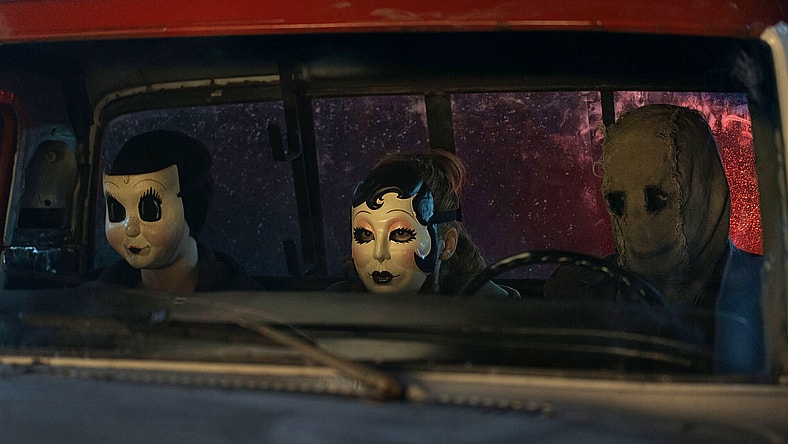
The Strangers – Chapter 3 closes out a reboot trilogy that never fully justified its existence. Still, somewhat unexpectedly, in its final hour, it manages to stand as the most effective and coherent entry of the three. That does not make it a great movie, and it certainly does not redeem the reboot as a whole. What it does do is finally feel like a complete film instead of an idea stretched thin across multiple chapters. And it folds in some welcome brutality that actually packs something of a punch.
This is not the Strangers horror fans hold sacred. The suffocating simplicity of Bryan Bertino’s 2008 original is obviously absent, and the pulpy, neon confidence of Johannes Roberts’ The Strangers: Prey at Night remains unmatched. Renny Harlin’s Chapter 3 exists in a colder, less intentional space. It is less concerned with suspense than with high-octane endurance, often asking the audience to sit with action rather than fear. The result is sometimes blundering, sometimes unpleasant, and an emotionally detached thriller with a healthy dollop of violence. But, unlike the earlier chapters, this one shows a level of cinematic control that makes its brutality more fun and definitely more effective.

The sequel works best when it strips itself down to blunt violence and its decent choreography. Midway through, Chapter 3 delivers the trilogy’s most effective sequence with the sudden killing of a couple the audience barely knows. The scene is difficult to watch, not because it is excessive or stylized, but because it is emotionally empty and downright mean. There’s little buildup, hardly any release, and barely any narrative reward. Still, the moment exists only to remind viewers that death in this world is arbitrary, and that it’s tied to romance. It is the clearest echo of the franchise’s original nihilism, and it lands precisely because it refuses to soften the impact. It works.
Richard Brake is another reason the film holds together. He is mean, unsettling, and clearly enjoying the menace he brings to the role. His presence adds a slight sense of danger. Clearly, he’s an expert. Brake understands what makes a character scary, and watching him work is one of the few things that brings Chapter 3 to life.
Don’t get too excited, though: most characters remain thinly sketched, even Madelaine Petsch’s Maya, who’s had three full-length films to develop. Emotional investment in her is impossible. Beyond its players, the film relies too heavily on repetition to generate impact. Long stretches feel confusing, like we’re literally running in circles rather than building anything suspenseful. Cruelty replaces fear as the primary sensation. And when the movie does try to deepen its world, those gestures feel half-formed and unnecessary, working against the very emptiness that once made the franchise effective. Keep the mask on next time, babe.

Turning The Strangers into a trilogy remains its deadly mistake, and Chapter 3 cannot undo the damage caused earlier, not to mention its bold and misjudged attempt to rebuild a sacred horror text. Character development stays thin, emotional investment is limited, and the film’s bleakness can feel punishing rather than entertaining.
Still, this review may seem generous for a movie of this caliber, and one that dares desecrate sacred horror territory. But unlike the previous two chapters, if you were to remove the context of the IP, it stands as a competent and entertaining slasher. As a conclusion to this trilogy, Chapter 3 is its strongest entry. It’s mean, fast-paced, and its centerpiece is brutal enough to make it worth a watch if you’ve seen the previous entries. Too bad it shares a title with one of the greats, or it’d have been a decent time
-
The Strangers - Chapter 3
Summary
If you can remove the sacrilegious context of the IP it dares to treat, ‘The Strangers: Chapter 3’ stands as a somewhat competent and entertaining slasher.