
‘The Rule of Jenny Pen’ Is The Ultimate Sleeper Horror Hit of 2025 [Dread Central Selects]

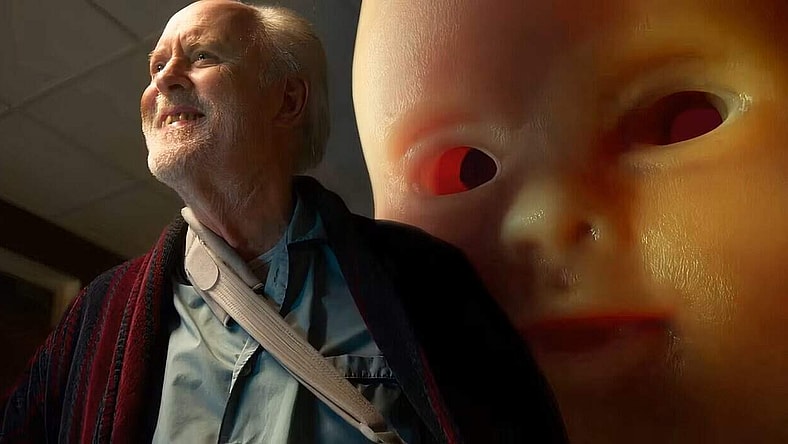
Getting older is terrifying. There’s privilege in it, no doubt, and it’s not one I’m going to scoff at. Far too many are denied the chance, and I echo the sentiments of the old and wise when I concede that the opportunity to age is a blessing. Still, that’s partly geriatric optimism, fifties and sixties, old without quite being, well… old. The “older” I’m terrified of is the end-of-life stuff, and that’s a fear adroitly, almost cruelly, exploited in James Ashcroft’s exceptional The Rule of Jenny Pen.
Both Editorial Director Josh Korngut and I included The Rule of Jenny Pen, adapted from Owen Marshall’s short story of the same name, on our year-end lists. For Josh, The Rule of Jenny Pen came in at number four. He wrote, “The Rule of Jenny Pen establishes director James Ashcroft as one of the most confident voices in contemporary horror, its co-leads Geoffrey Rush and John Lithgow deliver two distinct tour-de-force performances from true-blue legends of the craft.” The film cracked the top three on my list. I wrote, “The scariest suggestion is the collective concession that these residents are going to be dead soon anyway, puppet or not. Gotta love that puppet, though.”
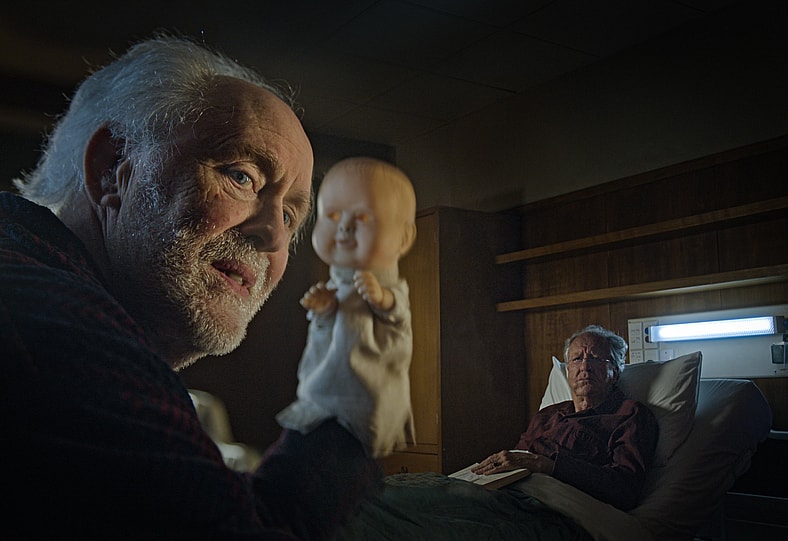
Naturally, The Rule of Jenny Pen will also be making Dread Central’s collective list of the year’s best horror. Yet, where The Rule of Jenny Pen deserves a special shoutout is its underdog, sleeper cell status. Alongside heavyweights like Sinners and Weapons, The Rule of Jenny Pen held its own. And while, yes, I ranked the former as my number one, I can easily acquiesce that The Rule of Jenny Pen is going to haunt me for much, much longer.
Per Shudder: A former judge must stop an elderly psychopath who employs a child’s puppet to abuse the residents of their shared rest home with deadly consequences.
Modern researchers largely conclude that, barring the unfortunate, longevity is a lottery. It’s genetic, and those who possess genes that guard against common age-related diseases are better poised to crack triple digits than those who don’t. Here in the United States, life expectancy, according to the CDC, is about 78.4 years. That’s up from past census surveys, and really not all that bad in the grand scheme. Thirty years has been a lot as it is…
Yet, when accounting for the most common fears among Americans, there’s a kind of projection. Death is feared less than illness or the loss of a loved one. We fear losing those close to us, perhaps a kind of inoculation from our own inevitable loss. The Rule of Jenny Pen is all about loss. It’s a propulsive, caustic depiction of hospice care where the body and mind deplete in equal measure. Aging is a privilege, yes, though a privilege we too conveniently—and conspicuously—forget comes with our body’s pivot from friend to foe. Bones and marrow break down. Skin sags. The brain gets all swimmy and tired. Our bodies and their many intricate systems work against us, a kind of internal Michael Myers that simply won’t stop fighting until we’re, well… dead.
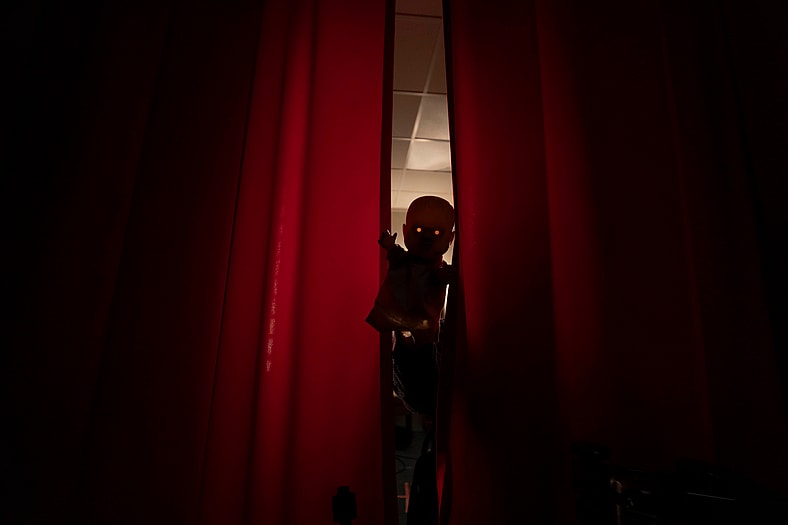
The Rule of Jenny Pen’s austere, matter-of-fact foray into end-of-life decline doesn’t need supernatural antics to probe and terrify. John Lithgow’s Dave Crealy does that easily enough with a hollowed-out baby doll. And Geoffrey Rush’s Judge Stefan Mortensen is a cad, a man whose collective life of solitude and malice has rendered him incapable of fighting back. The two performances are nothing short of stunning, two actors in their prime, and it’s never concealed that they are, as well, reaching their own ends. Lithgow is 80. Rush is 74.
That intrinsic truth augments the menace and the fear, the societal abandonment of the elderly into care (loosely used) facilities whose primary purpose is to placate until the residents die. Whether that’s because their bodies give in or another resident shoves a puppet down their throat is incidental—they’re going to die, either way, and the wheels of capitalism are best greased the sooner they do so. Imagine that, a late-stage capitalistic enterprise that profits off your death. Work until you can’t, and then just die.
Geoffrey Rush, speaking with Dread Central for our March digital cover story, said of his character, “The moment his world collapses, his independence is ripped away, and he’s thrown into a place where he has no control—it’s primal.” He later added, “He’s disturbed and fearful. He’s been a power-wielding figure, and suddenly, his body betrays him.” Lithgow echoed his sentiments: “My mother lived to 94. She spent her last years in a dementia unit, so I’ve been in these facilities. I know how isolating and frightening they can be. There’s so much to be explored in these settings. And James has done something truly remarkable—he’s created a horror film that respects its elderly characters instead of treating them as throwaways.”
Dread Central’s March Digital Cover Story with John Lithgow and Geoffrey Rush:
The Rule of Jenny Pen, with its modest budget and approach to conventional scares, shakes up the year’s best. A secret contender—one Stephen King adored—whose microcosm of anxiety renders it on par, if not better, than the studio-backed horror movies that hit theaters this year. The Rule of Jenny Pen worms its way into your brain, reminding you that you’ll not only be dead soon, but that everyone who might give a damn will be dead as well. If you make it that long, you’ll truly, earnestly be all on your own. Defenseless.
Defenseless against cruel residents and indifferent staff. Unable to shake the inexorable dread and regret of the life you lived, so infinite in retrospect, yet so small and immutable when taken as a whole. The Rule of Jenny Pen does what the best horror movies should, and in a just world, Jenny Pen will live on, contrary to the movie’s core ethos. It will endure as a classic, a warning, an incendiary indictment of how we treat the elderly and shuttle them off like cattle to the slaughter. Here, Rush previously remarked on the cosmic nature of aging and death, “We are small in the grand scheme of things. Fear is universal, whether it’s fear of the unknown, fear of death, or fear of losing control.”
And while The Rule of Jenny Pen isn’t the first film to tackle aging in such provocative, gut-churning terms—see Relic, Amour, hell, even Away from Her—it is the first to do so with such caustic, calcified realism. There is no restorative, heart-warming conclusion. Even Amour, which similarly ends with a suffocation via pillow, maintains an undercurrent of warmth and love. The Rule of Jenny Pen is rageful. Angry. Sad.
The Rule of Jenny Pen is now streaming on Shudder. If you missed it earlier this year, check it out. And for a more in-depth conversation, be certain to check out the Development Hell episode on the film. In the meantime, I’ll be monitoring my own body, taking stock of what I have, that lingering thought in the back of my mind—one day, it will be gone. When I look in the mirror now, I don’t see myself—I simply see Jenny Pen staring back at me.
Categorized:Editorials