
‘Buddy’ Unleashes Messy, Singular, Killer Unicorn Madness [Sundance 2026 Review]

Buddy is exactly the kind of deranged late night movie you would expect from Casper Kelly, a cult figure whose reputation was fortified by his viral Adult Swim segment Too Many Cooks. That infamous project was not just funny, but genuinely repulsive, an uncanny hell-comedy that expertly rots its humor into something oddly sinister. With his feature-length directorial debut premiering in the Midnight section of the 2026 Sundance Film Festival, Kelly presents a film that gestures toward that same creeping uncanniness, but instead favors a more casual, colorful, and less affective kind of fun.
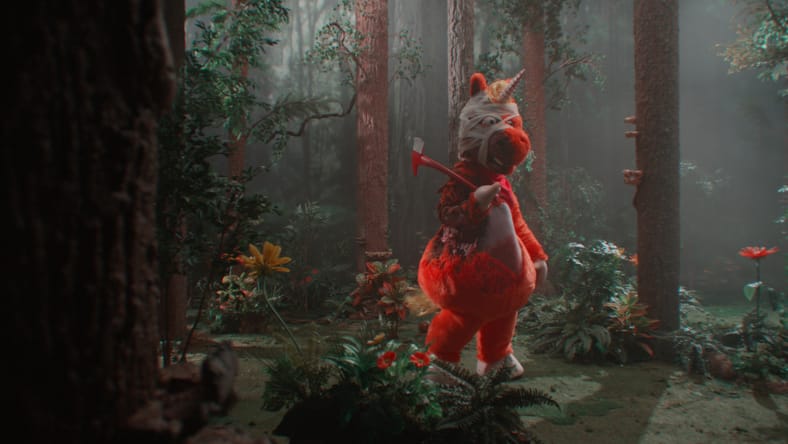
The premise is pure Kelly insanity. A group of children trapped inside a lost vintage television program are guided, or hunted, by Buddy, a giant orange unicorn with big Barney energy and a rapidly growing body count. Adults, kids, and puppets alike are slaughtered with manic cartoonish rage, the violence pitched somewhere between slapstick and literal nightmare. It is outrageous, mean, and regularly funny, even if it never quite establishes the sustained danger or suffocating unease that made Too Many Cooks feel so transgressive. This time, Kelly seems more interested in having fun than making us squirm, and that is a tradeoff I can live with.
Running parallel to the children’s blood-soaked television purgatory is a more grounded storyline in which Cristin Milioti plays a suburban mother who becomes psychically entangled with Buddy’s world and the kids fighting to survive it. It is here that Buddy begins to wobble. Milioti is a reliable presence, but the character is somewhat unfulfilled, and her performance comes across as a satellite compared to the wildness of the youngster ensemble. These kids, by contrast, are almost too real, so earnest and fully inhabited that they blur the line between satire and sincerity in a way that proves far more compelling.
Surprisingly, given its subject matter, Buddy arrives stacked with prestige names. Keegan Michael Key, Topher Grace, Patton Oswalt, Michael Shannon, and others appear in various forms, from doomed authority figures to voices for inanimate objects like backpacks fated for tragedy. These cameos are fun, but they also reinforce the sense that Kelly is speaking from place of impulse, maybe even stream of concious. Had he committed more fully to the children’s world and the charcaters in it, Buddy might have crystallized into a future Sundance cult classic. Instead, it occasionally loses its way, wandering into tonal and thematic side paths that somewhat dilute its impact.
A Barney-like children’s mascot who suddenly snaps, Buddy himself does not just menace his young ensemble, he literally butchers them, chasing terrified kids through the deep dark woods with a dead-eyed cheerfulness. The film’s willingness to kill children outright, without winks or mercy, gives the violence a sharp meanness that separates it from the pack. That same outrageousness, paired with its aggressive tonal bizarness, makes Buddy feel both instantly marketable while remaining quietly resistant to mass appeal. What is harder to predict is how wider audiences will respond to a film so openly disinterested in fulfilling either its horror or comedy expectations in any conventional way. Some viewers may feel duped, but that may also be exactly the point.
Still, the creativity and audacity on display are undeniable. Films like Buddy do not come along very often, and filmmakers like Kelly are even rarer. The imperfections are inseparable from what makes it so singular. Buddy feels like the work of an artist letting punk instincts override any obligation to audience comfort or need. Kelly does not seem to be chasing approval here. Instead, he is building the freakshow world he wants to play in. Even when it stumbles, this sort of singular vision is undeniably worth celebrating.
-
Buddy
Summary
Imperfect, yes, but films like ‘Buddy’ don’t come along very often, and filmmakers like Casper Kelly are even rarer.