
‘Bunny’ is Brimming with Visceral Dread and Unforgettable Imagery [Review]


Bunny opens with a literal firestorm. Writer/director James Branson’s new post-apocalyptic horror film, which premiered at SXSW Sydney in October, could have introduced us to its particular end-of-the-world scenario in any number of ways. But instead of Mad Max bombast or heavy-handed opening titles describing some dramatic cataclysm, we see it through the simple lens of a security camera as firefighters abandon a roadway to the encroaching flames, and the fire swallows everything. It’s a brilliant way to open an indie horror film, using real-life wildfires as a springboard, and it only gets better from there.
Anchored by an astonishing performance from newcomer Kate Wilson, Bunny is both a startling view of a plausible apocalypse and a deeply engrossing character study brimming with visceral dread and unforgettable imagery. It’s one of the best genre festival breakouts of 2025, and when it gets a wider release, you will want to see it as soon as possible.
Wilson stars in the title role of Bunny, a young woman living alone in a shack, surrounded by wildfire-ravaged Australian wilderness in a world where resources have run dry. Scavengers have taken all the food left to find, wildlife seems to have vanished, and the only real signs of life are a local sex cult of survivors who are really only suitable for stealing gasoline. With no more food, the only real source of nutrition left might be human flesh, and while Bunny’s father (Andy Gollidge) was always against that path, Bunny herself is a bit more intrigued.
While it presents a clear narrative arc for its title character, Bunny‘s story unfolds as a series of vignettes from her life, leaping between the recent past and a horrific present. We see what life was like when Bunny’s father was alive, and what it’s like when he’s gone. We know what happens when Bunny finds hitchhikers on the road, and when a haunting intruder (Ontrei) shows up out of the blue one day. Through it all, there is Bunny, not just fighting for her own survival, but for the chance to discover who she really is in a world that’s wasting away.
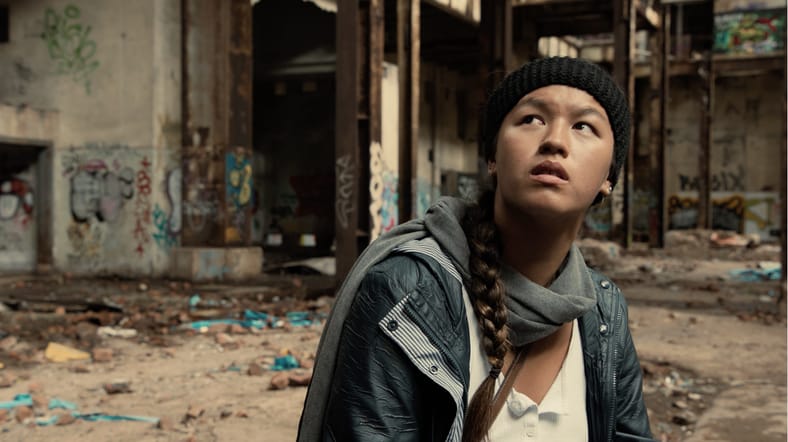
Apart from that firestorm, and a bit of opening narration to help set the stage, Bunny isn’t really interested in spoonfeeding apocalyptic lore to its audience. This is a lean film, but also a patient one, and one that makes excellent use of a recent Australian tragedy. The country surrounding Bunny’s home is land that was really ripped to shreds by wildfires just five years ago, leaving the trees dark and scraggly and the ground carpeted with still-growing scrub. Deserted industrial buildings and lonesome roads complete the effect, imbuing the film with a remarkably tactile sense of a world that ended slowly, extracting the maximum desperation from the surviving populace and pushing Bunny back to the wall. If you love the quiet, patient apocalypse of something as It Comes At Night, you will be happily lost in this burnt world.
The quiet, gradual crumbling of Bunny‘s universe leaves us with ample time to get to know Wilson, and she shines in one of the most compelling genre performances I’ve seen this year. This is a film that asks, in its own gradual way, not just what it means to be a survivor in this world, but what it might mean to be born to be such a survivor. Bunny’s particular tastes, her brand of survival instinct, all point to the psyche of a person who seems made for this moment, and yet being made for this moment could also transform her into a monster. The way she wields her own sense of destiny, and what it means for the kind of life she’s trying to build, is both complex and rewarding, and Wilson’s performance paints it all in stunning shades. She’s great all on her own, but when she’s paired with Ontrei for one of the most haunting scenes I’ve seen in any film this year, both of them are brilliant in a movie that melds Julia Ducournau’s meditations on human darkness with George Miller’s original Mad Max Aussie apocalypse.
We are drawn to post-apocalyptic stories for many reasons, but one of the most compelling is their ability to explore human cruelty, compassion, and endurance. Bunny is one of those films, a patient, slow-burning, atmospheric piece of survival horror that’s also the story of one young woman’s quest to figure out who she is, and what her very existence means in this world gone to ash. I was so impressed by this film, and I can’t wait for the world to see it.
Bunny is touring Australian theaters now. Check the film’s website for screening dates.
-
Bunny
Summary
Anchored by an astonishing performance from newcomer Kate Wilson, ‘Bunny’ is a startling view of a possible apocalypse that’s brimming with visceral dread and unforgettable imagery.
Categorized:Reviews