
A Rom-Com Slasher That Means It: Josh Ruben and Chris Landon on ‘Heart Eyes’

Valentine’s Day has never fully belonged to horror. Despite George Mihalka’s My Bloody Valentine becoming a cult staple, even earning a 3D remake in 2009, and the early-aughts slasher Valentine (2001), the holiday remains oddly underrepresented in the genre. Perhaps it is too kitschy in its pageantry to comfortably sustain terror. Heart Eyes found a way to truly blend horror and romantic comedy in a way that hadn’t been done before.
Director Josh Ruben admitted he was initially intimidated by the idea of merging the two. “I was like, I don’t know that this can be done. How can it possibly be done?” His concern wasn’t about whether the gore gags would work or if the jokes would land, but about mastering tone. From the start, Heart Eyes presented a challenge: how do you fully commit to two genres without turning either into parody?
“What if it could be as gruesome and fun a slasher as, you know… Friday the 13th: Jason Lives,” Ruben says, “but how can you also make it Nora Ephron?” The solution, Ruben and writer-producer Chris Landon realized, was refusing to treat either genre as a joke. Romantic scenes weren’t heightened for comedy, and horror sequences weren’t softened for laughs.
“You don’t want to scream funny,” Ruben explains. “You want to play horror for real. You don’t want to get caught trying to be funny.” The distinction sounds simple, but many horror films falter when humor undercuts the stakes.
Like most scary movies that want to stand out, Heart Eyes depends on well-written, three-dimensional characters to elevate it beyond spectacle. However, given the passion to make this movie part Garry Marshall and part Wes Craven, it couldn’t rely solely on inventive kills or gratuitous body counts. A romantic comedy has no buffer of blood. Its characters must be loved, or at least deeply understood, by the audience. Without that investment, nothing else matters.
“I think the key ingredient here was making sure that these two people were really struggling with their own personal stuff,” Ruben says. “That they both were seeking but also afraid of love. That’s a really classic rom-com layer. If you can create two characters that the audience connects to and is endeared to, they’ll go anywhere with you.”
That philosophy placed enormous weight on the film’s central relationship. Olivia Holt and Mason Gooding, cast separately and meeting for the first time on set, became the film’s secret weapon.
“I remember seeing the movie for the first time,” Landon recalls, “and I was just absolutely floored by their chemistry. That sold it. That was it.”
Without that chemistry, the tonal experiment collapses. It’s the difference between a clever concept and a film audiences actively root for. With it, viewers accept both the romance and the brutality without needing irony as a shield.
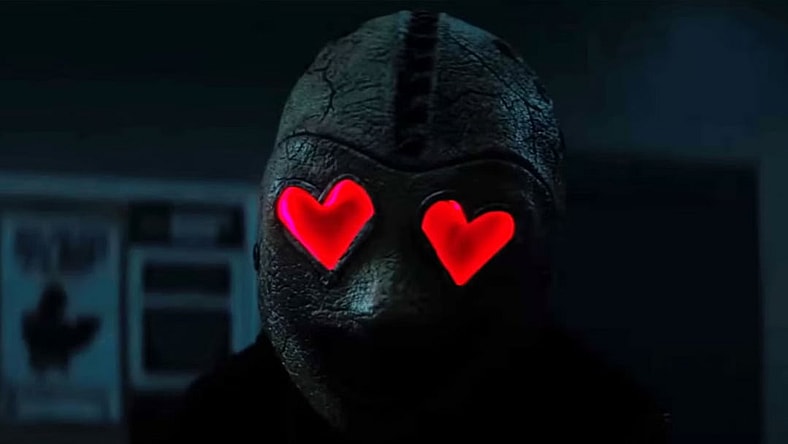
That same tonal balancing act extended to the film’s visual identity, particularly its killer iconography. The Heart Eyes mask had to embody the film’s duality: romantic, unsettling, and credible. Veteran effects artist Tony Gardner, whose career spans decades of genre filmmaking, helped bring the killer’s face to life.
Ruben describes the design process as an exercise in escalation. “Let’s truly see what a fucked up version of the emoji would look like,” he remembers saying. “How it would actually fit on an average head.” The heart-shaped eyes were designed to be seductive and threatening at once, an idea Landon was eager to lean into.
“We all knew that we wanted the mask to incorporate an element of S&M,” Landon explains. “A kind of kink factor… something you might be able to buy in a sex shop.”
Ruben later realized that adding a red glow to the eyes would sharpen both the menace and the romantic symbolism. It’s a small adjustment, but one that transforms the killer’s entire presence.
Even the film’s color palette reflects its tonal split. Ruben worked closely with his cinematographer and production designer to saturate romantic scenes in reds and pinks, then shift toward harsher lighting and shadow as violence intrudes.
“You kind of calibrate,” Ruben says. “This is too much. This isn’t enough.”
That calibration extended into test screenings, which Ruben describes as both alien and illuminating. “It’s a wild experience,” he says. “This data comes down to numbers… but there’s nothing like being in a room with a totally blind audience.”
Rather than reshaping the film to chase approval, the team used screenings to protect what already worked. “Knowing unequivocally that certain jokes work and certain scares work,” Ruben says, “those are the things that you don’t touch.” When audiences responded, they trusted that response.
In many ways, trust became the film’s heartbeat. Trust in the tone, trust in the performances, and trust in each other. Underlying all of it is a shared shorthand between Ruben, Landon, and collaborator Michael Kennedy, a creative trust forged through mutual taste and shared reference points.
“It’s like finding that table in the cafeteria where all the weird kids are sitting,” Landon says. “And you all love the same weird stuff together.”
In the end, Heart Eyes works not because it balances horror and romance, but because it believes in both. It understands that falling in love is a form of vulnerability, and vulnerability has always been horror’s sharpest weapon. By refusing to undercut its sincerity, the film proves that Valentine’s Day was never too kitschy for terror. It just needed someone willing to take it seriously.
!['Heart Eyes 2' Is Happening and My Heart Is Already Racing! [Exclusive]](https://www.dreadcentral.com/cdn-cgi/image/width=788,height=443,fit=crop,quality=90,gravity=auto,sharpen=1,metadata=none,format=auto,onerror=redirect/wp-content/uploads/2026/01/Heart-Eyes.jpg)
Categorized:News