
‘Backrooms’ Director Kane Parsons on the Perils of Eternal Consciousness [June Cover Story]

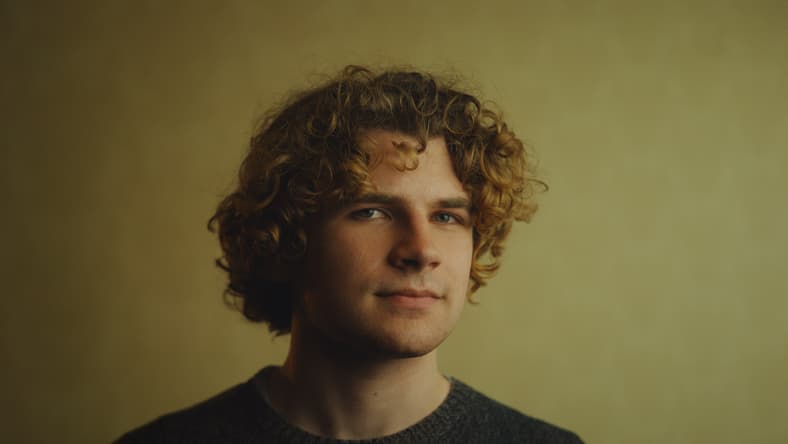
It’s not an understatement to say that Kane Parsons, director of Backrooms, is one of the most important new voices in cinema. While he’s been making plenty of headlines for his age, the young visionary has already been hard at work for a hot minute, producing short films with a larger digital footprint than many established filmmakers could ever dream of.
Parsons’ short The Backrooms (Found Footage) has garnered 80 million views and, more impressively, he’s helped push liminal horror into the mainstream in a very real way. It’s a term you’ve likely heard tossed around a lot recently. With releases like Exit 8 and Skinamarink becoming legitimate water cooler fodder, liminal horror owes Parsons thanks for helping push the form into the broader spotlight.
Now, his debut feature film, an adaptation of his Backrooms projects, is being released by A24 this Friday, May 29. For Dread Central’s June digital cover story, I sat down with Parsons to discuss his historic release, the anguish of eternal consciousness, and why he’s ready for a break to speedrun Portal.
Check out our full interview below.
Dread Central: I’d imagine it’s been an intense year for you. How are you feeling?
Kane Parsons: Other than staying up way too late last night working on finishing the soundtrack release, I’m feeling good. I don’t want to give the idea that there’s anything truly negative about the process, other than the severe amount of time we didn’t have to finish the film. Most of this year has been a crunch, since December. It’s been pretty extreme, especially near the end. I was doing 20, 21-hour days fairly often.
I love the work, I wouldn’t give it up for anything, but I need a break now. That’s what my nervous system would be saying.
DC: Do you identify as someone with anxiety?
KP: I have chronic stress, and autoimmune stuff, but I don’t get anxious easily, which is nice. My brain’s very active. I don’t have the most normal brain in the world — I’m a bit of a workaholic. I lean into that pretty hard. But I care about the longevity of it, I don’t think I do it in an overly self-destructive way. I care about what my life is going to be like — I feel like I’m going to peak in my 60s, so I need to act accordingly. I can’t burn out now.
DC: Do you have any phobias?
KP: I bet yes, because you can classify any human fearful impulse as a phobia. I have a hard time sleeping, thinking about death fairly often. That’s kept me up most of my life. The lack of consciousness forever. The lack of memory. The feeling that the consciousness I’m having in that moment, trying to go to sleep, will not exist, and I will not be able to reflect on it at a later point. At a certain point, everything I know will be gone forever. That definitely gets my heart rate up.
DC: No matter how bad human suffering can be, it ends — because we die. That can almost be a good thing. Do you think there are any dangers now with AI, etc., leading to the potential of eternal consciousness?
KP: Yeah, without a doubt. One of the earliest experiences I had with any media was with the Portal and Half-Life games. Science fiction has been in my life so heavily, and brain-computer interfacing, putting human consciousness in computers, has probably been the single biggest hyperfixation of my whole life.
So that specific subject matter — regardless of if it’s Backrooms, which is a bit more about putting a supernatural filter on those ideas — making no claim to whether or not I think it’s a good idea to do these things, I do think versions of it will happen.
DC: How do you think something like that could most likely happen?
KP: I would think what we arrive at first is probably a form of consciousness that we’re debating whether it’s even conscious in the first place — and we’d be subjugating a new kind of life form to some form of internal, eternal torment. That would probably be much more likely before we actually find a way to start putting people in.
Though I think, actually, if there’s some sort of chemical process we’re able to moderate more heavily in the brain — time dilation is more the thing rather than eternal. I’m not the person to ask when it comes to how we could put someone in a state of undying consciousness, but I do think messing with the brain’s perception of time is something we’re unfortunately — or maybe fortunately, in some ways — going to figure out. I doubt we’ll do it right.
We’ll see it at some point. I would wager in the next 100 years, at least. Probably sooner.
DC: Are there any other science fiction or horror references that you can recommend?
KP: I do a bad job of consuming too much stuff. Most of my inspirations come from people in the nonfiction space talking about these ideas in a non-fictional context. Sometimes they’ll reference things they’re a fan of, but the reference gets diluted through me — I get the idea pertaining to the concept, but not the IP itself.
Portal and Half-Life, obviously. There’s some interesting stuff with consciousness in Ted Chiang’s “Understand”.
DC: I’ve never heard of it.
KP: It’s a short story about a guy who undergoes a medical procedure to create more neuronal growth, and it cascades further and further until you follow this changing consciousness throughout, until it becomes something wholly alien — but described in a pretty real-time, interesting way. That’s something I’ve found compelling.
I’m a sci-fi nut, but not just for the broader cosmic-horror death aspects. I care about the world we live in. I care about being optimistic with the work I do, and making sure that — whether or not that reads with Backrooms always, I think it should the longer you spend with it.
Science fiction sometimes turns into a nihilism competition, and I want to be a little more productive and hopeful than that. Daniel Suarez — that author — I’m a pretty big fan of his stuff. I like the way he engages with in-depth techno-thriller ideas, but folds them in such a way that they’re not just for shock value. They’re building to something more.

DC: I read how No Clip inspired the initial idea for Backrooms. Can you talk to me a little bit about that?
KP: That’s mostly me deriving the information from the original 4chan post that was circulated, so it maybe wouldn’t have been a natural thought in my brain — though maybe it would have, a little.
With Backrooms, I never want to lean into the simulation trope. That’s not the idea I want to play to. What I like about that framing device is the humanity of it. By portraying the idea of falling out of reality as a glitch — something that happens accidentally — it’s very much at odds with the notion of it being some hell-like judgment, or a place you go to weigh your soul. It’s not, “you go to this place to atone because you murdered someone.” It’s reality failed. It’s like nature. There’s no one to answer to. It’s incidental.
DC: Could that be scarier — the indifference?
KP: That’s what I mean. I like to play this as hard sci-fi as I can. Obviously there’s so much impossibility and sci-fi mumbo-jumbo we don’t need to know. The more you try to explain it, the more you realize it’s obviously fictional, and you can’t quite articulate why and how the physics hold up. But that’s not the goal. The goal is to be in the position of not knowing, in the same way the characters are.
DC: In terms of the future of your career: what direction, genre-wise, could you see yourself taking?
KP: I’d be down to jump between horror and stuff that teeters on thriller, probably. I care about making sure stuff isn’t horror for the sake of horror. I don’t go into making horror because I watched a bunch of horror movies when I was young and fell in love with the genre. I enjoy bringing concepts and matters and different ways of being that aren’t inherently horrific, and cranking things up to ten to make people uncomfortable in ways that feel so unusual they become horrific — but aren’t necessarily straight-up violent or destructive.
DC: I know our audience would love to know some movies that are close to your heart, thriller or horror.
KP: For games: Portal, Half-Life. In terms of TV, I love Mr. Robot — I’ve watched it eight times. I love Breaking Bad, Better Call Saul, obviously great — so much tone and pacing there that I’m in love with and have pulled from. The British series Utopia, I highly recommend. One Hour Photo, a film I love. Punishment Park is a really good film I think more people should check out — I don’t know many people who’ve seen it. I enjoy The China Syndrome — it’s not for everyone, a little dated, but I enjoy it. I could keep listing stuff.
DC: What games are you playing right now, if any?
KP: Oh, I’d love to be. Some of my friends have been in school, obsessed with finals, and I’ve been working on this film, so none of us have been able to do anything together for months. Finally we’re all finishing right now, so we want to play things like R.E.P.O., Garry’s Mod — co-op multiplayer sandbox stuff.
DC: I want that for you.
KP: I’m going to replay Portal. Just keep speedrunning it.

Backrooms opens only in theaters tomorrow, May 29.
Categorized:Interviews News