
‘New Group’ Director Yûta Shimotsu Talks Cosmic Horror And Twisted Shapes

There’s a gleeful lack of subtlety that courses through director Yûta Shimotsu’s New Group.
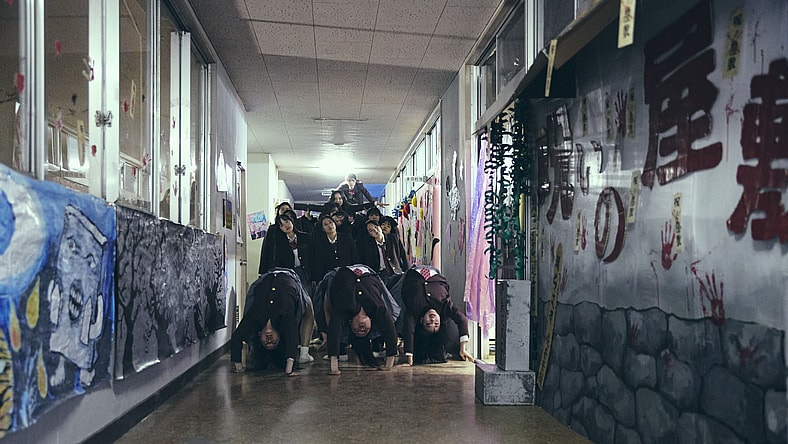
The Best Wishes to All director once again focuses on the foibles of collectivist thinking within Japanese society, though this time he imbues it with a sci-fi riff. It focuses on Ai (Anna Yamada), a high school student who is ostracized by her peers and befriends a new student, Yu (Yuzu Aoki). A strange signal—which may or may not have extraterrestrial origins in nature—transforms the students around her into mindless followers who contort and stack their bodies into various geometric shapes. Yu and Ai are pointedly the only ones who are free from the signal’s effects and have to evade the swarming mass that threatens to kill them unless they too fall in line.
Shimotsu viewed the film as a way to highlight the stories of those who are outcasts, particularly within Japanese society. “I was also drawn to letting people’s particular interests, no matter how strange they might be, live openly,” he shared, speaking specifically to the characters of Ai and Yu, two misfits who quickly cling to each other amidst the mounting crisis.
New Group played as part of the After Dark section of the Chicago International Film Festival (curated by fellow Dread Central writer, Nicola McCafferty). Ahead of the film’s second screening at the Gene Siskel Film Center, Shimotsu, whose words were graciously translated by Yuki Solomon, spoke with Dread Central about the role restrictions play in his art making, what inspired the twisted body movements, and whether collectivist thinking can be redeemed.
This conversation has been edited and condensed for clarity.
Dread Central: I enjoyed Best Wishes to All and found it to be a sibling film in many ways, similar to New Group. What made New Group the film to tackle right after your debut?
Yûta Shimotsu: Subconsciously, I could see the ideas as linked now that you mentioned it.
I studied sociology. One of the first things you learn is that society is composed of numerous groups and units. There are families, schools, companies, cities, and countries. If you think about it, zombies are also another kind of unit. I thought it would be scary if the group and structure were completely under one management. That’s part of what makes zombies so scary.
This collective idea extended even to the names of the characters. Anna Yamada plays “Ai” while Yuzu Aoki plays “Yu.” Together they take part in a story about “us” or “I and you.”
DC: To your point, it’s terrifying when we see the students join together and move as one, writhing mass, particularly when they’re in “attack formation” and some of them start doing the worm. What inspired that choreography and those movements?
YS: Now it’s prohibited because it’s dangerous for students to do, but students had to assemble into a human pyramid as a school activity in Japan. I wanted to use the human pyramid as a metaphor to show the peer pressure in these spaces and how the surroundings encourage people to follow the leader, even if it may be detrimental.
As for the worm, those students who were doing those extreme movements were actors from Nippon Sport Science University, a physical education university that’s famous for gymnastics. When I was in discussions with them about the movements we should create together, my main mantra to them was: make something strange, weird, and a little unsettling. Hopefully, it made you feel insecure.
DC: Were those performers the same ones who did the pyramid and sphere as well (before I’m assuming, you had to use CGI when it got too unwieldy)?
YS: For the first 30 minutes of the human pyramid, those students are actually doing those movements. But as the pyramid got bigger, we built people around this structure–sort of like a staircase–people could stack or be present on to help support. The sphere was all VFX work.
DC: I also loved the title sequence for New Group, which was all of those bodies that were squirming to be in the shape of the letters.
YS: There was just one guy who was in charge of the VFX. Every day, he was crying. [Laughs]
DC: Please pass on that he did a great job; it looks amazing.
YS: Incorporating those shapes was also significant for me, though. The pyramid represents a sort of hierarchy because of all of those layers; some people benefit by bearing down on the people below them, and it never ends. The thing with a sphere is that there’s no hierarchy; it’s equal no matter how you look at it. It’s a shape that’s a great equalizer.
DC: You’ve worked with Kotone Furukawa for Best Wishes to All and Anna Yamada for New Group. Both of your films explore the damage of rampant patriarchy and collectivist thinking in Japan. What draws you to exploring these stories from the perspective of adolescents, particularly adolescent women?
YS: I do think Japan is a very male-dominated society, and so as I can, I am drawn to telling stories of the ordinary people who don’t get as much screentime. I wanted to put these seemingly “unspecial” people’s stories and put them front and center.
I was also drawn to letting people’s particular interests, no matter how strange they might be, live openly. For example, in the film, Ai has a fascination with anything spherical; there’s that scene where she has a drawer full of round objects. Yu, by contrast, is obsessed with smell. He has scents that he likes. In America, it’s different because I think if you like a particular thing, people don’t care about it. But in Japan, if you like weird stuff, you’re shunned and encouraged to not reveal it, and that secrecy is amplified through the collective. If you want to be accepted in society, you’re expected to have purged yourself of those things.
DC: You’ve now looked at the dangers of collectivist thinking across two films. What draws you to that theme, or how does your approach differ from when they’re in different genres?
YS: Across both projects, I take care to exaggerate reality. I enjoy playing on that spectrum: if I make people go through unfortunate scenarios, I can then match that by making pleasant scenarios.
DC: In other interviews, you had shared how the budget for this film was low, but you tried your best to provide spectacle, regardless. As a filmmaker, what’s your relationship with restriction, or phrased another way, how do restrictions help your creativity?
YS: I’ve learned to enjoy the limits and restrictions. If I had unlimited resources, I don’t think I’d be able to make the best film because I wouldn’t have complete freedom. My brain works harder because of these restrictions, so I can make better films. But if I had more money, I would have loved to make the students do formations of even wackier shapes.
DC: Maybe in the sequel, you can make the students assemble into a deltoidal hexecontahedron. I remember you had shared at a Q&A for the film that if you had more money, you would have shown how the school principal was an alien. Yet by not showing that, it makes the film more eerie because of the uncertainty.
YS: By not showing that the principal is an alien directly, it helped me underscore something deeper about Japanese society. Especially in post-war Japan, people are hesitant to talk about politics openly. I think a lot of this can be tied to how people are brainwashed to follow the leader and to avoid standing out. This mindset is instilled into people in their early educational years, enacted by people like the principal. We all need some kind of awakening.
DC: What I loved most about that sequence was the unpredictability of it. I wasn’t expecting the principal to start singing, for example.
YS: I actually wrote the tune and lyrics to that song … I was pulling additional duties by doing the music. [Laughs] Originally, that scene was going to be just a dialogue scene, but reading it, it just felt like an exposition dump. Having the same information converted into a song makes it more interesting.
DC: When in doubt, always include a musical number. One of my favorite lines in the film is when the group of students says to the protagonists, “There is love here. Let us love you.” There’s beauty as well as danger in the collective. Do you think there’s a redemptive form of groupthink?
YS: I think filmmaking actually offers a beautiful corrective and is a portrait of the good of the collective. In a film production, you have to work as a team and invite people’s individuality. Everyone has to have their own ideas and bring them into that set. That’s what I define as a new group. Making movies is tough and not easy, but hopefully, the set I cultivate can be a way forward. I approach directing as if I were a teacher.
Categorized:Interviews