
Out of the Well and Into Our Homes: ‘The Ring’ and the J-Horror Boom

The horror world lost a legend recently when we learned that Japanese author Kôji Suzuki had passed away at the age of 68. Dread’s EIC Brad Miska wrote a piece highlighting the novelist’s accomplishments and how he influenced Brad’s own career. I recommend giving it a read. What I’d like to focus on, though, is Suzuki’s singular and genre-changing novel, Ring (aka, Ringu).
First published in 1991, Ring follows a reporter named Kazuyuki as he investigates a strange string of deaths that include his niece. His search leads him to an island, where he discovers an unmarked videotape. Upon finishing the tape, he receives the message that he has one week to live. As he digs deeper into the origins of the tape, Kazuyuki discovers a curse enacted by a mysterious young woman named Sadako. Everyone who watches the video dies. And Kazayuki’s time is running out.
The acclaimed novel was first adapted for a TV movie in 1995. But it was in 1998 that Hideo Nakata delivered a feature film version of Suzuki’s eerie tale that shook the world like a typhoon.

Nakata’s film tells a similar story to Suzuki’s novel with a few key differences. Namely, Kazuyuki gets a gender swap, becoming Reiko Asakawa (Nanako Matsushima). She has a son, Yôichi (Rikiya Ôtaka), estranged from his father and Reiko’s ex, Ryûji (Hiroyuki Sanada). Otherwise, the basic elements are the same, with Reiko showing Ryûji the sinister tape and the two banding together to save themselves.
Admittedly, I first laid eyes on the 2002 American remake of The Ring from director Gore Verbinski and starring Naomi Watts. As I’m certain many Americans did. Hence why I’d imagine some may prefer it to Nakata’s original (I’m not one of them). Still, the film chilled me to my core. So much so that I immediately raced to get my hands on a copy of the Japanese version, only to discover just how much more frightening a film it is.
Nakata’s The Ring sets viewers on edge right from the opening seconds. We see dark, tumultuous waves crashing into each other, set against the ominous tone of composer Kenji Kawai’s sinister score. The combination of sounds and visuals makes you feel as if you are sinking into an abyss from which there is no escape. Noises muted and echoing, slowed down, what you might hear as your lungs fill with water, and the surface world disappears. We don’t know during that first watch, but this is Nakata putting us into the wet shoes of the film’s ghostly antagonist, Sadako (Rie Inō).

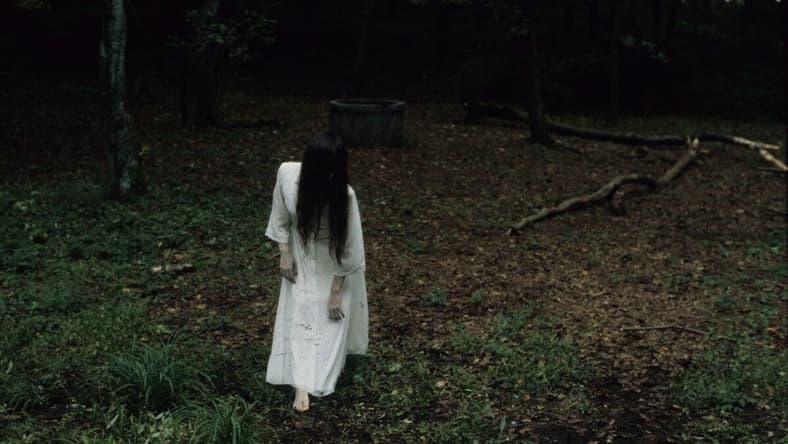
Every great horror franchise has an even greater villain. For The Ring films, that’s Sadako. Gifted with powerful supernatural abilities that we later learn allowed her to kill on sight while alive, the young woman was murdered by her father and tossed down a well, where she remains until our protagonists seek to find her body. Adorned in a dirty, white dress, long, black as night hair hangs over her face (a face that we never actually see). Where her nails should be, we find mutilated flesh. See, Sadako wasn’t dead when Daddy dumped her in the well. Her nails tore off from desperately trying to climb out of her watery tomb.
Complimenting the look is Inō’s unsettling performance. The actress never speaks—hardly even makes a sound—but there’s no damn way you can forget her. Inō crawls along the floor slowly, moving almost like a nightmarish crab, body twitching with each movement. There’s nothing quite like seeing her for the first time. And you never have to try to remember it, because the image becomes seared in your mind like an eternal curse.
Japan has a lengthy history of long-haired ghost girls in folklore. Known as yūrei, these vengeful spirits have been an iconic centerpiece of the country’s horror tales for centuries. Thanks to the success of The Ring, though, Sadako brought the trope to mainstream attention. Ask your average moviegoer now, and they’ll likely associate the image with The Ring.
Sadako’s unnerving appearance is just one of the many tropes common to what would become known as J-horror, many of them popularized by The Ring. Another major component is that of the curse.

Many J-horror films center around a deadly curse, often brought on by a vengeful spirit as their way of dishing out justice for an untimely and violent death. Granted, victims often have or had nothing to do with the murder itself, but that’s not the point. These spirits, as is the case with Sadako, carry such furious rage with them that their vengeance stretches out well past those who caused their death in the first place. Like the tumultuous sea of The Ring’s opening, these curses swallow anyone unlucky enough to cross their path.
This, I think, has a lot to do with why audiences went wild over The Ring and the J-horror movement. Here in the States and in many places around the world, men often carry the franchise torch as horror villains that fans typically popularize to a level above that of their (usually) female counterparts, generally referred to as Final Girls. But not Japan. In Japan, women such as Sadako are the horror icons. Vengeful ghost girls free to unleash violence on a society that has repeatedly wronged them. Exploring why that’s the case would require a whole different article. But the fact of the matter is, J-horror typically sees women dishing out the punishment, and that’s something we don’t get to see often enough in films from other parts of the world.
The Ring’s popularity, of course, also owes a good amount of credit to Nakata, who approaches the supernatural tale with an elegant patience that pays off big time. Some might complain that the ‘98 Ring is “too slow” or doesn’t feature nearly as many jump scares as the remake. Again, I’m not one of them. Nakata’s patient direction sinks audiences into the dread. He doesn’t bother to throw out cheap scares or barrage our eyeballs with a shrieking Sadako. We don’t even get a good look at her until deep into the film. Consider the shots of her progressing just a bit more out of the well throughout. Coming closer and closer to not just the characters, but us. I’m positive every one of you remembers the terror you felt that first time you witnessed Sadako crawl out of the TV. As if crawling into your own homes.

In a sense, that’s exactly what happened. The furious ghost became a sensation. We began to see more J-horror films reaching popularity in the States, such as Takashi Miike’s Audition and One Missed Call, Takashi Shimizu’s Ju-on, Kiyoshi Kurosawa’s Pulse, and Nakata’s own Dark Water (also based on a novel by Kôji Suzuki). Without The Ring, there’s a good chance most, if not all, these films don’t exist. Without Suzuki, who knows when or even if J-horror ascends to the heights that it did.
U.S. audiences became so infatuated with the movement that a whole series of remakes were spawned following the success of The Ring. All the above received the remake treatment (minus Audition), with The Ring and Ju-on both spawning whole American franchises of their own. Of course, none are as good as the originals they’re based on, but who cares? These films sparked a massive interest in J-horror that pushed audiences, including myself, to seek out their origins. Once I had worked my way through the popular titles, my own obsession with J-horror grew. I watched anything I could get my hands on. Three…Extremes, Versus, Uzumaki, Infection, you name it. I also went backward in time, wanting to see all Japan had to offer, from Kwaidan to Tetsuo: The Iron Man and a personal favorite, Nobuhiko Ôbayashi’s House.
The U.S. weren’t the only ones to feel the J-horror influence, either. Thailand was another country that took inspiration from the success of The Ring. Films such as Shutter jumped on the craze, incorporating J-horror elements on their way to massive success. Shocker, it, too, even got the American remake treatment. That film then created a separate boom in Thai horror, with filmmakers Banjong Pisanthanakun and Parkpoom Wongpoom also releasing Alone before directing segments in the Thai horror anthology series, Phobia. You’re likely familiar with Banjong’s terrifying most recent film, The Medium.
The list goes on and on.
No one, not even the most renowned horror expert, can say for sure what would have happened if Kôji Suzuki never sat down to write The Ring. But take it from someone who was around for it…I have rarely in my lifetime seen a film have quite the impact that The Ring did. It brought attention to the J-horror trend around the world. It inspired legions of fans to seek out other films from Japan, expanding their knowledge, with some watching foreign films for the first time. A whole generation of filmmakers found success in their careers in part because of it.
From far down in the darkness, The Ring rose up and changed horror as we know it. Kôji Suzuki couldn’t have known it then, but his story would go on to impact the film world in a way that so few do. His influence will surely continue to be felt for generations by filmmakers reaching down into the well of terror that he opened up all those years ago.

Categorized:Editorials