
‘Tales from the Crypt’: Peter Jackson, Quentin Tarantino & The Unusual History Behind the Movies


Tales from the Crypt’s cinematic installments helped expand its brand, but these campy grindhouse offerings were almost completely different movies.
Tales from the Crypt was dominating cable television in the 1990s while leading the way for a new age of anthology programming as an early flagship series for HBO. As Tales from the Crypt was heading into its final seasons, the franchise wanted to take advantage of its ongoing success by transitioning into a film series that could intermittently release new, high-quality stories. The initial plan was for a trilogy of films, which was a decision that seemed feasible and made sense considering that Tales from the Crypt’s creative team included some of the decade’s greatest genre filmmakers. While Tales from the Crypt nailed its production season after season without a hitch, there were numerous hiccups and false starts regarding the anthology franchise’s cinematic transition.
A Tales from the Crypt movie should have been a home run, especially after the success of other anthology series-to-film efforts, like Twilight Zone: The Movie and Tales from the Darkside: The Movie. However, high expectations and even higher standards would get in the way. Tales from the Crypt’s first feature film, Demon Knight, was a critical and commercial success and is seen today as a cult classic. However, it was just one of many potential Tales from the Crypt films in consideration, including a zombie epic in New Orleans and reappropriating iconic genre scripts from Peter Jackson and Quentin Tarantino.
The Many Sides Of Demon Knight – Pre-Production Woes & What Could Have Been
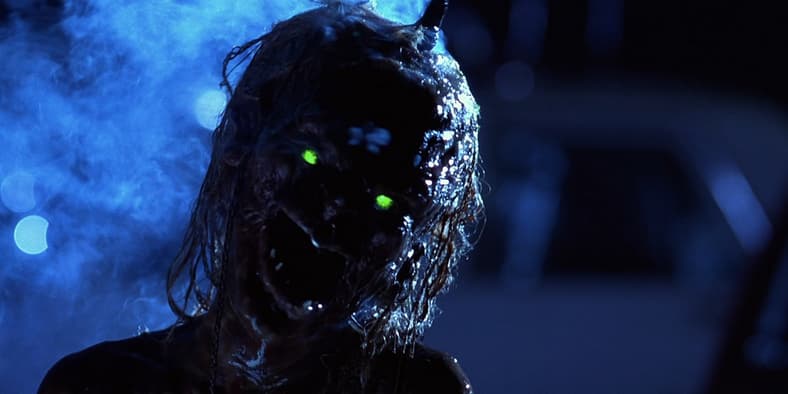
There were dozens of viable EC Comics stories that could have worked as the foundation of a Tales from the Crypt feature film, whether it was taking an anthology approach and cramming together several shorter stories or using this theatrical opportunity to tell one longer tale of terror. Ambitiously, Tales from the Crypt opted to use this cinematic showcase to tell an original story in line with the general EC Comics vibe, rather than adapting a pre-existing story. Demon Knight’s origins actually predate HBO’s Tales from the Crypt series, and its first draft was penned in 1987 with the intention of being directed by Tom Holland as his follow-up to Child’s Play.
Tom Holland, who directed three separate Tales from the Crypt episodes, began pre-production work on Demon Knight before he jumped ship to direct the forgotten Fatal Beauty. Mark Carducci of Pumpkinhead fame was the next to attempt to rework the script before it wound up with Pet Sematary’s Mary Lambert. Lambert, who was no stranger to Tales from the Crypt and directed the first season’s finale, “Collection Completed,” had bold ideas for Demon Knight. Ironically, the film’s pre-production was taking so long that investors were no longer interested in Lambert’s version of the movie after she directed the disastrous Pet Sematary Two in the interim.
Demon Knight then spent a brief tenure as a potential Full Moon Features production under Charles Band, which certainly would have been a choice, before being swooped up by Joel Silver. Demon Knight was intended to be the second entry in a Tales from the Crypt trilogy, but Universal executives thought that it had more potential than the other two work-in-progress scripts, Dead Easy and Body Count.
Silver’s version, with Ernest Dickerson directing, continued to move forward, albeit with two versions of the script to cover radically different budgetary scenarios. One version of Demon Knight featured demons, while the other was a more budget-conscious take on the story that omitted explicit monsters. The potential plan for the demon-less version (which involved macabre Bible salesmen) made Universal executives nervous, so additional money was allotted so Demon Knight could stay true to its name. This proved to be the right decision, and Demon Knight’s kitschy approach to its monsters is one of its most celebrated elements. Demon Knight’s box office nearly doubled the film’s budget, and production was fast-tracked on a sequel that would be out the following year. The only problem was figuring out which story would become the official sequel.
The Frighteners, From Dusk Till Dawn, Dead Easy & Finding The Right Sequel

Demon Knight’s success led to Universal Pictures greenlighting two more Tales from the Crypt Films, with Dead Easy (also later known as Fat Tuesday) – a zombie film in New Orleans – set to be the second entry. Dead Easy is even teed up by the Crypt Keeper in Demon Knight’s post-credit scene, which is now just cryptic cannon fodder. Regular Tales from the Crypt scribes Gilbert Adler and A.L. Katz struggled to crack Dead Easy’s script, which led to Silver hiring The X-Files’ Darin Morgan to do a rewrite.
It’s not surprising that Morgan excelled in this space, considering he was responsible for some of The X-Files’ best monster-of-the-week episodes. Dead Easy not materializing is unfortunate if for no other reason than it deprives the world of Darin Morgan’s version of an EC Comics-style story. Dead Easy was in pre-production and weeks away from shooting in New Orleans before Universal shut it down over concerns about the film’s mainstream commercial viability due to its New Orleans setting and wanting to pursue a campier project over a psychological thriller.
Producers considered plans to pivot to other popular genre scripts that were floating around and had a general Tales from the Crypt vibe, most notably Peter Jackson’s The Frighteners and Quentin Tarantino’s From Dusk Till Dawn. As production was struggling to figure out the sequel’s right direction, Robert Zemeckis was offered a contract with DreamWorks. In order to appease Zemeckis so that he wouldn’t jump ship and leave his working relationship with the studio, Universal offered him the opportunity to turn a revised version of an old script that he and Bob Gale had written fresh out of USC – Bordello of Blood – into the second Tales from the Crypt movie over the potential alternatives.
Bordello of Blood focuses on a private investigator’s infiltration of a seedy vampire brothel. It’s viewed as a major step backward from Demon Knight, yet it’s steeped in a surprising history. Bordello of Blood first took life as Bob Gale and Robert Zemeckis’ first professional screenplay, fresh out of USC in the early ’70s. The script was, of course, not written with Tales from the Crypt in mind, but it was intentionally devised as a pulpy exploitation grindhouse-style project.
Bordello of Blood made its way to John Milius in the ’70s– alongside another script of theirs titled Tank – but it failed to come together, and Gale and Zemeckis instead pivoted to 1941. However, it’s interesting to consider the trajectory that their careers might have had if this vampire exploitation project were their first professional calling card instead of a deranged war spoof directed by Steven Spielberg.
Once Bordello of Blood was moving forward, Adler would take on the project and rewrite Gale and Zemeckis’ script with Katz in an attempt to modernize and update the movie. Zemeckis and Gale would later acknowledge how far Bordello of Blood fell from their original vision, but it’s interesting to consider how the film might have performed had it been helmed by Zemeckis. It stands to reason that Bordello of Blood would have been at least a more memorable film, and it might have led to Zemeckis playing around even more in the horror genre.
Evidently, choosing the right story for the Tales from the Crypt sequel and refining its script was only the beginning of Bordello of Blood’s hurdles. Adler and Katz wanted Daniel Baldwin and Robin Givens to headline their film as Rafe and Lilith, respectively. Executive producer Joel Silver vetoed this casting and insisted upon Lilith being played by Angie Everhart (who was not a professionally trained actress and only had one major credit to her name, a small role in The Last Action Hero) and Dennis Miller as Rafe.
Miller’s casting became a major point of contention, and the actor made it clear that he didn’t want to be in Bordello of Blood from the jump. When Miller’s $1 million salary was refused by Universal, Silver cut $750,000 from the special effects budget to meet Miller’s requirements. Considering that so much of Demon Knight’s success was attributed to giving the special effects and makeup departments the necessary respect, this egotistical decision kicked Bordello of Blood off on a sour note. This gambit might have been worth it if Miller actually salvaged the production, but he was an albatross every step of the way.
Miller, disappointed in his dialogue, insisted on improvising the bulk of his lines, which led to plotting and continuity inconsistencies. Bordello of Blood’s production schedule also had to accommodate Dennis Miller Live, which created greater animosity between Miller and the crew when this schedule meant they had to work through weekends and couldn’t see their families. Miller was sometimes too exhausted to even show up to set, with a stand-in filling in for him. On top of everything else, production had to work out of Vancouver, with an inexperienced crew, because of Silver’s past union disputes in Hollywood.
Further issues were faced when Erika Eleniak pushed back against filming unless serious rewrites were done to her character, Katherine Verdoux. There seemed to be major communication issues regarding Eleniak’s character and how this role had been described to her or originally written. Eleniak, who had come out of Baywatch, left the series specifically because she wanted to be taken more seriously as an actress and not just perceived as eye candy.
There are conflicting reports on Katherine’s original character arc, who was originally written as a stripper, while Eleniak attests that her issues were with Silver’s interest in adding a sexually charged scene between her and Everhart’s character. There was also a piece of Katherine’s backstory where she used to be an overweight former adult actress named Chubbie O’Toole, with Eleniak even going so far as wearing special makeup prosthetics to convey “Chubbie’s” look. Regardless of where the truth fully lies here, Eleniak’s frustrations, combined with Miller’s bold requirements and radical script revisions, led to a production that was destined to falter and fail to meet the high standards set by Demon Knight.
Tales from the Crypt Presents: Bordello of Blood was critically lambasted and only grossed $5.6 million on a $2.5 million budget, barely a quarter of Demon Knight’s domestic box office of over $21 million. Ironically, what was devised as a project to keep Robert Zemeckis and Bob Gale happy turned into a messy misfire that they barely recognized and have since disowned. Gale said back in 2015 that he’s yet to see a finished cut of the film because he was so let down by the production’s dailies.
Exhuming The Dead – The Diminishing Returns of Tales From The Crypt: Ritual

Bordello of Blood’s troubled production and disappointing box office led to Universal ditching their original plan for a third Tales from the Crypt film. The Tales from the Crypt franchise would be dormant for a decade, at which point a third movie did emerge in 2006, just not how fans might have expected. Tales from the Crypt Presents: Ritual was released in 2006, but unlike Demon Knight and Bordello of Blood, it wasn’t produced under the Tales from the Crypt label.
Ritual looks at a supernaturally-driven story in which a denied inheritance prompts a voodoo curse with unexpected – and undead – consequences. Ritual experienced a very limited theatrical release in the Philippines in 2002 and 2003, with it not hitting North American markets until several years later as a direct-to-video release in 2006. It’s this direct-to-video release that adds the Crypt Keeper material. It’s a bizarre approach that’s not unlike what was done with Cloverfield’s various sequels, albeit much lazier and less intuitive. Ritual doesn’t really have the expected Tales from the Crypt energy, yet it still includes some regular Tales talent, like Tim Curry, while being produced by Richard Donner, David Giler, and Walter Hill.
Ritual is a movie that, for all intents and purposes, doesn’t exist. It actually started as a remake of 1943’s I Walked With A Zombie, before morphing into more of a voodoo-centric take on Fatal Attraction after Rob Cohen became attached to the project. Cohen would go on to leave the film, with Avi Nesher taking over the writing and directing duties, with the film now retitled Ritual. It’s kind of fascinating that this attempt to maintain the copyright of old RKO Pictures films would technically become the final Tales from the Crypt film, albeit only after it hit physical media.
Ritual is a weak note for Tales from the Crypt to go out on, but it’s all the more insulting that this film touches on comparable subject matter to the unproduced Dead Easy. Some casual fans were even under the impression that Ritual was Dead Easy, just under a different title. It’s incredibly disheartening that this promising feature film anthology series concludes with a random, poorly received, low-budget horror film that was never devised as a Tales from the Crypt movie. It’s essentially a direct-to-video misfire that tries to squeeze out the tiniest amount of blood from this stone by tacking on a perfunctory Crypt Keeper wraparound segment. This, of course, doesn’t salvage the film and, if anything, makes it even more disappointing that, for years, the Crypt Keeper’s final appearance featured a mildly offensive Jamaican stereotype that’s lacking any of his usual charm.
With Ritual in Tales from the Crypt’s rearview mirror for two decades now, it’s unclear if the anthology horror franchise will experience some modern legacy sequel or revival. For years, rights issues held back new Tales from the Crypt projects and not much has changed. However, Shudder’s recent streaming acquisition of Tales from the Crypt has the potential to put the series back in the spotlight and trigger something new.
If nothing else, the Crypt Keeper needs to be a guest on a special Tales from the Crypt edition of The Last Drive-In with Joe Bob Briggs.

Categorized:Editorials Movies