
‘Hokum’ Is This Generation’s ‘The Babadook’ (Affectionately)


The Babadook, Jennifer Kent’s feature debut that stunned the world in 2014, is a meme. I mean that affectionately as someone who would rank it among the greatest horror movies ever made. For everyone else? Not so affectionately, I’d imagine. The Babadook was released at the cusp of the post-irony digital era, where nothing mattered, and nothing was taken seriously. This allegedly terrifying horror movie that had critics in shambles was really just a bunch of hokum. Oh, trauma and depression are the Big Bad? Probably singular and won’t inspire an entire decade of horror… right?
I’d wager those people are fools, even if they’re reasonably right about The Babadook shifting the trajectory of the genre toward horror as metaphor. Granted, the genre had always been that, but it was rarely so pronounced and conspicuous as it was in the wake of The Babadook’s critical success. Everything from slasher IPs to indie darlings were imbued with such earnest sentiment, the horror genre might as well have been sponsored by BetterHelp. We’re not fully out of it yet, but if there is a sign of things changing, it’s got to be Damien McCarthy’s Hokum. Not only is McCarthy’s Hokum the scariest movie of the decade, but it’s also the strongest metaphorical outing since Kent’s debut.
All That Hokum
The conceit is simple. Adam Scott’s Ohm Bauman is a struggling author. He’s had great success with his Conquistador series (of which audiences are treated to an epilogue in the cold open), but he’s grappling with how to end his trilogy. What’s shown is pretty grim, an early and effective visual preview of where Ohm’s mind is at. Grief is circular and unpredictable, and in the midst of an alcohol-fueled writing session, he decides to hop on a plane to Ireland to spread his parents’ ashes at The Bilberry Woods Hotel, the site of their honeymoon.
McCarthy has always excelled in the Gothic and the personal. Caveat and Oddity, his previous two features, contextualized deeply personal stories with genre tropes. The scares are familiar even if the main players are intentionally singular. I’d reason it’s what he does best, and why his three films thus far are all reasonable candidates for the “scariest of all time” moniker. It’s campfire tales as moviemaking, the kind of story you’d hear from a friend of a friend, seated around a crackling fire deep in the dark, dark woods.
The Bilberry Woods Hotel has its ghosts, principally those tethered to the prohibited honeymoon suite. Rumor has it that the hotel’s owner imprisoned a witch in the room long, long ago, and no one has been able to stay there (or even enter) since. Ohm Bauman is a skeptic. He’s also clinically depressed. Where most movies would light a fire under Ohm to get him into that room as soon as possible, here, he has no interest. He’s come to Ireland to honor his parents (mostly his mother) and to die.
Death as Recompense
The transition to the second act of Hokum is marked by Ohm’s suicide attempt and subsequent recovery. He’s saved by hotel bartender, Fiona (Florence Ordesh), and after his stint in the hospital, he returns to thank her, only to hear she went missing shortly after she saved his life. It’s that quest to find Fiona that drives Hokum’s scares, finally getting Ohm to the honeymoon suite, where he spends the remainder of the film, trapped by Fiona’s killer (and trapped with an ancient witch).
Where The Babadook’s specter was clinical depression incarnate, Hokum’s witch is complicated grief with a mystical, folkloric bent. There’s a deluge of guilt trapped in and around the suite. Ohm, it’s revealed, killed his mother by accident when he was a child. Mal (Peter Coonan) killed Fiona to hide her pregnancy from his father-in-law. And sweet, sweet Jerry (David Wilmot), while accused of his late wife’s murder, was really just ending her suffering.
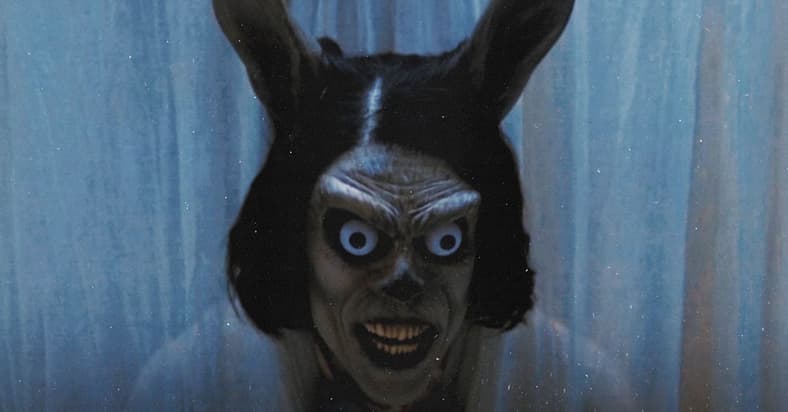
McCarthy’s scares are rooted in the vagaries of guilt, and as effectively as Kent, his metaphor drives the horror rather than simply existing alongside it. The best scares are contextual and earned. When boogeymen (Jack the Donkey) and witches pop out to startle Ohm (and the audience), the jolt is as much for him as it is for us, the audience. It’s a simple idea, but a profound one in a genre that often trades in loud noises and ephemeral spikes in heart rate, whether the scare makes sense or not.
Jerry is scared, too, principally by the appearance of Fiona’s ghost and the sinking feeling that she’s died, afraid and all alone. McCarthy stages and deploys the scares like a James Wan acolyte, but they’re so rooted in the mythology of these characters, so rooted in their internal strife, they land that much harder. Jack the Donkey isn’t just a scary face—he’s a perennial reminder of Ohm’s childhood guilt. And the collective, all three men, see death as salvation. In death, their guilt might cease.
Meeting Their Ends
Of the three, only Ohm survives, though it’s happenstance more than it is earned. His trajectory in the hotel was largely the same as Mal and Peter’s. Jerry’s salvation comes as he endeavors to save Ohm, seeing his promise through to the tragic, bitter end. He’s killed by Mal, who subsequently pursues Ohm through the basement of the property. And had it not been for Mal, Ohm would reasonably have been killed, too. The witch had him chained, ready to drag him into the Underworld, only to turn her attention to Mal as he stumbled upon the imprisoned Ohm. Ohm is given just enough time to flee before the property collapses around him in an inferno.
In a cheeky twist, McCarthy teases the audience with the idea that all the supernatural shenanigans might have been in Ohm’s head, the psychedelic side effect of some mushrooms he unknowingly ingested. It’s introduced not to play with the audience, but to solidify how, whether it did or did not happen, misses the point.
I’ve always loved horror whose scares feel personal in the diegesis. Beyond what’s scary to us, the audience, the best horror employs scares and shocks rooted in character. Hokum’s best scares resonate because they matter to Ohm. We get a jolt out of it, yes, but it’s singular to Ohm’s own deep-seated strife, a manifestation of his own fractured mind, no one else’s. If those competing interests align, as they do in Hokum, fantastic. McCarthy, in particular, is a master at that, and Hokum should be sufficient to establish him as a contemporary pioneer of the genre. He’s an understated yet phenomenal craftsman whose nightmare workshop is fantastic and fantastical.
I’ll stake my claim right now. Hokum is one of the scariest movies ever made, and by year’s end, don’t be surprised to see it top my best of 2026 list. It’s an intimate, ever-evolving nightmare that enraptures and terrifies. And it’s also, in its twisted, subtle way, an end to an era. Grief horror, trauma horror, elevated horror (gag)—whatever you want to call it, we’re likely at the end of this cycle. With Hokum, McCarthy leads us out in the most stirring way imaginable. It’ll tug at your heart as often as it plays with your mind. Just make sure you’re not covering your eyes so you’re there to see it.
Categorized:Editorials