
‘Urban Legend’ – Jamie Blanks’ Cult Classic Remains a Fascinating Examination of Horror’s Effect on Our Culture


Most of you are probably familiar with the classic urban legends. The babysitter who receives a call coming from a killer inside the house. New York City sewers full of alligators. An unfortunate boyfriend’s hanging corpse scraping against the roof of a car. All tales that have percolated throughout our culture, believed to be true yet as fictional as werewolves.
In a sense, horror films aren’t that different. When we go camping, we tease each other with fears that Jason Voorhees may be lurking in the trees. We gather in front of mirrors and dare each other to repeat “Candyman” five times (I’m still too scared to do it). Some of us worry about dream demons like Freddy Krueger that can kill us in our sleep (who, me?). Like a good urban legend, horror films pass from person to person, becoming legends in their own right. Over time, some manage to burrow so deeply into the zeitgeist, that they become more than a film…an idea that Jamie Blanks’ slasher, Urban Legend, cut into decades ago like a removed kidney for all to marvel over.

No Copycat Killers Here
Penned by Silvio Horta, Urban Legend follows college student Natalie (Alicia Witt). When her ex-best friend is viciously murdered, old wounds become fresh again, flinging the young woman into despair. But that pain soon turns to fear as she discovers a killer on campus offing those closest to her by recreating urban legends. With the anniversary of a supposed school massacre approaching, Natalie embarks on a mission to discover the murderer before they can transform her into a bloody new legend for the ages.
Released just two years after Scream, Urban Legend followed the same fate as every other slasher to walk in the bloody footsteps of Wes Craven’s classic. Many dismissed it as a copycat. But where Scream acted as a commentary on the tropes of the genre, Blanks’ film instead looks at horror’s place in our culture.

The Beginning of a Legend
Brand new studio Phoenix Pictures was looking for a horror title that could make money. They found that in Horta’s script for Urban Legend. Producers had seen Blanks’ short, Silent Number, and interviewed him for the project. To ensure he got it, the filmmaker shot a trailer cut in the style of what would ultimately become Urban Legend. The rest is history.
Despite criticisms, Urban Legend went out to slay the box office, raking in over $70 million worldwide on a budget just under $15 million. Not too bad for a so-called “copycat”. Perhaps the film’s success can be attributed to audience’s craving for clever slashers post-Scream. Or maybe it’s because Blanks delivers a slick, stylish slice and dice with a knockout cast. But for me, who first laid eyes on it during my impressionable pre-teen years, Urban Legend is one of those horror films that’s stuck with me because of its whip-smart exploration of how these movies impact us in our day-to-day lives.
There’s Someone In the Backseat
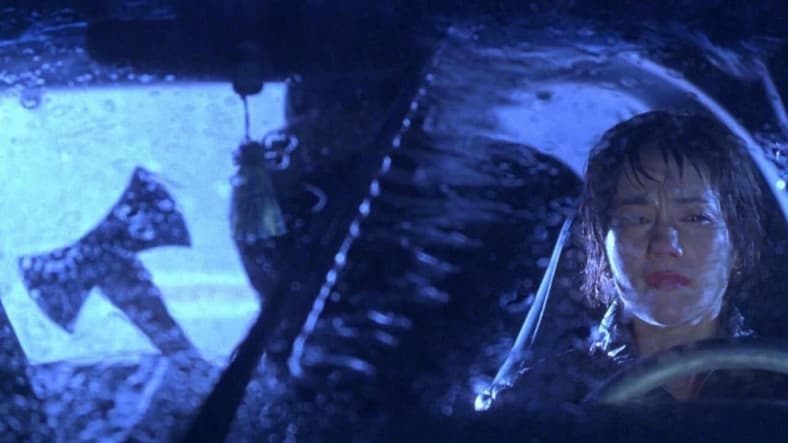
Like Scream’s use of Drew Barrymore, Urban Legend opens with Michelle (played by popular actress at the time, Natasha Gregson Wagner), driving through a treacherous storm before stopping at a gas station. There, she encounters a creepy, stuttering attendant played by Brad Dourif (the voice of Child’s Play’s Chucky). Believing she’s under attack, Natasha drives off as Dourif shouts, “There’s someone in the back seat!” In tears and singing an off-key version of ‘Total Eclipse of the Heart”, the poor woman’s neck meets the blade of an ax held by the killer sitting behind her. This is why you always listen to the Harbinger. Slasher movie 101, Natasha.
Shot with Hitchcockian flair and recalling Psycho’s surprise killing of Janet Leigh’s character, the shocking opening scene sets the stage for a film that is full of surprises. And though many 90s babies would credit the moment for causing them to check the backseat each time they enter their vehicle, it’s far from the first time a killer lurked just behind the driver. Michael Myers did the same in Halloween when he picked off Annie. Dead of Winter also features a woman killed off by a backseat murderer amidst the cold howling of a winter storm. The point being that Urban Legend didn’t create the idea of the world’s worst backseat driver. It pays homage to a concept that had filtered through horror stories for decades. Blanks’ film establishes that the following ninety minutes are a reflection of the fears that percolate through society because of scary stories.
A great example of this can be seen when Dean Adams (John Neville) checks his own backseat before getting in. Not once, but twice. Unfortunately for him, he should’ve peeked under the car, instead. It’s a point-blank display of how some stories are so frightening that they follow us wherever we go. We check the backseat of our cars. We get nervous when in the shower, expecting Norman Bates to pull back the curtain at any second. Some of us even double check the toilet bowl, afraid there might be a ghoulie down there. Fictional stories that become real life fears, treated as if they could be true, despite knowing they aren’t. Actually, I’m not sure about the ghoulie thing. You do never know what horror you might find at the bottom of a porcelain throne.

A Culture of Fear
One vital scene involves Robert Englund (Freddy Krueger himself) as Professor Wexler and eventual red herring discussing various urban legends. The most well-known being the tale of the babysitter receiving phone calls from a killer inside the house. When a Stranger Calls (1979) was itself based on that legend. Everyone believed it had happened somewhere near them. Audiences at the time were familiar with the story, but for me, Fred Walton’s film was my introduction to it. Those terrifying first twenty minutes or so became my basis for fears of phone calls. Scream would re-establish that fear for a whole new audience in the mid-90s. The actual urban legend may have existed long before, but When a Stranger Calls was my legend, just as Scream became one for those after me.
Wexler also muses on urban legends as folklore that we use as a gauge for cultural beliefs and morality. A true urban legend may be stories that are believed to be true, but don’t horror films do the same? Early slashers like Friday the 13th taught us that if you do drugs and have premarital sex, you’ll die. Bullshit, obviously, but a moral lesson society pushed on teens, anyway.
Though we may know most horror films aren’t true stories, some, as mentioned above, make us believe they are. The Blair Witch Project had us all convinced it was real in 1999, a “found” film passed from person to person on unlabeled tapes. The original Faces of Death did the same, combining real footage with effective gore makeup to convince viewers that they were seeing actual snuff films. Be honest, can you say “Candyman” in a mirror five times without feeling a little fear (or excitement, I don’t judge), at the prospect of a hook-handed Tony Todd suddenly appearing?

Legends on Legends on Legends
Speaking of Mr. Todd (I miss him so bad), Urban Legend also seeks to pay tribute to modern horror icons by casting faces representative of some of our scariest stories. There are Brad Dourif and Robert Englund, representing Child’s Play and A Nightmare on Elm Street, respectively. Danielle Harris as Natalie’s roommate, Tosh, an actress who rose to fame as Laurie’s daughter in Halloween 4-5. Hell, even the killer’s parka inspires thoughts of the poster for John Carpenter’s The Thing, intentional or not. All reminders of the genre’s boogeyman that have moved beyond film and into our everyday fears.
Some horror films are stories with a power that transcends the fiction they began as. We learn that Natalie has been targeted with urban legends because she and Michelle accidentally killed a man while attempting the gang high-beam initiation…a story they had heard passed around. A story that felt so real, it became so. Turns out, he was the fiancé of Natalie’s new best bud/killer, Brenda (Rebecca Gayheart). That’s one way to end a friendship.
A Legendary Slasher
It’s easy to label Urban Legend as a Scream knockoff and leave it at that. To each their own. But Blanks and Horta delivered a slasher that’s so much more. It doesn’t just pay tribute to the popular stories and horror icons that came before it. The film stands as a deep cut into our fascination with fear. These tales change our everyday lives, some of them gaining a life of their own beyond the screen. Occasionally, these stories strike a chord so deep, so terrifying, that they feel real even when we know damn well that they’re not. Right?
One last thing…have you remembered to check the backseat lately?
Categorized:Editorials News