
The 2003 ‘Texas Chainsaw Massacre’ Remake Is Better Than Tobe Hooper’s Classic

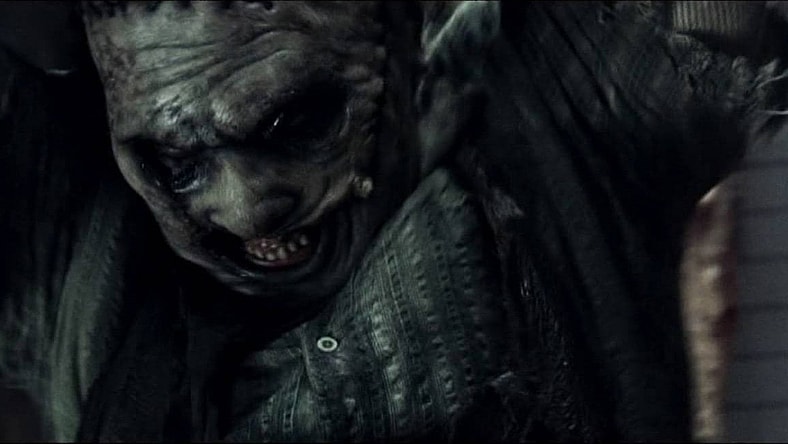
In 1974, a college professor and aspiring filmmaker named Tobe Hooper released The Texas Chain Saw Massacre, which is widely regarded as one of the greatest and most influential horror movies ever made. With a minimal budget, Hooper relentlessly builds tension from the first frame and masterfully uses his cast, props, and locations to create a gritty, claustrophobic atmosphere. Most impressively of all, he does it with almost no blood and gore effects.
For these reasons, that movie is rightly deemed a classic. Yet the 2003 remake, which bears its name, is better.
Exactly seven minutes into The Texas Chainsaw Massacre (2003), audiences are treated to a character vignette that both sets the entire story in motion and serves as a self-contained cautionary tale. If you watch it and forget it, you either have no soul or have suffered brain damage.
The year is 1973, and the setting, of course, is Texas. Five young adults are riding in a weed-filled van to a Lynyrd Skynyrd concert when they stop to pick up a hitchhiker. Thus we meet our five heroes — reformed delinquent Erin Hardesty (Jessica Biel), her younger brother Morgan (Jonathan Tucker), her boyfriend Kemper Sterling (Eric Balfour), her friend Andy Partain (Mike Vogel) and his girlfriend Pepper Harrington (Erica Leerhsen) — and see them react with a mixture of kindness, fear and self-aware amusement to their predicament. The unnamed hitchhiker (Lauren German) babbles incoherently, weeps alarmingly, and gives every sign of being mentally ill, on drugs, or suffering an infection. Our protagonists try to figure out what to do.
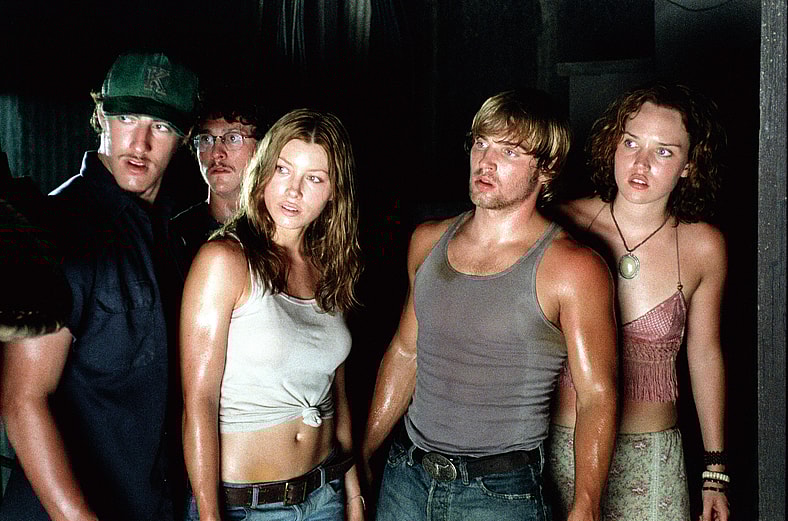
Before they have much chance to decide, though, the hitchhiker does so for them. First, she lunges for the wheel, forcing Kemper to pull over. Then she reaches between her bloody legs and retrieves a gun. “You’re all gonna die,” she moans ominously, raising the specter that, like the dangerous hitchhikers of urban legend (and true crime), she will slay the main character.
But instead, before any of them can react, she sticks the gun in her mouth and blows off half her head.
Thus, we have our movie. As someone who was 18 in the fall of 2003, when it was in theaters, I remember it being everywhere.
Grossing more than $107 million on a $9.5 million budget and being raucously watched by millennial youths as their elders (critics) sneered in disdain, The Texas Chainsaw Massacre takes the basic premise of the original and warps it into something even more depraved and sinister. Like its 1974 namesake, the main characters in this version wander around a rural Texas community, albeit here to dispose of an unexpected corpse. Just like the first one, on this occasion they are attacked by a vicious family of depraved rednecks, with the most memorable being a chainsaw-wielding, human face-wearing madman nicknamed “Leatherface.”
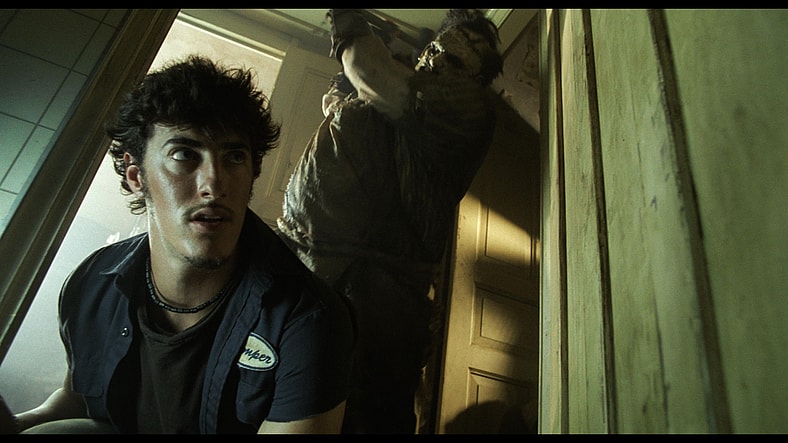
Yet this is where the similarities end. Frankly, that’s to the remake’s advantage. First, every villain in this one surpasses their 1974 counterparts. I will not single out any of those actors for opprobrium because they worked under Hooper’s allegedly authoritarian thumb, but suffice to say their performances often veered more in the direction of “mug for the camera” and “shriek and laugh like a maniac” rather than “dig into this person’s soul.” I certainly wouldn’t want to meet the villains from either film, but I doubt there is anyone like those inbred yokel caricatures from the 1974 iteration in our three-dimensional world.
The five standouts here are Thomas Hewitt/Leatherface (Andrew Bryniarski), Sheriff Winston Hoyt / Charlie Hewitt Jr. (R. Lee Ermey), Luda Mae Hewitt (Marietta Marich), Henrietta Hewitt (Heather Kafka), and the Tea Lady (Kathy Lamkin). Other ghoulish individuals scamper around in the background, but these are the standouts. Even before we learned his backstory in the 2006 prequel (which I reviewed here), Bryniarski’s Leatherface is easily more savage than the original. This Leatherface is more beast than man, a barreling, hulking 6-and-a-half-foot mass of pure muscle and malice. In the first film, he seemed like an inbred but innocent man saddled with a disability and sick obsessions. Here, he seems like a wounded kid who (again, because of disabilities) grew up while being mistreated and therefore has a massive chip on his shoulder.
It is a testament to Bryniarski’s performance that an intuitive audience member can sense this backstory, even though it isn’t officially revealed until the prequel. Yet the deduction isn’t Sherlock Holmesian in this case. One need only observe Bryniarski’s body language as he brutalizes humans as if they were livestock… or look at the environment where he grew up. As a temperamental, mean-spirited old-country sheriff, Hoyt’s initially odd behavior is written off by our comparatively urbane characters as harmless bumpkin quirks. This gives Hoyt an edge, and Ermey uses it to slowly but surely slash the characters in his clutches into ribbons — figuratively, but only barely.
Ermey’s sadistic mind games are as much a high point of the film as Bryniarski’s more traditional horror movie brutality. He is a character straight out of a nightmare, a maniac with pretensions of grandeur who we can tell does not wield his badge with integrity long before our protagonists do (in their defense, the plot leaves them with few other options.) Imagine if Ermey’s Gunnery Sergeant L. Hartman in the 1987 Vietnam War drama Full Metal Jacket berated and bossed you around, not because he was a drill sergeant or officer trying to help you, but because he was a genuine, cruel monster.
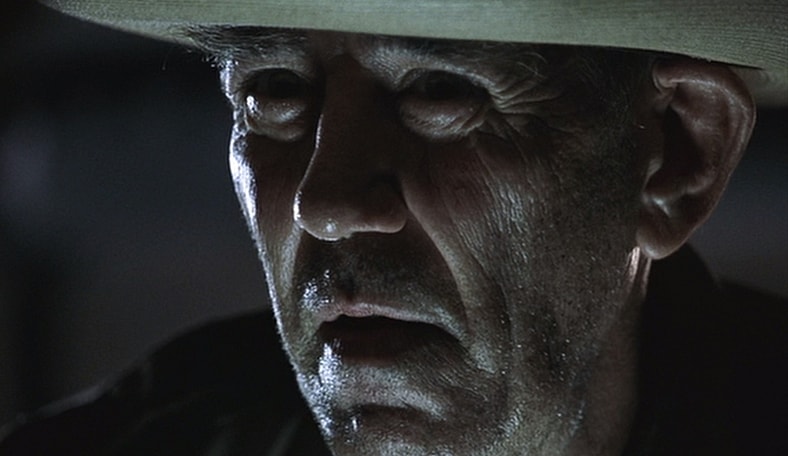
That’s Ermey’s in this film, and he is supported in spades by his two chief female costars. Lamkin, who is otherwise best known for a memorable cameo in another gloomy Texas film (the 2007 Oscar-winning classic No Country for Old Men), is fantastic at seeming nurturing and reassuring in one shot, then menacing in another. Marietta Marich as Luda Mae Hewitt adds a welcome matriarchal presence to a family dynamic that was a downright sausage factory in the original. She seems part-mom, part-wife to Sheriff Hoyt, and views his murdering and other crimes as colorful indulgences rather than true evil.
Even the physical locations feel like characters in this movie. The decrepit yet ornate and spacious mansion, the gas station hawking rotten meats, the rust-and-grime-covered mill, the slaughterhouse not even nightmares could conceive. If this The Texas Chainsaw Massacre had been the original movie to bear that name, I am convinced it would have grossed $107 million in 2003 just as easily as it did without the brand’s potent legacy. It is a nihilistic, overly emotional, grimy, gritty, and grungy horror folk tale that perfectly fits the zeitgeist of its decade, despite being set in and inspired by one 30 years earlier.
This isn’t to say that I don’t love the first one. Indeed, I think it is overlooked as a pro-animal rights masterpiece. As I wrote for Salon in 2017, “This movie is about vegetarianism. In fact, its vegetarian themes are so obvious that it’s hard to believe people took so long to pick up on this. Even if you didn’t have director/co-writer Tobe Hooper outright saying that the movie is ‘about meat,’ think of the first act monologue in which one character graphically describes how animals are slaughtered. Throughout the rest of the movie, the major characters are killed in ways that are reminiscent of slaughterhouses (hammer to the head, meat hooks). And, of course, the fate of the murdered characters is to be cannibalistically devoured.”
In short, I’m not writing this to hate on the original movie. It’s simply that, while that film is undeniably influential and intelligent, in my mind, it does not work quite as well as a holistic horror experience. That honor belongs primarily to its 2003 remake.
Categorized:Editorials