
A New Kind of Werewolf: Why ‘The Howling’ Has the Scariest Transformation Scene

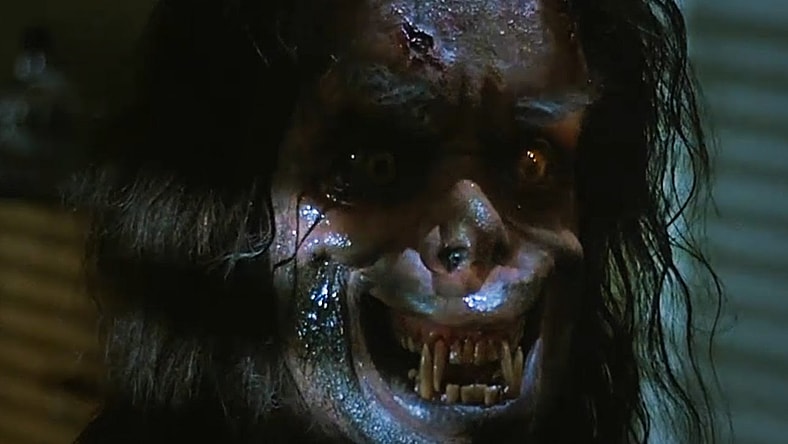
If you’re a massive fan of werewolves like I am, then I’d guess 1981 is one of your favorite years in film history. There was something wolf-y in the air, as that year gave us a full moon’s worth of werewolf movies featuring all types. You had the classic wolf man look of Larry Cohen’s Full Moon High. Your average-looking (albeit supernatural) wolves of Wolfen. The four-legged monster wolf of An American Werewolf in London. And my personal favorite, the bipedal creatures of The Howling. The latter two are still considered by many as the top tier of the sub-genre. Fans have been at each other’s throats for over four decades now in the debate over which is “better”.
I’m not here to answer that. Both are superb. For me, it’s like asking which one of my dogs is better. They are each perfect, little fur baby angels. That said, in honor of The Howling’s 45th anniversary, I am here to puff my hairy chest and tell you why I prefer that film’s transformation scene over the consensus pick, An American Werewolf in London.
As most werewolf movie fans would agree, a proper transformation scene is the key to success. It’s the highlight of the film. The grand guignol. The money maker. Blow it, and audiences will be howling about it for years. I still can’t believe An American Werewolf in Paris went with full CG. Talk about falling off a cliff for that particular franchise. No amount of time can heal that one.
1981 set the bar for what we’d consider the modern werewolf movie. Practical effects had just begun to reach new heights, sparking the ’80s golden era for monster makers. Gone were the days of the time-lapse dissolves and clever edits that allowed Lon Chaney Jr. to transform into the Wolf Man. Filmmakers sought to elevate the terror of their monsters with revolutionary techniques that would stun audiences. Both An American Werewolf in London and The Howling reached for the moon in that regard. Neither has ever been matched, as far as I’m concerned.
An American Werewolf Horror Story
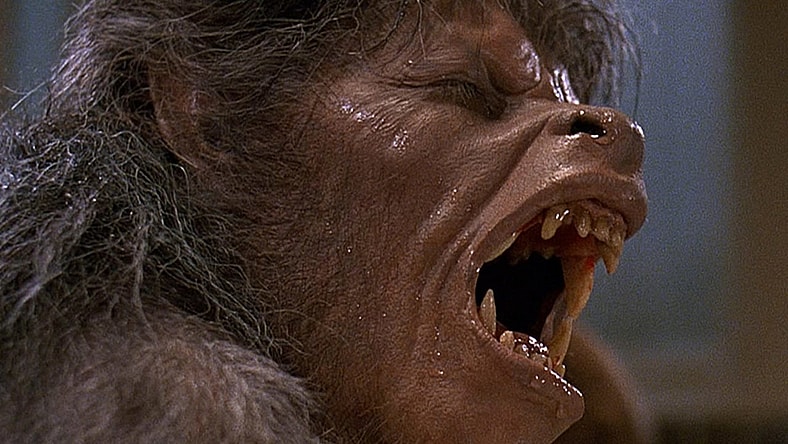
On a technical level, Rick Baker’s work featured in An American Werewolf in London earns the crown of “most impressive”.
For his first foray into horror, writer/director John Landis’ tale sought to update Universal’s Wolf Man for the modern world. A Jewish man born in Germany, writer Curt Siodmak’s 1941 tale was heavily inspired by the demonization of Jews. Lon Chaney Jr.’s character is forced to suffer with the idea that society sees him as nothing but a monster. He’s branded by the pentagram, a reference to the Star of David that Jews were forced to wear during Nazi Germany.
For An American Werewolf in London, Landis incorporated Siodmak’s ideas, this time with a focus on the survivor’s guilt felt by Jewish men and women still experiencing the pain that the Nazis had inflicted. Main character David (David Naughton), a Jewish man, witnesses the death of his best friend, Jack (Griffin Dunne), at the claws of a werewolf. David survives, but not without receiving a savage bite from the beast. Throughout the film, Jack shows up repeatedly, a ghostly corpse slowly rotting, and a constant reminder of the guilt David feels. Once he realizes what he is, the poor man contemplates suicide before an inevitable and tragic ending.
The transformation scene in An American Werewolf in London acts as a reflection of David’s internal pain. He starts burning up. He screams how sorry he is. And he begins an agonizing change. Bones pop. Skin stretches. Hair sprouts in tufts. Baker’s ingenuity is on full display. Why so many consider it the greatest werewolf transformation of all time is because, not only are the effects jaw-dropping, but it’s all shot under heavy fluorescents. That’s something you rarely see, especially back in those days. Effects designers tend to have their creations shot in shadowy lighting to hide the imperfections. Not Baker. Every inch of his werewolf is put under a microscope, and it is indeed perfect.
A Werewolf Film for a Modern Audience
The Howling’s approach could not be more different.
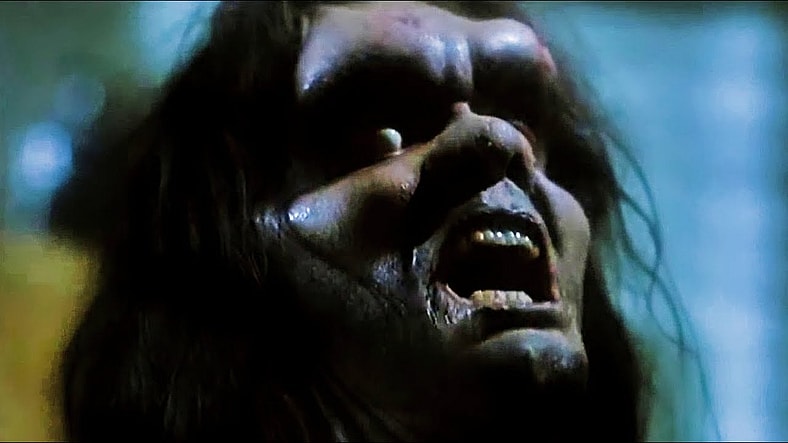
Adapted for the screen by John Sayles and based on the inferior novel by Gary Brandner, Joe Dante’s The Howling arrived with a howl unlike any werewolf film before it. The story centers on Karen (horror’s anointed mom, Dee Wallace), a reporter tracking a man named Eddie (Robert Picardo), who she believes is responsible for gruesome killings around Los Angeles. After he attacks her in the booth of a porn shop, Karen loses her memory. She has vague images of Eddie turning into something terrible but recalls only shadows. Her therapist, Dr. George Waggner (Patrick Macnee), sends her to a retreat, where he believes she’ll find help. Turns out, there are werewolves prowling the wilderness commune, and they have their eyes set on Karen.
For The Howling, Dante and Sayles decided to throw out Brandner’s novel and start from scratch (by far the correct choice). They sought to deliver a werewolf film not just for the modern day, but unlike anything that had come before it. As a result, they transformed the sub-genre entirely.
Dante’s werewolf picture feels like the eerie, mist-covered gothic horror films of old, but with an almost cartoonish, alien quality that makes the creatures seem as if they stepped right out of a dream world. In an archival interview found on Scream Factory’s release of the movie, Dante states, “Horror films, I think, are much more effective when they take place in a sort of dream world”. I couldn’t agree more, which is why this one remains my favorite full moon terror.
The filmmaker also adds, “You have to appeal to deep-seated fears,” another element that The Howling expertly tears into. Dante’s film delves heavily into psychology, exploring ideas of the Id unleashed, as well as the attack on Karen as a metaphor for rape, and the trauma she suffers from afterward. In the book, Eddie is no more than a despicable rapist and Karen his victim, so there’s one of many reasons I prefer the changes made.
I thought we were here to talk about the transformation scene, you may be asking, but trust me, this all plays into why it’s so effective.
The First Ever In-Camera Werewolf Transformation
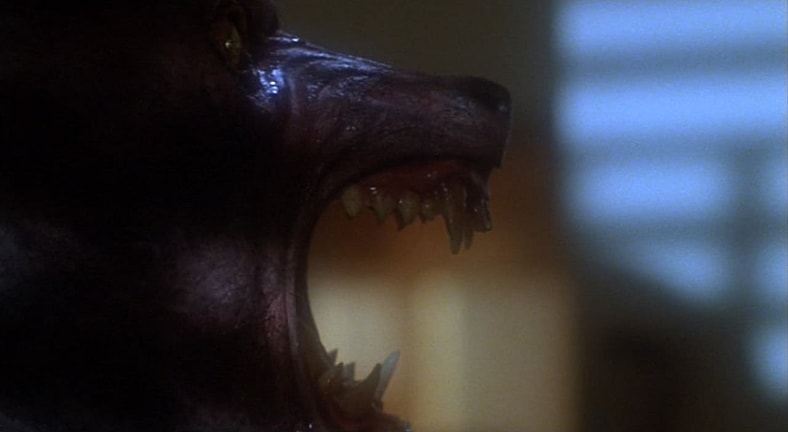
In a fascinating twist, Rick Baker was originally hired to create the werewolf for The Howling, but he left to take another job…none other than Universal’s An American Werewolf in London. So, he assigned the task to his protégé/assistant, Rob Bottin (The Thing). That was a big deal for Bottin, as AVCO Embassy’s entire purpose in green-lighting the picture was to unleash the first-ever in-camera werewolf transformation. Not only did Bottin deliver, but The Howling beat American Werewolf to theaters by at least four months.
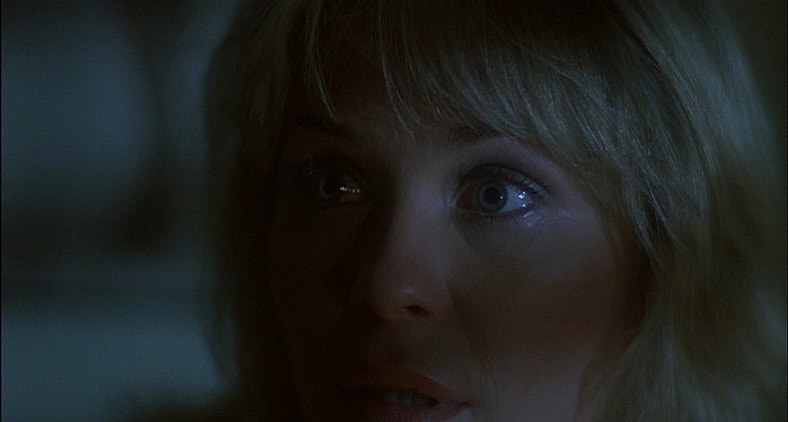
In the scene, Karen arrives in an office, where she discovers the mutilated body of her best friend, Terry (Belinda Balaski), lying on a gurney. Heartbroken, Karen lays a sheet over her loved one. Brilliant composer Pino Donaggio’s (Carrie) forlorn score rises, punctuated by the cacophony of howls erupting outside. As Karen steps back, Eddie suddenly leaps from beneath the sheet she laid over Terry, very much alive despite having been shot to death in the film’s opening. And boy, does he look dead. Skin pale. Eyes monstrous. The flesh of an ugly bullet wound on his forehead spread out like a grotesque, blooming flower. He confronts Karen with his male stalker bullshit, claiming he trusted her, she betrayed him, blah blah blah, before offering to give her “a piece of my mind”. Eddie means it literally, digging the bullet out of his brain.
And then the transformation begins.
Primal Terror Made Flesh
Unlike David’s painful change in An American Werewolf, Eddie relishes in his. To become a werewolf in the universe of The Howling is to release all inhibitions. Take on the purest form of your primal self. That’s what makes the scene—and the werewolves themselves—so much scarier. Because, for a person like Eddie—a misogynistic rapist and killer of women—the beast merely represents his inner monster made flesh.
Some audiences may laugh at Karen standing there like a deer in headlights for the entire three minutes of the transformation—nearly a full minute longer than An American Werewolf’s, I might add—or scream for her to run, but can you really blame her? She isn’t just witnessing someone changing into a howling creature. That would be terrifying enough on its own. No, she’s watching the undead corpse of her abuser shed the false appearance of a normal man for the ravenous monster that he really is. Eddie’s werewolf takes on the physical form of her greatest trauma, the fear that has destroyed her life, that no one seems to understand, and that no one would ever believe. All of which plays into the fact that so many women go unheard in similar situations.
Of course, she’s terrified. Of course, she can’t move. Can any of us truly say we’d react differently?
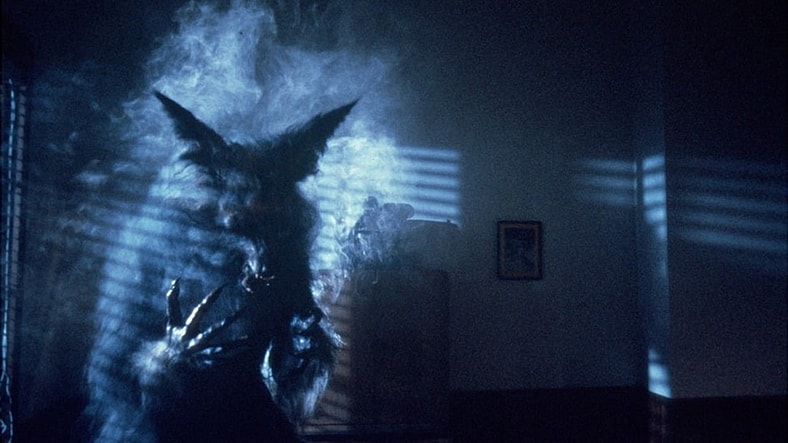
Achieved through new techniques involving mechanics and bladder effects—aka, condoms that were glued to poor Picardo’s face—Eddie’s change features all the cracks, pops, and groans you’d expect. Usually, these scenes are unpleasant for the werewolf, a “curse”. Eddie instead relishes in the expression of his ferocious power. One of many unique updates that The Howling makes on the lore.
Heightening the eeriness of it all, Donaggio’s score here takes on a sci-fi tone, incorporating the sorts of sounds you’d hear in a ’50s picture like The Thing from Another World. Forget the gothic moors of old. The Howling depicts a world where the werewolves are in your backyard. Like Invasion of the Body Snatchers, we don’t know who they are, no mark to identify them. The terror of them looms over us, as do they, standing at over seven feet, depicted so strangely and horrifically through Eddie’s vertically stretching skull as he looms higher over Karen. They might as well be from another world, these werewolves. But they aren’t. They’re merely the most monstrous part of each of us made whole.
The Werewolf Genre Forever Transformed
We could debate every full moon until the end of our days over which is scarier, The Howling or An American Werewolf in London. What scares us is different for everyone. But underneath The Howling’s camp, lurking within the dream world atmosphere, is the truly terrifying and real confrontation of the Id. The metaphorical horror of Eddie’s attack on Karen as a rape that breaks her down to pieces. And the uncomfortable realization that anyone around you can become a monster at any time. No full moon needed.
Forty-five years ago, Joe Dante didn’t just deliver one of the greatest transformation scenes of all time in The Howling…he unleashed a werewolf movie that transformed the sub-genre forever.
Categorized:Editorials