
‘Sinners’ Is Inferior to ‘From Dusk till Dawn’ – So Why Do Critics Like It More?’


Fleeing south after pulling off a dangerous heist, a pair of brothers believe they are safe and stop to party. Just when they start to relax (and one even seems to get lucky with a girl), the rug is pulled out from under them. No, they aren’t apprehended by law enforcement. Instead, they are attacked by bloodthirsty vampires.
Thirty years ago, in January 1996, director Robert Rodriguez and screenwriter Quentin Tarantino released a movie with that premise called From Dusk till Dawn. It received lukewarm reviews from critics, only two-thirds of whom liked it according to Rotten Tomatoes. Most praised it for convincingly pulling off an unexpected genre pivot (from crime thriller to gory horror), but otherwise denounced it as exploitative schlock. Notably, Desson Howe of The Washington Post called it “gratuitously nasty” while Owen Gleiberman of Entertainment Weekly complained that “as the ghoulies kept popping up, one after another, like exhibits in a demented Disney World ride, any dramatic stake I had in From Dusk till Dawn quickly fell away.”
The Mystery Behind Sinners: Why do We Overlook Its Similarities to From Dusk till Dawn?
Where Rodriguez and Tarantino failed to win over critics, however, their spiritual successor Ryan Coogler succeeded. Coogler’s film has received near-universal acclaim from critics — and a record 16 nominations at the upcoming Academy Awards. Therefore, even though both movies were box-office successes, only Sinners earns the distinction of also being a runaway critical success.

In an ideal world, the explanation for this difference between From Dusk till Dawn and Sinners would be as simple as the latter being superior to the former. Yet this is simply not the case. From Dusk till Dawn beats Sinners in virtually every meaningful qualitative metric: it has better special effects, higher-grade action sequences, deeper characters, smarter dialogue, and a more original hook (relative to its era) than Sinners. None of this is meant to diminish Sinners, which is a fitting tribute to From Dusk till Dawn while including its own creative twists. Examining why Sinners has landed better with the elite opinion-shapers than From Dusk till Dawn, though, illuminates why the horror genre may have a more hopeful future.
My Sinners-Related Promise to My Late Friend, the Comedian Nate Marks
Before I proceed with my analysis of Sinners, I must doff my figurative hat to my late friend, the comedian Nate Marks, who unexpectedly died last year. For years, we would meet up whenever possible for a movie double feature — he’d pick one flick, then I would — and we would break them down together. The last time I saw Nate in person, as we prepared to see the recent Toxic Avenger remake in a historic movie theater, he observed that Sinners was in his mind an inferior copy of From Dusk till Dawn. Jokingly, he suggested that I — his professional film critic friend — compare the two films and offer a totally honest breakdown of the two.
He added, though, that he realized I might find the request deeply insulting, since any self-respecting critic knows that honesty is strictly reserved for private conversations and deathbed confessions. Little did I know this conversation was occurring the last time I’d see Nate — a man I viewed like the big brother I never had — in person.

For those unfamiliar with the two films, From Dusk till Dawn stars George Clooney and Tarantino as brothers Seth and Richie Gecko, while Sinners stars Michael B. Jordan as identical twins Elijah “Smoke” and Elias “Stack” Moore. The Gecko brothers live in 1996 and flee Abilene for a raunchy bar across the border in Mexico, while the Moore brothers live in 1932 and flee Chicago for their hometown of Clarksdale, Mississippi. Between the two, the Gecko brothers are more sociopathic and cruel; Richie rapes without remorse and psychotically hallucinates, while Seth unapologetically holds innocent men, women, and children as hostages with murderous threats. The Moore brothers, by contrast, are closer to antiheroes than villains when we meet them. They try to mentor and support people in their community, and show genuine affection for their respective romantic interests.
Thus, we have the first reason why Sinners has been easier for critics to digest. Its protagonists, instead of being hard-bitten criminals who might challenge audiences intellectually and ethically, are traditional hero archetypes with only a few mild (and forgivable) criminal edges. When they fight vampires to survive, we identify with and root for them… but aren’t ever confronted, as we are in From Dusk till Dawn, with the uncomfortable juxtaposition between real-life criminal violence and the depraved supernatural type thankfully limited to the world of fiction.

In this understanding of basic psychology, we can further illuminate why Sinners is more welcome in the 2020s than From Dusk till Dawn was in the 1990s. On a fundamental level, the critical ecosystem around horror has changed. Critically well-regarded publications like Dread Central, Bloody Disgusting, Fangoria, and Nightmare Magazine all elevate the horror genre’s reputation, treating it not as disposable entertainment but as a serious artistic and political mode worthy of sustained analysis.
They started receiving greater popular recognition shortly after From Dusk till Dawn was released in 1996. This shift was further reinforced by the critical success of The Shape of Water, a 2017 horror film directed by Guillermo del Toro and co-written by him and Vanessa Taylor that remade the 1954 horror film Creature from the Black Lagoon (directed by Jack Arnold and co-written by Harry Essex and Arthur Ross) as a romance. It went on to win Best Picture and three other awards at the 2018 Oscars, and its triumph signaled that horror and horror-adjacent storytelling were no longer marginal but fully legitimate in the eyes of mainstream cultural gatekeepers, making critics far more receptive to films like Sinners.
We can also look at more recent horror movies to see why critics were primed to recognize Sinners. The other standout horror flick of 2025, director/writer Zach Cregger’s Weapons, is notable for containing similarly subtle yet inescapable political analysis. When I interviewed Cregger about his attitude toward modern politics in 2020, his comments could have been viewed as foreshadowing the profound cynicism imbued in every frame of Weapons.
“Now the person is on life support and at death’s door. It’s just not funny anymore,” Cregger said at the time, comparing America to an ill patient whose condition cannot be mocked (Cregger was once a comedian). “Everything is ruined. You could kind of hint at it and poke fun at it because society was kind of sick this way, but now we’re f***ed.”
The Politics Behind Sinners… and Why They Matter.
Relatedly, the increased receptivity to Sinners has everything to do with politics and timing. Sinners has a political message about fighting racism that resonates perfectly in the age of President Trump, when explicit confrontations with white supremacy, systemic injustice, and reactionary violence feel both urgent and unavoidable. When the Moore brothers fight white supremacy in the Jim Crow South, it is easy to see their analogues in the people of color who struggle against resurgent systemic and institutionalized racism in MAGA America. Much as Coogler saw the political subtext in the superhero genre in the first Black Panther movie in 2018, he intuitively sees the ways in which From Dusk till Dawn can be about something much, much more profound than fighting vampires and surviving criminals. For this, he deserves full credit as an artist.
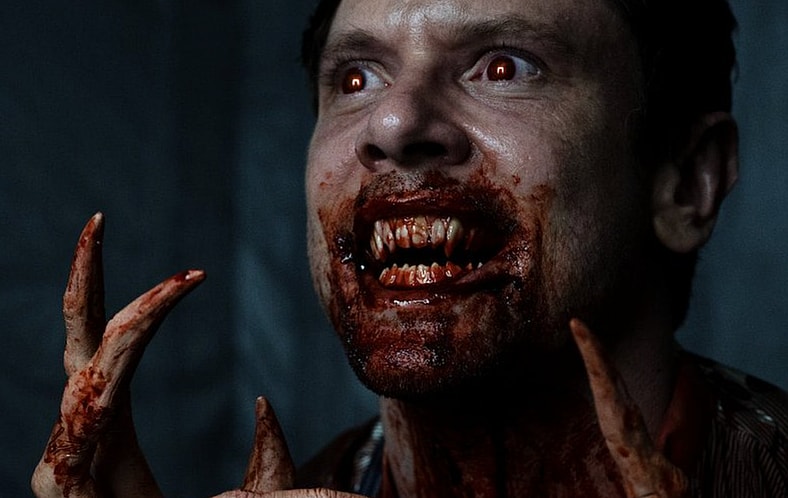
By contrast, From Dusk till Dawn’s message about the porous boundaries between human and inhuman depravity was too subtle and, in its depiction of graphic violence (far more explicit than anything in Sinners), too controversial during President Clinton’s comparatively placid 1990s. In an era that preferred irony and genre hybridity over overt moral confrontation, its ideas were easier to miss or dismiss.
Just because From Dusk till Dawn’s message did not fit as neatly within the zeitgeist of 1996 as Sinners‘ message did in 2025, though, does not mean the former was less thoughtful or less worthy than the latter. Quite the opposite, in fact. Because From Dusk till Dawn is more ambiguous and more nuanced, it prompts more reflection than the cathartic-but-tidy resolution that wraps up Sinners.
This is not the only way in which From Dusk till Dawn outshines Sinners. It has more pleasing and believable special effects, easily mixing CGI with practical methods like makeup and props, and steering clear of the fake-looking and ethically-challenged AI that suffuses Sinners. While Coogler’s writing is tightly wound and engaging, it falls short of the delirious pacing and snappy dialogue that Tarantino deftly brings to the From Dusk till Dawn script. Likewise, the characters in From Dusk till Dawn contain little individual idiosyncrasies and layers that give them an extra degree of verisimilitude beyond what exists in Sinners. Even the action set pieces hold up better from 30 years ago than those from Sinners released just last year. Rodriguez has a visually creative versatility that, alternatively arresting, disgusting, horrifying, and humorous, shows a more innovative command of the action genre than Coogler’s more traditional approach to fight choreography.
The Sequels
From Dusk till Dawn also creates such a rich world that — whereas Sinners feels like an Oscar-tailored piece of “cinema” that will sequelize only to its own diminishment — the spinoffs to From Dusk till Dawn were both inevitable and delightful. First, in 1999, we had Scott Spiegel’s (with co-writer Duane Whitaker’s) From Dusk till Dawn 2: Texas Blood Money, which, despite getting shellacked by critics, is a romping good B-quality Western horror led by actors Robert Patrick, Bo Hopkins, and Whitaker.
It was also followed in 1999 by the prequel From Dusk till Dawn 3: The Hangman’s Daughter, directed by P. J. Pesce and written by Álvaro Rodriguez and Robert Rodriguez, which beautifully fleshes out (pun intended) the Mexican backstory behind this universe. There was even a 30-episode “From Dusk till Dawn” TV series from 2014 to 2016 (premiering on the aptly-named network El Rey) which with great zest reimagined the premise of the 1996 movie by allowing Seth and Richie to develop a more complicated relationship with their teenage captive Kate Fuller (played by Juliette Lewis in the movie, Madison Davenport in the series).

This is not to say that Sinners won’t create spinoffs, but merely that this would be highly ill-advised. Like The Shape of Water, Sinners feels in every frame like a self-contained story, in large part because, like its antecedent, it exists mainly as a high-brow adaptation of mass entertainment (Creature from the Black Lagoon in the former case, From Dusk till Dawn in the latter). If The Shape of Water began to sequelize, it would almost certainly seem derivative and opportunistic, and the same is true for Sinners, because both are at their core postmodern commentaries. From Dusk till Dawn, on the other hand, was something entirely new, something breathtakingly original, when it first came out.
A Final Tribute to My Late Friend, the Anti-Sinners Nate Marks
Shortly before he unexpectedly committed suicide in October, my close friend, stand-up comedian Nate Marks — with whom I shared a deep love of horror movies — commented that he resented that Sinners was lauded while From Dusk till Dawn continues to receive the critical cold shoulder. I suspect he would have been apoplectic at Sinners being set up to make history as the third horror movie to win the Best Picture Oscar (joined by The Shape of Water and the 1991 crime thriller directed by Jonathan Demme and adapted by Ted Tally off a Thomas Harris novel, The Silence of the Lambs). While I enjoyed Sinners, and he was deeply disappointed by it, I share his frustration with the critical responses.
Even so, if Nate were alive, I’d argue to him that the success of Sinners is ultimately a salutary development. I’d even let him know of my willingness to proudly put that declaration in print.
The critical and box office triumph of Sinners sends a clear and overdue message to Hollywood: horror films that are thoughtful, politically engaged, and aesthetically ambitious can succeed with both audiences and awards bodies. For decades, studios treated horror as either a low-budget cash grab or an awards-season liability, rarely investing in prestige-level talent or production values unless the genre elements were heavily disguised. Sinners disrupts that logic in ways that The Silence of the Lambs and The Shape of Water never could. Its financial success proves that audiences are hungry for horror that respects their intelligence (even if it doesn’t quite make them feel as ethically uncomfortable as the first From Dusk till Dawn did), while its critical acclaim demonstrates that genre filmmaking no longer precludes cultural legitimacy.
This combination of profitability and prestige is precisely what studio executives respond to. When that happens, future movies like From Dusk till Dawn won’t have to wait three decades to be treated like the critical darlings they ought to be from Day One.

Categorized:Editorials