
‘Surveillance’ Is a Slick and Twisted Exploitation Throwback [The Overlooked Motel]

Welcome to The Overlooked Motel, a place where under-seen and unappreciated films get their moment in the spotlight. I hope you enjoy your stay here and find the accommodations suitable. Now, please take a seat and make yourself comfortable. I have some misbehaving guests to ‘correct.’
Today on The Overlooked Motel, we are reflecting on Surveillance, a criminally underrated cinematic offering co-written and directed by the great Jennifer Lynch. The flick takes ample inspiration from the exploitation output of yesteryear and melds that with crime thriller tropes and horror elements. The end result is a winding and unpredictable affair that touches on themes of corruption, abuse of power, and trauma. Surveillance benefits from a smart screenplay that reveals just the right amount of information and a non-linear timeline that gradually reveals a rampant undercurrent of deception.
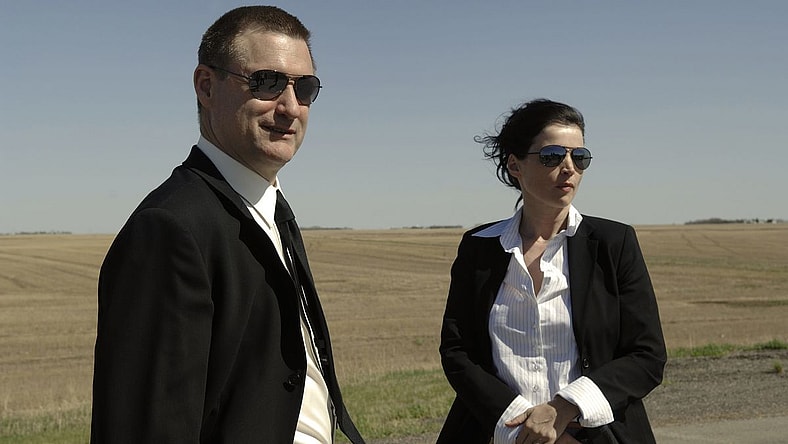
The film establishes its unflinching tone immediately, opening on a violent crime in progress, effectively setting the stage for the unsettling events and rampant bloodshed still to come. Immediately after, we catch up with FBI Agents Anderson (Julia Ormond) and Hallaway (Bill Pullman) as they descend upon a small town police station in Nebraska. The pair has designs on uncovering the details behind a series of violent crimes, including a grisly roadside massacre and the disappearance of a young woman.
The agents interview three different survivors of the massacre, including Stephanie (Ryan Simpkins), a young girl orphaned at the scene, Bennett (Kent Harper), a local cop who was there when the bloodshed transpired, and Bobbi (Pell James), a drug-addicted woman who lost her partner in the violent ordeal. As the pair of law enforcement officers digs deeper into the violent and tragic turn of events, the less sense it makes. We gradually learn that nearly everyone involved is hiding something. Finding where the truth lies will surely be easier said than done.
Read Also: ‘The Gift’ Is the Best Sam Raimi Film You’ve Never Seen
The narrative in Surveillance is winding, unpredictable, and intense thanks to a strong script by Lynch and co-writer Kent Harper. A nonlinear storyline and a cast of characters, each with their fair share of secrets, ensure the viewer will likely spend much of the film just trying to get a read on each of the key players. What motivates them, and what are they hiding? Lynch assembles the footage so as to give us a number of contextual clues that offer us the chance to piece the puzzle together, but with so much happening and so many different perspectives, that’s no easy feat. The first time I watched the film, I was flabbergasted by the way everything shook out. I love a well-crafted twist, and Surveillance contains several of them.
With that in mind, this is a picture that you might want to watch more than once. Everything is so nebulous on a first-time viewing that it’s nearly impossible to piece together all of the seemingly innocuous clues you might have missed the first time around. On my second viewing of Surveillance, I was floored by how differently the first two acts sat with me. Knowing the twists in store, I was able to see exchanges that I previously didn’t read much into in an entirely different light. You’ll know exactly what I mean upon a repeat visit to this chilling crime thriller.
Also Read: ‘Emily the Criminal’: Aubrey Plaza Stars In This Underrated Crime Thriller About A Broken System [The Overlooked Motel]
Along the way to a series of shocking reveals, we see the film’s core themes examined with thought-provoking nuance. The picture tackles abuse of power, corruption, and the lasting impacts of trauma on the human psyche. On the way to the decidedly unnerving dénouement, Lynch explores the various ways in which corruption and overreach destroy lives, along with an insightful look at unprocessed trauma turning vulnerable people into monsters. That piece points to the way that abuse is often cyclical, and reminds us that perpetuating the cycle robs us of the chance to heal. Additionally profound is the way the narrative posits that those we rely on to keep us safe are often the most likely to hurt us. That might be a parent or guardian, or even law enforcement. My takeaway from that is that trauma simply hits harder when it’s also wrapped in betrayal.
The picture unpacks a lot of heavy themes and does so in an appealing package. Lynch invokes stylistic flourishes and character traits popular in the exploitation output of the ‘70s and ‘80s, including that of the debonair, fast-talking criminal. I won’t go too deeply into that piece, because it’s not always abundantly clear who is the hero and who is the villain. However, you’ll see what I mean when you experience this one for yourself.
See Also: ‘Deathtrap’ Perfectly Balances Camp and the Macabre [The Overlooked Motel]
Lynch assembles a great cast here, with almost every character adding something meaningful to the collective whole. However, none is more effective than Pullman as Agent Hallaway. We see two very different sides to his character as the actor taps into his boundless versatility. The scene where he lights up a cigarette in the police station really blows my mind. He delivers a nuanced turn by way of subtle cues and slight changes in mannerisms and body language that give us meaningful insight into his psyche.

Ormond is also rather effective as Anderson. She briefly reveals a traumatic past that has shaped her worldview in the present. That revelation is delivered in an almost offhanded fashion that initially appears unimportant but gives us plenty of food for thought once everything comes into focus.
At its core, Surveillance is a thrilling affair that is rarely predictable. Beneath the surface, the film poses a series of interesting points about trauma, corruption, abuse of power, and our relationship to authority. Not to mention, this unsung offering also features dynamic performances from a talented cast, with two exceptional performers turning in scene-stealing showings that are even more enticing upon a retrospective visit.
If my musings have you game to track this twisted tale of mayhem down, you aren’t without options. At present, you can find the film available to watch on Tubi, Xumo Play, Pluto, The Roku Channel, Philo, and Fandango at Home.
That’s all for this installment of The Overlooked Motel. If you would like to chat more about under-seen and underrated films, feel free to hit me up with your thoughts on Twitter, Threads, or Instagram.
Categorized:Editorials