
It’s Alive!: AI, Shareholder Value and the Ruling Class


In a slick, posh lab deep in Silicon Valley, a monster has broken free of its constraints and is on the loose, upending nearly every industry it encounters.
The horrific potential so brilliantly conveyed in Stanley Kubrick’s 2001: A Space Odyssey is upon us. Or for those more optimistic, the tech of Star Trek: The Next Generation. But for many, the unholy birth of AI is more akin to Mary Shelley’s Frankenstein.
We know all too well from the many incarnations of that oft-told tale what invariably transpires. The misunderstood and confused monster goes on a rampage, destroying all in its path, before finally turning on its creator.
While comparisons to AI as Frankenstein’s monster unleashed upon the globe are valid and obvious, a key difference is that Dr. Victor Frankenstein worked outside of the system. He was a rogue scientist with a vision. A vision that, while delusional and dangerous, was rooted in genuine intent. This Frankenstein monster has been built by the ruling class with the sole intent of boosting shareholder value. And as long as it does so, its masters do not care how recklessly this monster flails about, destroying lives, jobs, or the planet.
Since the loss of pensions (over 84,000 since 1985), the reliance on 401 Ks has placed folks in a morally perilous position. For example, what’s good for humanity or for their neighbor may not be good for their 401 K. And guess which one wins out every time? Any improvements needed for a society to survive and thrive—may it be affordable health care or affordable housing—can’t be had, because it may ding shareholder value. We are living through the nightmare end of growth at all costs. The human toll of quarterly earnings reports no longer matters. Shareholder value is all that matters, the world be damned.
The least wealthy 50% of US households hold less than 4% of the nation’s wealth. The top 10% own 70% of all wealth in the US. and they’ve made it clear it’s not enough. We’ve entered a new Gilded Age. A modern-day feudalism has emerged, and many believe AI is the weapon to land the decisive blow that will permanently divide the royalty from the peasantry.
The world George A. Romero crafted in Land of the Dead has never been more prescient. A select few reside in their own well-guarded Fiddler’s Green, living in luxury, far removed from the struggles of the increasingly desperate people who amass outside like ravenous zombies.

AI is not attractive to the powers that be simply because it’s new tech with seemingly unlimited growth potential, but because it also promises to replace millions of employees by eliminating scores of jobs. Having to pay people a fair wage and deal with unions, benefits, and retirement funds is something the ruling class abhors. So, this satisfies their two biggest drivers: greed and cruelty. And unfortunately, the ruling class, through the media they control, also controls the people who would be the raging villagers with their pitchforks and torches in Shelley’s timeless tome.
Will we ever arrive at the point in the story where the monster turns on its creator? Even if it threatens the human race? In the United States, the ruling class will not do much, if anything, to contain this monster. Its devastation will mostly impact the lower classes, already weakened by years of Republican rule, impotent Democratic policy, and poorly educated, brainwashed citizens voting against their own interests. Compounding matters is that many of these same citizens have pledged fealty to these oligarchs and corporations. Like the grave-robbing Igor, they hope for a seat at the table or some scraps to be tossed their way. But they’ll get neither.
The government, who, on paper would be the ones to regulate AI, are so thoroughly corrupted by the money machine, and crippled by demented ideology and cowardice, that they can’t be counted on, either. So, just as Frankenstein’s monster can accidentally kill the innocent and purposefully kill the wicked and vice versa, so too can AI. However, being so much more isolated and protected than the rest of the population, what may ruin the lives of the lower class may simply be the occasional short-lived inconvenience to the upper class.
Hollywood has already been roiled by advancements in AI. It’s predicted to decimate the commercial industry over the next few years. Tyler Perry cancelled his $800 million proposed studio after seeing the initial Sora text-to-video footage. Ironically, the strike settlement of 2023 did nothing but accelerate Hollywood’s woes. The studio bosses retaliated by slashing production by 40% once they learned they could get the same viewers by dusting off and releasing old shows like Moonlighting and Suits. Now they’re slow rolling production as they wait on AI to get good enough for it to usher in the next era of filmmaking and the next era of profits.
This calls to mind the fate of the auto industry years back. When the workers were perceived as overplaying their hand, the automakers decided to escalate the rise of automation to replace them because it was easier and more profitable than dealing with the unions.
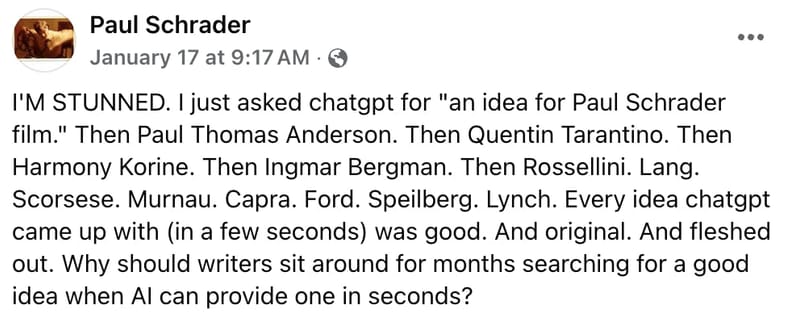
As far as AI screenwriting is concerned, Hollywood has been prepping audiences for what that could look like for years now. Those Netflix originals with their stories and dialogue blatantly cut and pasted from older, better movies are the most obvious example. There’s no doubt that AI could hastily slap together something just as good, if not better. Hell, Paul Schrader has already said as much in his now-infamous Facebook post. But those who believe AI’s arrival is the destruction of the screenwriting profession don’t know their history. The ruling class decided they didn’t want to pay writers decades ago, and AI is just the latest nail in the coffin.
The film industry is a strange bird. It openly prides itself on being ruthless and vindictive, but pleads for public sympathy whenever it faces a downturn. People have become annoyed by an industry that, in many cases, is obscenely overpaid, yet openly delights in the mistreatment of its underpaid workforce. Allowing the business to become a golden sandbox for rich kids to play in hasn’t helped matters, either. There’s also the sermonizing, the scandals, the hypocrisy…we could be here all night.
The industry has also done a horrible job of policing itself. It is riddled with con artists and incompetent, unreliable workers. The indie horror film scene is particularly guilty of this with its countless fake Kickstarter campaigns and unfinished films.
Much like Victor Frankenstein’s creation, a lot of the artwork generated by AI is an awkward patchwork of already existing images culled from other sources, often resulting in unintended results. People may laugh at the awkward phalanges of some of these images, but those laughs ring hollower with each passing month as AI breaks new ground seemingly on a daily basis. People fret over a possible Terminator 2 Skynet event, but much closer on the horizon is the ability to create your own movie. Discussions of this inevitable advancement, often couched in alarmist rhetoric, have been growing. Why? Because it’s a realistic end game for where AI is headed for the film industry.
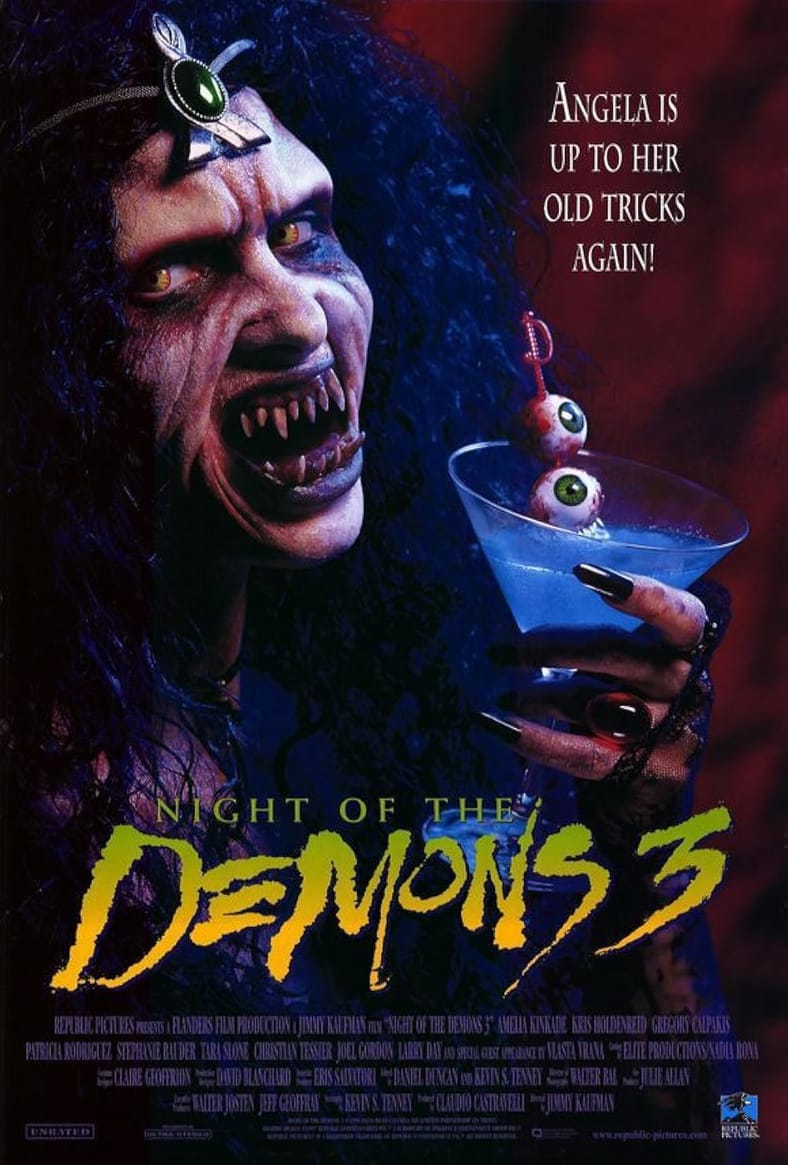
The horror genre is ripe for such evolution primarily because so many sequels to beloved franchises are written and/or directed by folks who simply have no love for those IPs. I can’t tell you how many directors and screenwriters I’ve read interviews with who say they loathed the horror movies they did and only did them for the money. Because the passion of those cynically cranking out these films often pales in comparison to the passion the fans have for them, fan fiction and fan films have exploded in recent years. Could AI fan-generated movies be the next step? Many think so. You laugh, but I promise you AI could crank out something more inspired than Witchboard 2 or Night of the Demons 3 right fucking now. And I had a Night of the Demons 3 poster proudly displayed on my bedroom door throughout my sophomore year in film school.
But who wouldn’t want to be able to create their own Friday the 13th or A Nightmare on Elm Street flick? Rather than wait on some cheap director-for-hire or nepo baby to come through with that umpteenth Candyman sequel, why not get together with some fellow horror nerds, create your own, and then have a watch party for it? Does any horror fan really think they couldn’t program something better than the last Netflix Texas Chainsaw Massacre flick? With its odd mash-up of fan fiction and elements nabbed from other prequels and reboots? I’m not saying all sequels or straight-to-streaming horror content is dreck, but the inconsistent quality has opened up a hole big enough for AI-generated horror movies to fill.
And unlike those failed choose-your-own-adventure movie prototypes that pop up every few years, this could actually stick. These movies never took off because, despite how fickle audiences may be, they like to keep their games and movies separate. And as far as games go, there’s plenty of grizzly offerings for fans to choose from. Genre fare like SOMA, Alien: Isolation, and I Have No Mouth, all boasting the latest in AI gameplay, are incredibly popular. But being able to type in some prompts and generate your own Scream sequel to watch with your friends is a whole different story.
This would not replace but would rather augment more standard forms of cinema. But most importantly to the ruling class, it would be a new revenue stream. One not reliant on a lot of bodies to run, thus exponentially increasing shareholder value. This, more than anything, is why it is being developed. If all this sounds kind of nauseating, yeah, it is.

For those in the cinematic arts who are worried about AI, you should be. The number of jobs that will become obsolete is jaw-dropping. But you’re not alone. In a recent interview, Bill Gates stated that most jobs in the medical and educational fields will not exist within a decade. The more jobs are replaced, the more shareholder value is increased for the few who have it all. Any societal safety net needed to accommodate the millions upon millions of displaced workers would cost money that the ruling class will never part with. There will not be any concerted effort to care for the jobless or their families. Some may cite the job opportunities that will arise in the wake of AI, but don’t kid yourselves; those jobs will be few and pay far less than the jobs AI replaces.
As far as pushing back against AI, there’s not enough conviction, nor do we live in a society with enough moral integrity to mount an effective protest against AI’s inroads into the arts or any industry, for that matter. A society that won’t band together over school mass shootings to save its own children is NOT going to squash AI.
One is reminded of the iconic Dead Kennedys album, Give Me Convenience or Give Me Death. This is the American way. Americans didn’t care when Amazon destroyed more small businesses than the great depression. And they won’t care now. Not even when it impacts those closest to them. In our society, bad luck is seen as bad character. Close friends or family rendered jobless will be seen as irresponsible saps who didn’t pull themselves up by the bootstraps when the going got tough.
This leads us to the moral conundrum of using AI. The recent controversy involving Late Night with the Devil and The Brutalist presents a dilemma, or rather, invents a dilemma that can’t be solved. Just how do you define AI that is acceptable as opposed to what is unacceptable? The reason it’s a quandary is that it’s a fabricated quandary. It’s an unsolvable riddle now that this Frankenstein monster has broken free of its chains.
Is it wrong for people who have no drawing ability and no money to use AI to make their dreams come true?
Is it wrong for cash-strapped non-profits to use AI to create content desperately needed to assist them with fundraising for noble causes?
Are people supposed to hold out in the name of artistic integrity while the 1% use it to make fortunes?
It’s murky territory, and I’m not saying I have the answers. But in my opinion, we’ve already crossed the Rubicon. The era of ‘you’re a traitor if you use AI’ is almost over. It’s already become too integrated into our daily lives through smartphones, Google, and Adobe Suite for any purists to have their way or their say. Attempts to pick and choose what AI is acceptable or cool and what is not will fail in both regulatory, professional, and social contexts.
My own use of AI is extremely limited. I’ve not used ChatGPT, Midjourney, or any of the other popular ones. However, when writer/producer pal Jill Killington asked me to whip something up for a proposed series for Shudder, I used AI Comic Factory and was able to conceptualize the entire thing professionally and creatively in just a couple of days. At no expense. Using the free version. Think about that.
We already live in extremely tumultuous times, and a disruptor like AI, with its penchant for deep fakes and spreading misinformation, is the last thing we need. A world at war, the government collapsing, mass deportations, civil unrest, income disparity at its highest recorded levels…We’re experiencing a monster mash where Dracula, The Mummy, Wolf Man, and the Creature from the Black Lagoon are terrorizing the joint, and then Frankenstein’s monster crashes through the door and joins the party!
As companies like Nvidia, SoundHound AI, Palantir, and Twilio Inc. are relied upon more and more for the sustained growth of the stock market, there’s no going back, and there will be no consideration for the human cost. Since I began this piece, DeepSeek has entered the fray and has ignited a Cold War-style arms race over AI. Meanwhile, the chasm between the haves and the have-nots has been accelerated as the ruling class tightens its grip on our government.
“It’s alive!!!,” Colin Clive famously exclaimed in James Whale’s classic 1931 film. But as the Frankenstein’s monster that is AI roams the countryside, driving down wages and annihilating entire career fields, now more than ever we need the villagers to come alive and rise up with their pitchforks and torches, and take on the oligarchs and Silicon Valley overlords that have unleashed this menace upon us before it’s too late!
Categorized:Editorials