
‘Angel, Angel, Down We Go’: How A Horror Musical About Sky Diving Death Cult Predicted America in 2025 [Celluloid Purgatory]

Welcome to Celluloid Purgatory, your friendly neighborhood video store (er, column), offering the finest in unseen, underseen, forgotten, and obscure films of yesterday and today. From the grindhouse to the drive-in to the movie your neighbor shot on VHS and beyond, store manager Preston Fassel hopes to offer you recommendations that will broaden your horizons even as they melt your mind.
In 2025, it’s almost impossible to escape “The Simpsons Predicted the Future” headlines on any number of (formerly) reliable websites. While many such stories have a tongue-in-cheek, “slaves to the algorithm” quality, there’s often a more credulous undercurrent. Consider: there’s now a Wikipedia page dedicated to instances in which The Simpsons allegedly predicted the future (which tells you everything you need to know about the reliability of Wiki these days). All this bordering-on-astrology use of an animated sitcom to make prognostications ignores the nature of creativity, though.
When any fictional endeavor lasts as long as The Simpsons, has as many people from so many diverse backgrounds working on it, and the entire point is to satirize a very specific culture, it’s inevitable a number of jokes will “come true.” None of this is to say that pop culture doesn’t make predictions about the future—Margaret Atwood’s The Handmaid’s Tale becomes less sci-fi and more historical fiction every day. Rare, though, is the case when a piece of media makes such startlingly accurate predictions that it describes the exact political climate a full half-century after it was made.
Such is the case with this month’s rental, AIP’s 1969 rock-musical skydiving death cult thriller, Angel, Angel, Down We Go.
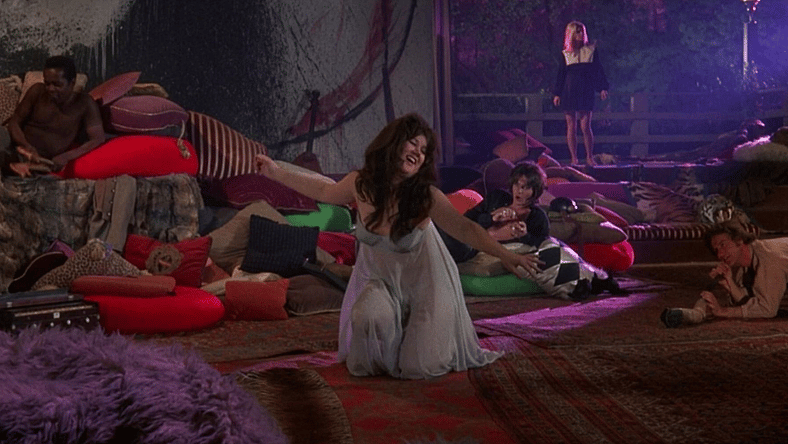
It’s 1968, and Tara Steele has a lot of problems. The daughter of Hollywood mega-couple Astrid and Willy Steele, Tara’s predisposition towards obesity, coupled with good old-fashioned parental apathy, has resulted in her spending her teens at European boarding schools. Though Tara’s gotten to see parts of the world only accessible to the extremely wealthy in the 1960s, we get the impression she’d rather have enjoyed a “normal” upbringing. That subtext becomes text once we see Tara interact with her folks.
See, Willy and Astrid have brought their daughter back to LA to throw her a coming out party in the hopes of scoring her a plum marriage that’ll make her someone else’s problem. Like many vulnerable young people looking for validation, Tara’s primed to fall in with exactly the wrong person. In her case, that turns out to be Bogart Peter Stuyvesant, front man for the unnamed yet righteously sick psychedelic rock band hired to play the party.
Meet the Rockstar
Part Jim Morrison, part Jim Jones, Bogart has the cult musician/cult leader shtick down pat. Charismatic, handsome, and a master of negging, Bogart would be right at home hanging with Andrew Tate, and he’s got the musical chops to back up his protestations of greatness (aided in no small part by Roddy McDowall and a pre-fame Lou Rawls).
Realizing he’s finally found his meal ticket, Bogart exploits Tara’s insecurity to seduce her and move his entire band into her house. What transpires next isn’t so much a battle of wits as it is a psychological vivisection—imagine if the killers from Funny Games were primarily concerned with financially and sexually exploiting the family, with murder as an amusing afterthought. As Bogart quickly elicits from them, Astrid used to be a highly desirable porno star in the golden age of stag films, while Willy was a sleazy producer on the Harvey Weinstein model who inadvertently turned a hookup into a marriage when Tara was conceived. This bit of demythologizing is all Bogart needs to shatter the couple’s booze-and-pills-fueled perception of reality.

Before you know it, Astrid has declared her undying devotion to Bogart, while Willy enters a slow-motion nervous breakdown of substance abuse and pontification on right-wing American values. Little does he suspect that last bit aligns quite nicely with Bogart’s own philosophy. See, Bogart digs drugs, casual sex, and killer guitar riffs. But he loves money, power, and privilege. Come to think of it, marrying Tara would be excellent for Bogart’s career, to say nothing of the death cult he’s starting…
Counter-Cultural Satire
Much has been done to parallel 2024’s culture of campus unrest with that which swept America in the 1960s. There’s a key distinction to be had, though: anti-Vietnam protestors, by and large, weren’t protesting the war. They were protesting the draft. Once that ended, history saw a rapid downtick in protest activity. That observation dovetails with the age-old question of, “How did the hippies sell out and become the yuppies?”
Writer-director Robert Thom has the answer: the hippies never had anything to sell out. Sure, they knew how to make it sound like they were proponents of global fraternity, but at the heart of the whole “anti-war” sentiment was the desire to make it rich like their parents, not die ignominiously in a jungle. At a point in time when anti-war activists were being lauded as the harbingers of a kinder, loving world, Thom already saw the truth behind the flower-power window dressing.
Robert Thom: A Prophet of Sorts
What’s most startling is that Thom didn’t just see it coming from a mile away; he saw it from about ten miles away. Angel, Angel, Down We Go began life as an unproduced stage play in 1960. Though it featured murderous beatniks terrorizing an elite New York university instead of rockers in SoCal, the message was the same, and remained relevant enough that Thom was able to keep interest in the project alive for a decade.
Unfortunately, Thom’s cinematic warning took the form of a terminally 60s piece of filmmaking. He may have wanted to cast a critical eye on the excesses of Vietnam-era youth culture, but he—and other filmmakers of his generation—were nonetheless beholden to (or seduced by?) the aesthetics of the age. The end product is a movie that would feel at home in a Goddard film festival, with plenty of Laugh In-style musical sequences, cutaways, and video art montages. Contemporary audiences lacking the cultural context may find themselves bored, incredulous, or simply frustrated when the movie pauses for the third time to play a folk-rock song in its entirety while the camera lingers on a collage.

Stellar Performances and Witty One-Liners
Those excesses can become virtues in the right moments, though. Influenced by the whiz-bang dialogue of Clifford Odets, the script is cut through with ludicrous one-liners that were meant to be comic in their day and have only aged like fine wine by way of their absurdity. “In my heart of hearts, I’m a sexual tramp,” Astrid laments, before proudly declaiming, “I made thirty stag films and I never faked an orgasm!” They’re all delivered with delectable aplomb by Jennifer Jones, clearly having a ball playing a skewed version of herself: a Silver Screen icon going back to the Great Depression, her star had long faded by the time she was cast here. It’s a testament to her professionalism that she was willing to deliver so fiercely for a role many actresses would’ve seen as a personal affront.
Going toe-to-toe with her is Jordan Christopher in the Bogart role. The Doors had just released their debut album, allowing Christopher to deliver a performance that’s at once a loving piss take on Morrison and an entirely original character. Another actor would’ve turned in a mugging, ironic performance. Christopher clearly understands that, at the same time, the role is meant to be fun; he’s giving voice to a very real and very dangerous sentiment. The results are moments of palpable menace punctuated by backhanded comic relief, such as when Astrid snaps at Bogart, “Do you want me or my daughter?” only to be met with the retort, “Are they mutually exclusive?”
Unfortunately, Some Parts Have Aged Like Milk
In addition to its stylistic excesses, Angel, Angel, Down We Go has aged poorly in other ways. That laissez faire approach to dialogue also gives us such cringe inducing lines as “You’re out of your Chinese skull” and the liberal use of no-longer acceptable pejoratives for queer people. Compounding that narrative wrench is that Near herself is a member of the LGBT community, leading the film to have acquired a camp following among a particular generation of elder queers. Meanwhile, the movie has a slightly more complicated relationship to queer identity than initially meets the eye, as briefly explored in an underdeveloped subplot regarding Willy’s repressed bisexuality and Bogart’s hidden leather daddy proclivities.
The film also seems to struggle with its own perspective regarding beauty standards. Dialogue and characters treat Tara as though she belongs on a TLC show, even though Near is maybe ten pounds above BMI at absolute most. Meanwhile, Astrid is meant to be an aged casualty of too many plastic surgeries and prescribed narcotics, while Jones remains absolutely stunning—at least, perhaps, to modern sensibilities.

It’s difficult to cut through the layers: was Thom a product/victim of his time? If so, are audiences meant to pity Tara as overweight and Astrid as old and ugly to give this a layer of Tennessee Williams-esque California grotesquerie? Was Thom a true progressive calling out unrealistic beauty standards? He did also pen such forward-thinking material as Death Race 2000 and The Witch Who Came from the Sea, the latter of which remains one of the most thoughtful and psychologically complex (if not deeply upsetting) rape/revenge movies ever made. Then again, assuming Thom himself meant well, how did audiences respond? Even in the information age, there are Trekkies who complain that the franchise “got woke.” What does that say for media literacy in 1969?
Struggling To Find Its Audience
Predictably, Angel, Angel, Down We Go suffered an ignominious fate at the box office. Quite simply, audiences didn’t know what the fuck to make of it. In a way, that allowed the film’s strengths to emerge where they would be best appreciated: on the grindhouse/drive-in circuit, where the film enjoyed a healthy second life throughout the 1970s among individuals with no love lost for the Boomers or what they’d come to represent. Ironically, a bit of unintended foresight would allow it to continue profiting into the Reagan era.
In 1970, AIP re-released Angel, Angel, Down We Go as Cult of the Damned with a lurid yellow one-sheet playing up the film’s “killer hippies” angle in the wake of the Manson Murders (modern audiences are often surprised to learn Angel predated the crimes). Not only was that an inspired bit of marketing, it, like the movie, was eerily prescient. That’s because in 1978, Jim Jones coerced the followers of his People’s Temple into committing mass suicide in Guyana.

The phrase “Cult of the Damned” became so connected with the People’s Temple it lent itself to the name of the 1979 Jonesploitation cash in Guyana: Cult of the Damned by Mexico City filmmaker René Cardona Jr. That Angel had been playing second-run under the Cult moniker for nearly a decade gave it even further staying power and led to no small number of unsuspecting audience members getting roped into watching it.
The Verdict?
Angel, Angel, Down We Go is not meant for casual horror fans. The filmmaking style owes so much to the countercultural satires of the 1960s that it may prove impenetrable to audiences unfamiliar with the era’s narrative conceits and cinematographic vocabulary. A certain streak of contemporary audiences may also bristle at the more problematic aspects of the film, or, rather, elements that may be problematic. Still, for those willing to make the investment, Angel, Angel, Down We Go is a unique bit of horror filmmaking that effortlessly weds the narrative beats of a cult thriller to a social satire that manages to remain as provocative and transgressive as when it first appeared.
As of the writing of this article in May 2025, Angel Angel Down We Go is available to stream free on Pluto
Categorized:Editorials