
‘Mother Mary’ Review: David Lowery’s Feverish Take on Pop Superstardom

There’s nothing quite like a redemption story, especially when it involves a beloved pop star. Pop music has always promised resurrection: The comeback single, the dramatic reinvention, the moment when a pop star rises from the ashes of a tabloid scandal and reclaims her throne. Writer-director David Lowery’s (The Green Knight, A Ghost Story) latest feature, Mother Mary, understands the mythology of the pop star intimately. A filmmaker long preoccupied with the idea of legacy, memory, and time, Lowery turns his attention to the power of pop music, a genre that functions as a time machine unto itself, transporting listeners to specific moments in time or reassuring them that the future will be bright. As Lowery himself puts it, “Pop songs have the power to unite millions with shared emotion—they can make you feel seen and heard, even heal a broken heart. Mother Mary is about how art can take something terrible and turn it into something beautiful.”
But there can’t be any conversation about pop music without acknowledging how we treat our pop stars. We uphold women like Britney, Amy, Whitney, and Janet as icons, only to gleefully tear them apart. In 2023, there was an epidemic of concertgoers throwing water bottles and other objects at performers like Cardi B and Bebe Rexha, who went to the hospital after a phone was hurled at her head. Late last year, Charli xcx—who was tapped alongside Jack Antonoff and FKA Twigs to create original music for the film—wrote on Substack that though being a pop star is “really f*cking fun,” she’s been finding herself “spending a lot of time inhabiting strange and soulless liminal spaces,” surrounded by people “determined to prove that [she’s] stupid.”
“Being a pop star,” she writes, “has always been partially about being a fantasy and obviously the fantasy is decided mostly by the consumer.” And there’s no fantasy the consumer loves more than the artist’s destruction and resurrection.
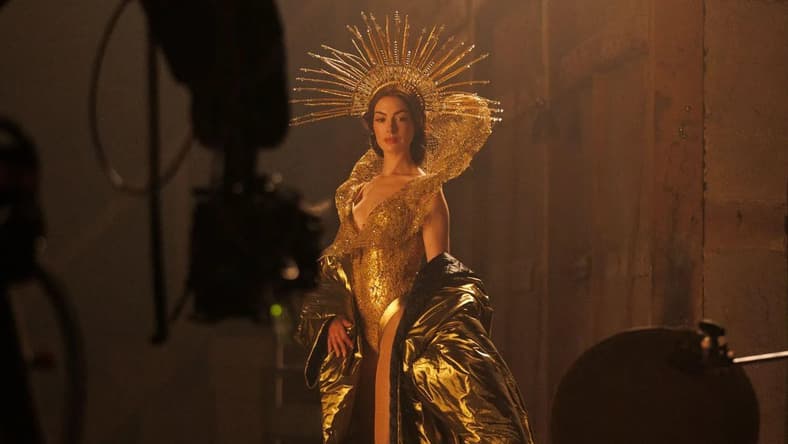
Anne Hathaway fully embodies the role of a tortured artist as Mother Mary, a larger-than-life pop star whose persona is a hybrid of Taylor Swift (one of Lowery’s inspirations was Swift’s Reputation tour) and Lady Gaga. Onstage in her platform heels and halo, she is an unstoppable force whose music has captured the attention of generations of devoted fans. Hathaway, who took voice and dance lessons in preparation for her role, is entirely believable as a woman who has spent years perfecting her craft, moving with a blend of military-like precision and freedom that only a seasoned performer could pull off.
But after a horrifying accident onstage, Mother Mary has found herself in need of a comeback, and the only person she can trust to create a dress to usher in her new era is Sam Anselm (Michaela Coel in a performance that feels almost Shakespearean), her estranged best friend and former costume designer. In the 10 years since their fallout, Sam has become a renowned fashion designer working from her secluded atelier in the English countryside. After a lackluster fitting in LA, Mother Mary turns up at Sam’s doorstep unannounced, but she already sensed she was coming. Sam agrees to make Mother Mary a dress, with the condition that she is allowed to do whatever she wants. But Mother Mary has one request—absolutely no red.

In some ways, Mother Mary is the story of two women who are trying to make sense of their fractured relationship, of the time they’ve spent apart, and the way they’ve spent that time. While one was suddenly catapulted into super stardom, the other slowly and deliberately poured her resentment and heartbreak into a successful career behind the scenes. For the first 30 minutes of the film, the women circle their shared past, unwilling to actually discuss what actually transpired between them and instead, how they felt about it. Mother Mary claims she didn’t mean to hurt Sam, and Sam wants to believe she’s mostly over it, even though she clearly enjoys the fact that her friend is practically begging at her feet for help. But as the night progresses, their memories begin to haunt them like ghosts.
Though there are plenty of other characters—Hunter Schafer is a literal breath of fresh air as Hilda, Sam’s assistant, and Kaia Gerber and Sian Clifford make appearances as part of Mother Mary’s team—it’s the dynamic between Mother Mary and Sam that really drives the film. Hathaway and Coel manage to capture the unique pain and trauma of their characters while also reminding us that these women are more alike than we think. Coel is particularly exceptional here as a woman who has figured out how to turn her pain into art, but it doesn’t mean she has stopped hurting. She calls her ex-best friend a “carcinogen” and a “tumor,” the reason she cracked a wisdom tooth, but every so often, her eyes flicker with love and tenderness.
Mother Mary insists it “isn’t a ghost story,” and I agree. Even as the more fantastical elements—an extremely vaginal stigmata, a possessed FKA Twigs, a sentient piece of fabric—begin to show up and the dialogue becomes progressively more poetic (Coel delivers them as though she’s been speaking like this for years), the story somehow manages to stay fully grounded in reality. In one flashback, we watch as Mother Mary reluctantly walks on stage, her confidence shaken, her nerves shot. We’ve seen this image in pop culture before. We know what’s coming, and it’s more frightening than any ghost Lowery can conjure.

Visually, Mother Mary is one of the most stunning films to come out this year, filled with ornate costumes by Bina Daigeler, darkened stadiums and Gothic interiors, and dance sequences that rival the ones in Luca Guadagnino’s 2018 remake of Suspiria. Yet, for all its beauty, the film seems somewhat unfinished. This might have something to do with the fact that the details of Mother Mary and Sam’s friendship and eventual fallout are frustratingly vague. There are moments where the tension between them feels romantic, but the film never quite explores this or some of the more psychosexual themes either, which feels like a missed opportunity. And while Mother Mary‘s abstract structure is one of its most intriguing aspects, it also doesn’t necessarily work when it comes to the film’s conclusion. By the time Mother Mary has exorcised her demons and decides she’s ready for her comeback, we are left feeling slightly lost and underwhelmed.
Despite its narrative and structural shortcomings, Mother Mary is like a pop song you can’t quite get out of your head. The imagery and music are both unforgettable, the performances are some of the best we’ve seen from Coel and Hathaway, and the costume design is sure to inspire more than a few Halloween costumes this year. Lowery may not fully resolve all the wounds at the center of this story, but he manages to capture the pain of being a famous pop star, the power that comes with taking your darkest moments and impulses and transforming them into art, and the power of intimacy and self-expression.
Mother Mary is in select theaters April 17, with a wide release April 24.
-
Mother Mary
Summary
David Lowery’s Mother Mary blends pop spectacle with Gothic horror, anchored by stunning performances from Anne Hathaway and Michaela Coel.
Categorized:Reviews