
‘The Death of Snow White’ Review: A Campy, Gory Twist on a Fairytale Classic

Like most children, I owned a giant book of fairy tales. But in this particular book, the fairy tales were unapologetically dark, even matter-of-fact in their depictions of gore and violence. Rumplestiltskin splits himself apart at the legs; Rapunzel’s prince throws himself from her tower in his grief, piercing his eyes on the thorn bushes below. In the book’s introduction, psychologist Bruno Bettelheim writes that the power of fairy tales lie in their ability to “speak about man’s fate…his fears and hopes, and his most basic problems: in becoming and proving himself, in relating to his fellow men, and relating to the supernatural.” Darkness is as essential as magic. Without it, we’d be “unable to give name, form, or body to [our] deepest fears,” be it abandonment, envy, or the inevitable decay of the body.
Jason Brooks’ The Death of Snow White understands this better than most of the dark fairytale retellings put to screen recently. His low-budget fantasy horror film may wobble in its execution—with a runtime of 110 minutes, it’s way too long for the story it’s trying to tell, the acting is uneven, and the English accents aren’t exactly English or accents but a secret third thing—but it commits to gore, sincerity, and oddball invention in ways that feel closer to the brutal spirit of the brothers Grimm than anything Disney has attempted in recent decades.
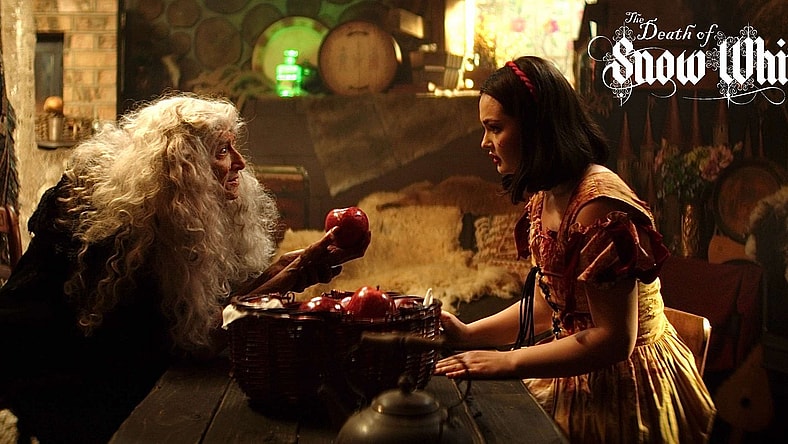
The script by Brooks and Naomi Mechem-Miller follows the 200-year-old fairytale faithfully: a kind young princess named Snow White (a perfectly cast Sanae Loutsis, who looks like the cartoon version come to life) must flee her kingdom when her stepmother, the Evil Queen (Chelsea Edmundson), learns that her beauty has surpassed her own. The Evil Queen orders her execution, but Huntsman Gunnar (Jason Brooks), who swore to the Good Queen (Kelly Tappan) before her death to protect the princess, spares her life. Snow White finds herself lost in the Dark Woods, where she meets the seven–er, six dwarves and a seven-foot-tall man the Evil Queen banished upon taking the throne. Snow White hides in their cottage until the Evil Queen discovers her whereabouts. She disguises herself as a helpless old woman in order to trick the innocent princess into letting her in.
Cue the poisoned apple.
You might be wondering what makes The Death of Snow White different from any other fairytale movies, considering the plot is mostly unchanged. Even when the Evil Queen stabs the Good Queen in an effort to kill both her and the unborn princess in a scene as graphic as the one in À l’intérieur, I had mostly resigned myself to another basic yet bloody retelling.
But Brooks manages to introduce some fun changes in his version of Snow White. Here, the magic mirror isn’t a disembodied face, but three nude spirits whose mean-girl eagerness to encourage and bully the Evil Queen drives her to the kind of psychosis I’ve only ever seen in people who use ChatGPT as their friend and therapist. The Evil Queen’s handmaidens are unwilling estheticians and dermatology guinea pigs, patch testing arsenic and belladonna and carving up village girls for literal blood baths à la Elizabeth Bathory.
But it’s the gore that makes The Death of Snow White truly stand out—more relentless, even, than the gore in The Ugly Stepsister, the stomach-churning Cinderella reimagining. This is where the warrior dwarves—and Tiny (a very charming Eric Pope), their towering outlier—shine. They delight in smashing heads in, disemboweling huntsmen, and doing whatever they can to protect Snow White. Everything, that is, except for reminding her to keep the cottage door locked.
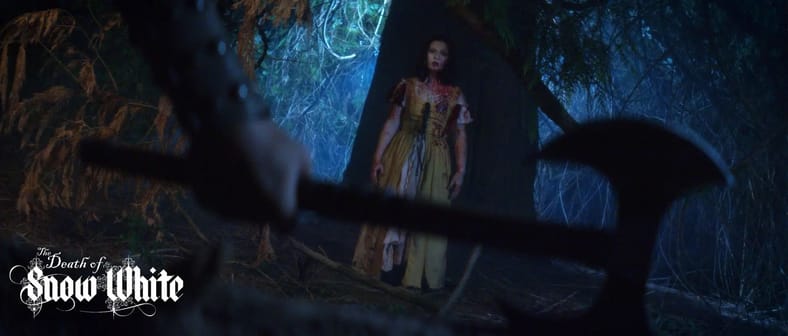
But despite all the arterial spray and hyper-realistic compound fractures, The Death of Snow White lacks tension and terror. The forest creatures deliver what I would consider some of the film’s most horrifying moments (one unfortunate village girl is pulled apart like a Chili’s mozzarella stick), but they’re sidelined way too quickly in order to make room banter between characters whose names and personalities are virtually indistinguishable, including the brothers Grimm (Milo Mechem-Miller and Christopher Burnside), who don’t do much besides make some vaguely meta jokes that aren’t all that clever or funny.
Unfortunately, this is also the reason why The Death of Snow White doesn’t quite work as a dark fantasy adventure either. Instead of being invested in the Prince’s (Tristan Nokes) quest to save Snow White with his rag-tag group of fighters, I found myself wanting to check in on the Evil Queen. Has she discovered hyaluronic acid or Botox yet? Oh, she’s testing out leeches and taking a hit from her vape. The vape isn’t a joke, by the way.
If The Death of Snow White works at all, I’d argue it’s because of its campiness. I don’t mean that as a backhanded compliment. I got a sense the cast and crew genuinely believe in what they’re making, even when the result is ultimately silly.
For that, I can’t quite dismiss it outright. But I’d also hesitate to call it good. It’s a decent time if you treat it like one of those movies you’d find during Netflix’s early days and watch at a sleepover, stealing sips of vodka from your friend’s parents’ liquor cabinet in between gagging and giggling at the absurdity of it all. But when it comes to delivering on the scares or the adventure, unfortunately, the apple doesn’t fall far from the Public Domain Fairy Tale horror movie tree.
-
The Death of Snow White
Summary
This low-budget fantasy horror film may wobble in its execution, but it commits to gore, sincerity, and oddball invention.
Categorized:News