
Disturbing Masterpiece Guillermo del Toro Loves is on HBO Max

I’m not a unique-looking woman. This isn’t a complaint, by the way—I think it’s a good thing. I know which haircuts will flatter my face best and which makeup looks to try by looking at any one of the dozen or so celebrity women I’ve been compared to (no to blonde, yes to nude lips, absolutely not to bleached eyebrows). Sometimes, people tell me that I don’t look like any of these celebrities, but rather like one of their personal friends—or a friend of a friend. And I’ll wonder if I’ve ever met her before. But if I had, wouldn’t I have recognized her? After all, they’re saying she has my face.
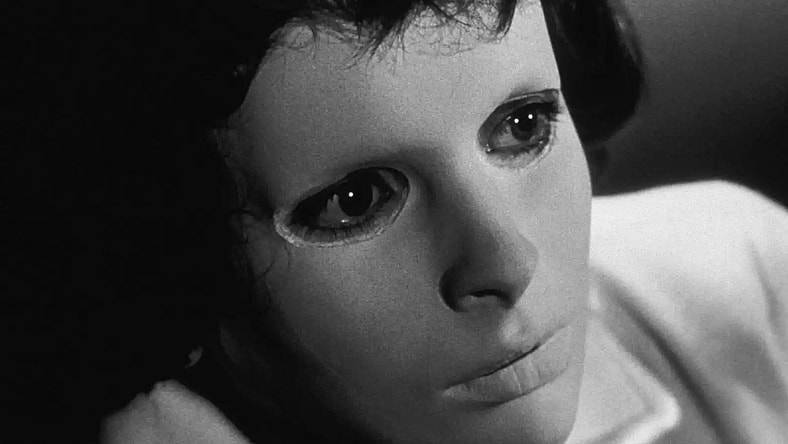
Directed by Georges Franju, Eyes Without a Face (1960) tells the story of Professor Genessier (Pierre Brasseur), a renowned plastic surgeon who has resorted to kidnapping young women in hopes of grafting their faces onto his daughter, Christiane (Édith Scob), who has been left disfigured after a car accident. While he’s away, Christiane drifts through her father’s mansion, wearing a porcelain mask that resembles her face before the crash, her large, expressive eyes the only sign of life beneath it. She can’t confide in her fiancé—Professor Genessier has tricked him into believing she’s dead. She has no one to keep her company besides her father’s assistant and possible lover, Louise (Alida Valli), who acts more like her mother than a friend. So she seeks comfort in the birds and the dogs her father uses for his experiments, creatures who won’t judge her for what she looks like.
In a 2003 review of the film, Roger Ebert wrote that “the matter-of-fact way [Franju] presents the outrageous is in the tradition of Buñuel, who felt that the only response to the shocking was to refuse to be shocked by it.” The startlingly graphic surgery scenes are treated as just another day in the life of this plastic surgeon, which makes sense—this is his profession, after all—but when one transplant is interrupted, Genessier just leaves the skin flaps on the victim’s face open as if that’s totally normal.
It’s this very coexistence of elegant and grotesque imagery that struck Guillermo del Toro, who cites Eyes Without a Face as a key “influence” on his own work. “[The main character is] like an undead Audrey Hepburn,” said del Toro in a round up of his favorite films for Criterion in 2018. “It influenced me a lot with the contrast between beauty and brutality.”

Del Toro has spent the entirety of his career pursuing that blend of “beauty and brutality,” whether in the tragic romance of The Shape of Water (2017) or the Gothic fairy-tale that is Crimson Peak (2015). But nowhere is this more apparent than in Pan’s Labyrinth (2006), which is my favorite del Toro film. Ofelia’s lush imagination and the brutality of fascist Spain owe a clear debt to Franju. I still cover my eyes whenever I get to the scene with the rabbit hunters.
And then there’s Christiane, the “undead Audrey Hepburn” at the center of Eyes Without a Face. Del Toro recognizes her beauty not despite her mask, but through it. He treats all his characters (but especially his creatures) with reverence, insisting they are lovable and luminous because of their strangeness.
Eyes Without a Face is streaming on HBO Max. As much as I’d encourage you to have a snack while watching a movie, try to finish yours before the surgery scenes. If you love it, let me know: @ashjenexi on Instagram and X.
Categorized:News