
Black Girl Burning: Claudia in AMC’s ‘Interview with the Vampire’

Editor’s note: This piece contains spoilers for AMC’s Interview With The Vampire
On June 15, 2020, Oluwatoyin “Toyin” Salau was confirmed to be dead after having been missing for nine days. I followed this story online at the height of COVID and the Black Lives Matter protests. I combed through articles about what happened leading up to her death and the activism she engaged in while alive. My heart shattered with every word I read, not just because the details were horrific but also because I saw so much of myself in her. We were the same age, 19-year-old Black girls who dreamed of liberation for our people. And yet, a man was able to cut her life short just like that.
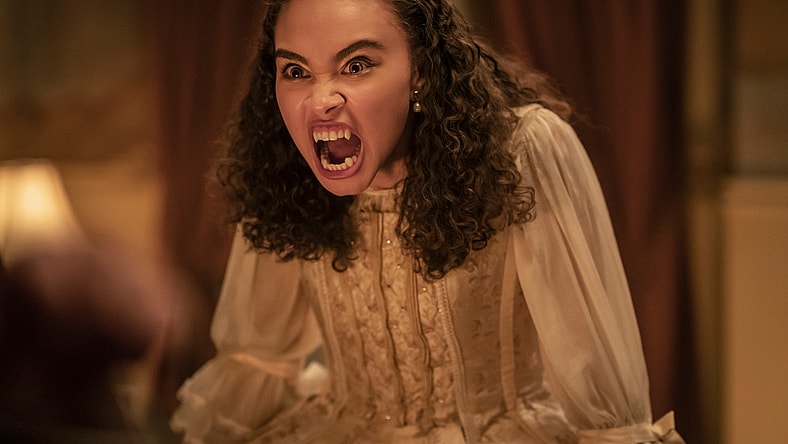
In 2022, AMC began releasing Rolin Jones’s adaptation of The Vampire Chronicles by Anne Rice. Breaking from the source text and the 1994 film adaptation of the same name, Interview with the Vampire turns Claudia, the child vampiress, from a 5-year-old white girl to a 14-year-old Black girl. Played by Bailey Bass in season one and Delainey Hayles in season two, this latest iteration of Claudia embodies the beauty and the pain of Black girlhood.
The Birth of a Vampire
From the moment of Claudia’s creation in Interview With The Vampire, she is a tool for the relationship of her vampiric “fathers”, Louis de Pointe du Lac (Jacob Anderson) and Lestat de Lioncourt (Sam Reid). Amid their crumbling relationship, Louis begs for a daughter pulled from a burning boarding house during race riots. Contrast this to Louis’s turning. Lestat chooses Louis for who he is, because he desires to be with Louis specifically. Louis chooses Claudia because she’s there.
As Claudia lives with her toxic dads/uncles/brothers, she takes to vampirism like a fish to water. All the while, she is aging, growing into an adult woman stuck within the body of a teenager. She tries out a relationship with a young man named Charlie (Xavier Mills), which ends with her accidentally killing him. This moment causes Claudia to spiral into a murder spree, where she attempts to create her own vampire companion. When Louis and Lestat confront her, she asks in a broken voice, “Who am I supposed to love?” They’re stunned into silence. She is supposed to be their object, a tool to save their marriage; she was never supposed to have her own desires. Her wanton murders, irresponsible as they are, serve as an insistence on her personhood. She deserves love and companionship. She deserves to be chosen.

Eventually, Claudia is fed up with being a secondary character in her own (un)life, and she leaves the undead husbands to find other vampires. In her travels, she meets Bruce (Damon Daunno), a vampire whom the narrative implies sexually assaults her. He chastises her for being rude and then proves his dominance over her body. Every man that Claudia encounters views her body as a site from which they can derive pleasure. They do not view her as an entity unto herself.
Briefly Finding Happiness
At the end of Interview With The Vampire season one, Claudia and Louis carry out a plan to kill Antoinette (Maura Grace Athari), Lestat’s vampire mistress, and Lestat himself. However, Louis ends up choosing Lestat again. He refuses to burn Lestat’s body, which opens the door for Lestat to survive and return to him. Then, in the season two premiere, as they travel across Europe, Louis makes an impassioned speech to Claudia claiming that she is enough for him. He says, “If you were the last vampire on earth, it would be enough.” And yet, his eyes drift from Claudia to a hallucination of Lestat.
Claudia and Louis end up in Paris with a coven of Lestat-worshipping theatre vampires led by Armand (Assad Zaman). Claudia, desperate for community and a sense of intrinsic value, leaps at the opportunity to join the coven despite the dangers of being the (attempted) murderer of Lestat. The coven puts her through what amounts to psychological torture by forcing her to play a baby in the show for 50 years. She also begins a relationship with an ostracized French woman, Madeleine Éparvier (Roxane Duran). Claudia convinces Louis to turn Madeleine, finally creating her an immortal companion. Things begin to look up for Claudia. It looks like she might be able to carve out a piece of happiness in this life that has attempted to beat her down.
At The Mercy Of Men
However, once again, Louis’s lover ruins her life. Armand gives up Louis, Claudia, and Madeleine to the Paris coven for a “trial” that is more of a lynching. The trial is scripted to give each of them the death penalty, in a move that now feels reminiscent of the way the US justice system is rigged against Black people. During the trial, Claudia points to the obvious bias of the audience and other vampires. She wills herself to her feet, despite a sliced Achilles, and demands, “Can I cry and say that I’m sorry, too?”
Lestat’s tears over his abusive violence toward Louis endear the audience to him and allow the vampires to forgive him. Claudia and Louis have no such luck as the Black figures on stage. She comes to the realization, “Never been about me. I was just a roof shingle that flew off your house.” Claudia isn’t even the most important part of the process that will lead to her death. Santiago (Ben Daniels), the new leader of the Paris coven, was jealous of Louis’s hold over Armand and sought his destruction. She is once again at the mercy of the petty feelings of men.

In one of the most tragically beautiful scenes in Interview With The Vampire, Madeleine is given the choice to live with the Paris coven or die with Claudia. Madeleine says, “I’m the Vampire Madeleine Éparvier, and my immortal companion is Claudia. My coven is Claudia.” Before this moment, Claudia gave Madeleine silent permission to live, to abandon her just as she had been tossed aside for most of her short, immortal life. Claudia’s face registers shock, gratitude, and love as she realizes that Madeleine would not abandon her. She has truly found her person, someone who would choose her even if it meant death.
A Triumphant Death
Before her death sentence is meted out, Claudia has a final request. She asks a man on the balcony to remove his hat. Now having seen and committed to memory each face that participated in her lynching, she promises, “If there is an afterlife, I’m gonna come back and fucking kill all of you. And if there isn’t an afterlife, I’m still gonna find a way.” You can tell that the audience doesn’t know whether or not to believe her, but I did. She has the raging defiance that queer Black femmes can use to burn our mark on those who wrong us.
As Claudia and Madeleine are killed by sunlight, Claudia refuses to be the whimpering victim they want her to be. She smiles and sings the song she performed night after night with the Paris coven. It is perhaps the most haunting moment in the show, not least of all because it feels like art imitating life. A young Black girl’s life is cut short by men. A tale as old as time.
A Symbol of Hope For Black Queer Femmes
Despite her tragic end, Claudia is an inspiration to all queer Black women and girls. She never lies down and takes the abuse handed to her. She cries and claws and scratches her way to personhood and agency. Claudia knows that the world wants her dead, but she grips tightly to life anyway. And god help you if you wrong her, she will get her revenge. Don’t you doubt it.
Claudia from AMC’s Interview With The Vampire represents something deeper than an immortal child to me. She is an avatar for the burning light within queer Black girls. Even the sunlight can not shine brighter than her spirit. Until the world changes, Black girls like Claudia and Toyin and Cameron “Cam” Thompson will have their lives snuffed out. But it is up to us to carry their torches, keep their memories alive, and use their light to illuminate a better path forward. Black girls may be burning, but you will too if you don’t get out of our way.
Categorized:News