
‘Anything That Moves’ Director Alex Phillips And Adult Film Star Ginger Lynn Allen Talk Erotic Thrillers and Sex Positivity

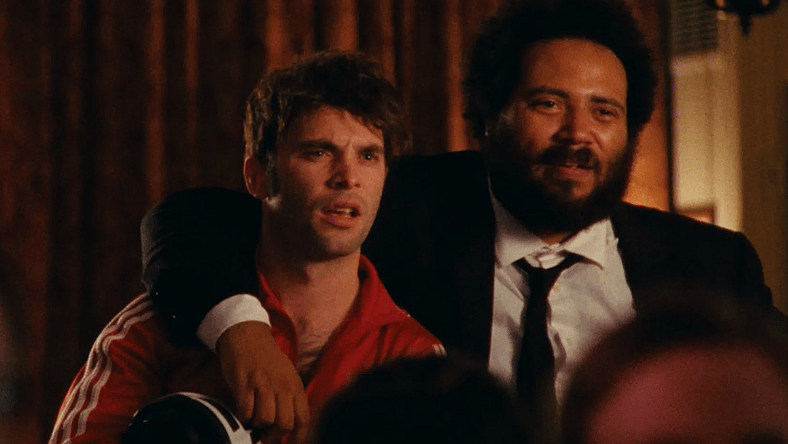
I’ve been dying to see Alex Phillips’ follow-up to the instant Midwest-sleaze classic All Jacked Up and Full of Worms ever since I heard its title: Anything That Moves. That voracious horniness does translate into Phillips’ sophomore feature, which starts as a sex comedy about a bike messenger named Liam (Hal Baum) who has an erotic gift that he can’t help but share with the world.
Liam and his partner, Thea (Jiana Nicole), are part of an underground ring of bike messenger sex workers who deliver “cookies” and “pizza” to lonely souls throughout Chicago, enraging a duo of sexually repressed cops who will do anything to stop them. That’s when the “thriller” part of this erotic thriller kicks in.
The tonal shift midway through Anything That Moves is, well, violent, transforming from the sunny innocence of a nudist colony to the grimy shock value of a serial killer posing a victim’s body next to a dumpster. Think of Hot and Saucy Pizza Girls crossed with The Exorcist III, and it’ll give you a rough idea of what’s happening here.

As dark as the movie gets, however, writer-director Phillips and co-star Ginger Lynn Allen—a 40-year veteran of the adult film industry with nearly 200 screen credits to her name—were both cheerful and enthusiastic when I met them after the world premiere of Anything That Moves at the Fantasia Film Festival.
Allen co-stars as one of Liam’s clients, a suburban woman whose maternal nature bled through into Allen’s experience on the set. For Phillips, it was more about trying to create a tactile, visceral experience, down to the grain of the 35mm film.
Dread Central: Ginger, you spoke a little bit at the Q&A about what a great experience you had filming this movie. What made it so easy?
Ginger Lynn Allen: One of the reasons that it was so easy to work with Alex and his crew was that a lot of them were from the Midwest. There’s a down-to-earth kindness that people from the Midwest inherently have. It was so easy, I just slid right in there and went wherever [Alex] wanted me to go. And you know what? It was wonderful.
DC: Alex, both of your films were shot in Chicago. And you always end the credits with “shot in Chicago, Illinois, where everything is alright.” How do you think the city affects the sensibility of your work?
Alex Phillips: I have this song stuck in my head called “The Midwest Can Be Alright” By The Gizmos, so that’s where I get that from. And there’s a real—I don’t know if it’s nostalgia, but there’s a sentimentality to my tone that gives it an emotional grounding. I think you get that in the Midwest. There’s no bullshit. People will tell you what they think, but they’ll do it knowing that you’re a human being.
Ginger Lynn Allen: I love that they’re brutally honest, but in a kind way.
DC: Something that I really want to talk about with this movie is that it has a certain joy, almost an innocence, to it about sex. Sometimes you see that attitude in these golden-age adult films of, “sex is fun. Let’s have fun with it!” How did you incorporate that into this film?
Alex Phillips: Part of it was just emotionally grounding the characters in every scene and letting people play with the way we shot. It was not traditional coverage; we were moving the camera around to land on these extreme close-ups, but we’d start with a wide shot and move around. This allowed people to live in the dialogue and play in the room.
DC: So how structured was your dialogue then, and your scripting?
Alex Phillips: Oh, it was completely [scripted]. The way that it was written is how it is on screen.
But when you shoot with traditional coverage, you get a wide and close, and there’s less interaction between characters and people in the room. The way that we shot involved people moving around and actually physically being with each other and delivering lines to each other, as opposed to “here’s the dot. Talk to the dot.” It’s more like a play in that way, and it allows the actors and the characters to live in the scene.
DC: Do you think that contributed to this sense of fun?
Alex Phillips: I think so. Everyone was comfortable with each other. The tone of the script is weird, but there’s a gentle humor to it despite the horror. Like you said, sex should be fun. It should be an adventure.
DC: Or just silly.
Alex Phillips: Yeah. Even when [the film] gets horrific, there’s still humor and care that goes into it.
DC: No spoilers, but the Puritans are the villains.
Ginger Lynn Allen: That’s the way it really is. I love that you saw joy and innocence in the film. Being a little bit older than the rest of the cast, and coming from my adult background, I felt maternal on the set, especially in my scenes with Hal. It was beautiful—honest and very loving.
So many people fantasize about living different lives, and then judge you for what you do. With this film, it’s in your face. Everything’s in your face. And it is brutally honest. Beautiful and brave.
DC: In a way, this is also a movie about following your life’s true purpose, because sex work is Liam’s purpose. He’s like, “This is what I do.”
Alex Phillips: He loves love. He loves his job.
DC: Yeah. It’s a movie about a guy who loves his job. [Laughs] Ginger, can you tell me a little more about this maternal aspect of the shoot?
Ginger Lynn Allen: I’ve been around for a while. I’ve been in front of the camera since 1983. And working with so many civilians, people who are not in the sex industry, I wanted everybody to be comfortable with who they are and what they are. And I think that my attitude spread [among the cast] where people were like, “This is really cool. Sex is awesome, and everybody has it.”
But that’s not what the sex in this movie is about, in my opinion. To me, it’s more about love and need. And so with [the character of] Rachel, working with Hal felt maternal. I wanted him to be comfortable, because if you hear, “There’s this porn star coming on the set and you have to get naked,” that could be really intimidating. And he nailed it. And our work together was beautiful. I keep saying that. [Laughs]
Alex Phillips: I wanted their scene to feel like home. We’re in the burbs, and she’s like, “Go spread your gift with the world. Leave home and go on your big adventure, baby.” We get this comfort. Even the way we lit it, everything is so warm. I was trying to create a sense of safety.
DC: I think it’s Hal that says it, but a line in the movie that captures both this and the Midwest of it all is, “Are you hungry? Did you eat?”
Alex Phillips: Yeah. It’s this attitude of care.
DC: Ginger, when was the last time that you worked on a project that was shot on film?
Ginger Lynn Allen: I did a movie about six months ago that was on 35mm. It’s going to be streaming soon. Before that was Rob Zombie’s 31, which was eight years ago now. Rob has a habit where every eight years he’ll call me for another project.
DC: What’s the difference, in your opinion?
Ginger Lynn Allen: As an actor, I’m much more comfortable in front of a 35mm camera. It just makes it real. I grew up with my grandparents a lot of the time, and I would watch old movies, black-and-white movies, with my grandmother. Fred Astaire and Ginger Rogers—I thought she was so cool. “Her name’s Ginger! She’s got the same name!” There’s something magical to me about film, and I think that’s because of the way I was raised. My favorite movie is Arsenic and Old Lace. And I thank my grandmother for teaching me all of these things.
DC: What do you think, Alex?
Alex Phillips: Well, there’s a practical difference.
DC: True. For a director, there’s the technical aspect.
Alex Phillips: Yeah, and it’s just so important for this movie [to be shot on film] because of the erotic thriller aspect. Everyone’s being so physical, and with film, we get this literal texture to the image that allows the audience to access the scenes. We can taste it, smell it, feel it. It’s like breathing.
Also, when you shoot on film, you’re not thinking about post-production. You’re thinking about what the gate is catching. You’re not thinking about how you’re going to shift stuff around. You’re not going to change shit in post. It’s just literally what’s in front of you. So then that means on set, the world becomes what everyone is living in. Everyone’s engaged, everyone’s living in the space.
DC: Is it more pressure, too? If you fuck it up, that’s money wasted.
Alex Phillips: Yeah, definitely. But it’s always that way.
DC: I guess that’s true.
Alex Phillips: Digital or film, you don’t want to have a bunch of footage you can’t use. Here, the anxiety was, “Will this get exposed before we get a chance to scan it, so we lose our fucking day?”
Film also has all these weird quirks, and I get to use them instead of trying to make something that isn’t authentic. For example, in the beach scene, there are these blue and red lines across the frame. It’s because we shot it on film, and when they went to scan it, the top layer got scratched. I think it’s fucking cool, and I didn’t have to do any weird grindhousey stuff in post. It’s the emulsion.
Ginger Lynn Allen: “Authentic” is the perfect word to describe it. Shooting on film is like a real movie. With digital, you shoot the thing and you’re done. With film, you can touch it, taste it, feel it, like Alex said.
DC: One thing that I like about making a print [of a film] is that now it’s an object that exists. It’s externalized. It’s a physical thing in the world.
Alex Phillips: You’ve got to lug it around now.
DC: It’s a heavy thing. That’s true. Well, I actually do want to ask you a little bit more about filming that beach scene specifically, Alex. Is that the same beach from All Jacked Up and Full of Worms?
Alex Phillips: No, but it’s crazy because how many beaches have factories behind them?
DC: I mean, in Indiana…a lot, probably.
Alex Phillips: The Worms beach is also in Indiana, although my EP for this film is really Illinois-focused. Another reason I chose that location is that the water treatment plant has these insane security lights that are just blasting the beach. So that way we could shoot at night without lighting it.
DC: The vibes in that scene are rancid, and I mean that as a compliment.
Alex Phillips: Hell yeah. It was crazy. We were trying to get a lot of pages in with limited resources in the middle of the fucking night.
DC: You stayed to get the dawn scenes in the morning?
Alex Phillips: Yeah, the dawn was the dawn of the same day that we shot. So it was like we did it in real time. We got a permit—maybe I shouldn’t say this—but I don’t know how forthcoming we were with how naked the actors were going to be. But it was fine and fun, and it was great to just run around. Our base camp was this rented RV where everyone went to get warm and eat. Everything was about being physical and literal, from shooting on film to the sex scenes to the way that we shot it. I was trying to create a very visceral effect.
DC: By that point, the tone has completely shifted from Ginger’s scenes, which are really warm and loving.
Ginger Lynn Allen: That’s Alex. That’s how he wanted Rachel to be. And I love the fact that you have no idea what’s going to happen. You see people having sex and a little nudity, and it’s so warm and wonderful. I’m glad that I was a light in the film, because it gets so dark.
I haven’t done a film festival since 1992 or 1993. I usually don’t go because I am not comfortable seeing myself on film with an audience. But this screening felt right. Everything about this film did. I actually have a question for you as an audience member…
DC: Sure.
Ginger Lynn Allen: How did you feel about the nudity? Did you see it as something more than that, or was it sexual for you? Did you want to walk out? Were you sick of penises?
DC: No, I didn’t want to walk out. I’ve seen hardcore films in theaters, so I’m comfortable watching whatever with an audience. And for me, given that I have that perspective, the nudity added to the Garden of Eden of it all.
Ginger Lynn Allen: Wonderful. I’m glad that people these days are more accepting of things, and they don’t just go, “ahhhh!” or have a false puritanical view.
DC: That’s a relatively new thing, I think. Sex scenes in film and nudity in film, and erotic thrillers are all coming back around. They were gone for a while.
Ginger Lynn Allen: It’s about time. I mean, I love violence in films. I do. But I love that we’re bringing naturalness back to it. As you said, there’s an innocence to it.
Alex Phillips: I think that part of what sells the horror or the rancidness of it is the innocence. Part of it is that juxtaposition. We feel for these characters; we’re worried about them, which is why it feels so horrible [when things turn dark]. And our villain is stunted and puritanical. He’s afraid of himself, and it makes him hateful.
DC: Did you say to yourself, “I’m going to bring erotic thrillers back?”
Alex Phillips: No, I’m just a weirdo. I try to come by all this stuff honestly. I take in all this stuff, and then that comes out in my writing and what I want to make. I wanted to deal with real, personal human relationships, but I also wanted to use genre and surreal poetry to heighten it so people can access it on a deeper level.
Categorized:Interviews