
Creepy Kids? No. This Is the Real Reason ‘The Omen’ Is Still the Scariest Antichrist Movie

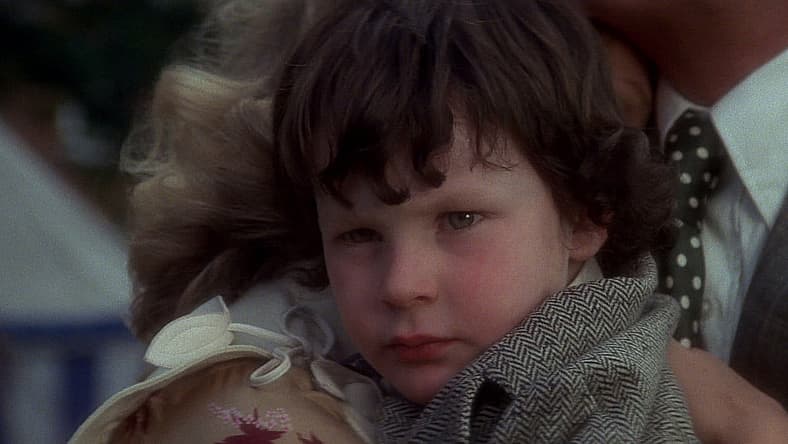
“If something frightening happens to you today, think about it. It may be The Omen”.
Thus reads the tagline for Richard Donner’s The Omen, released a whopping fifty years ago today. And thus signals why the shocking horror film has held a devilish grip over audiences for decades.
There’s no shortage of reasons to find The Omen terrifying. The film didn’t invent the creepy kid genre, but it did follow in the footsteps of movies like The Bad Seed and spark a new wave of killer tykes. David Seltzer’s script loads up on horrific “accidental” deaths that no doubt paved the way for the Final Destination franchise. Jerry Goldsmith’s satanic Oscar-winning score conjures images of hellfire and ritualistic sacrifice conducted deep in the bowels of some evil place below. All effective. All brilliant. Yet none compare to what’s really at work in this masterpiece of terror from the director behind Lethal Weapon and Superman… the psychological nightmare of paranoia, and the lengths we’ll go to based on belief and belief alone.
Three sequels, a prequel, a remake, and a TV series later, we’re all well aware that Damien (played here by Harvey Stephens), the child at the center of The Omen, is in fact the Antichrist. Adopted by unknowing politician Robert Thorn (Gregory Peck), the kid’s intent is to destroy him, inherit his wealth, and rise to power so that he may spread evil throughout the world. But in the 1976 original, Damien is no more than a child who might be the son of the Devil, making the events of the film all the more chilling.

Donner’s iconic tale opens on June 6th, 6 am with a doozy of a moment, in which we learn Thorn’s child died during birth, unbeknownst to his wife, Katherine (Lee Remick). But wait! The mother of another child died giving birth at the same time. What if Thorn adopted that kid? Then Katherine would never have to know! Typical politician thinking, as Thorn goes along with the clearly foolproof plan and presents Damien to Katherine as her own. What could possibly go wrong? Anything and everything, it turns out.
The decision sets in motion a film about the Antichrist, yes, but also a tale about deception, paranoia, and what happens when the lines between coincidence and fact become blurred like an odd marking on a photograph.
One of the first things you might ask about The Omen is, what in the world is Gregory Peck doing in a horror film? The legendary star of movies like To Kill a Mockingbird and Roman Holiday wasn’t exactly known for his genre appearances. And the short answer is, he didn’t think it was horror. Instead, Peck referred to it as a psychological thriller. That bugged me the first time I heard it, as it seemed to fall in line with the usual reframing of the genre as anything but horror, so that it would be taken more seriously. I’ll never understand, especially when you have movies like Obsession and Backrooms slaying. That said, Peck wasn’t far off. In fact, Donner had any direct supernatural occurrences removed from the script, as he wanted the audience to be as unsure of the truth about Damien as Thorn. Less is always more, and few horror films make that case as well as The Omen.
Moments after Thorn hands Damien to Katherine, we watch as an older version of the child strolls near a river with the couple. Serene happiness turns to terror as the two turn to find Damien has disappeared. One look at the river, and they assume the worst. Panic sets in, and the two begin screaming for their son. Out pops Damien, a grin on his face at the “joke”. On the surface, it’s a solid moment of tension, but like that torrential river, it signals a theme of paranoid fear coursing through the film.

That paranoia’s already eating at Thorn when the horror begins. He must worry that his wife or some reporter will discover Damien isn’t his child. He’s a politician, though, so who can say for sure how bad he truly feels about it? What we can say for certain is that it isn’t every day the nanny hangs herself from the house during the kid’s birthday party, but that’s exactly what happens just ten minutes into The Omen.
At this point, Donner begins to toy with the audience. Just before the nanny (Holly Palance) leaps to her doom—“It’s all for you, Damien”—she makes eye contact with a mysterious rottweiler. A few closeups of their eyes and Goldsmith stingers later, and the audience assumes the dog must be a hellhound that hypnotized the poor woman. The power of suggestion in film, my friends. However, before the dog, Katherine snaps at the nanny and takes Damien away from her. We don’t know the woman’s story. Perhaps she was depressed. Maybe the fear that she’d be fired was the last straw to push her over the edge. Frankly, it doesn’t matter. What matters is we have a suicide on our hands, and neither we nor Thorn know what really happened. Yet we’ve already started to assume, and assumptions can be very, very dangerous.
Consider the source of information that first comes to Thorn, for a moment. The manic priest, Father Brennan (Patrick Troughton). He claims to have been there the night Damien was born. That Damien is the son of the Devil and must be killed. Understandably, Thorn doesn’t believe him at first. But he doesn’t take much convincing, either. Think about it. The man that we and Thorn are trusting as the guy who knows it all is the same one who burst into Thorn’s office like a religious Kramer from “Seinfeld”. The same guy who covers his walls in pages of the bible and tells Thorn to drink Christ’s blood. And let’s not ignore the widely known fact that priests aren’t exactly always so trustworthy…especially when it comes to kids. We believe him because it’s a horror movie. Thorn believes him because constant suggestion and paranoia leave some people ready to believe anything.
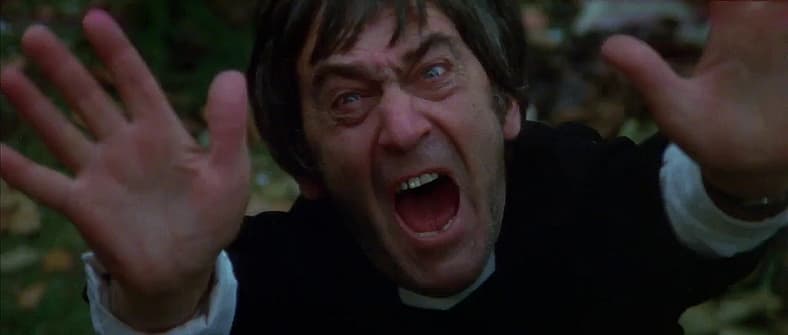
Then there’s the so-called “evidence” damning Damien. He freaks out at the church. Baboons attack him and Katherine at the zoo. Damien runs into Katherine’s chair with his tricycle, sending her to the hospital. Proof that he’s evil, or merely the things that kids and baboons do? Seriously, though, a drive-thru zoo is a terrible idea. Accidents, just like the fates that befall Father Brennan and photographer Jennings (David Warner), could be mere accidents. Granted, highly coincidental and sadistic, but it’s not like we see the Devil twirling his mustache as he knocks that rod off a church and into Brennan. The most damning element of Damien’s case is the 666 birthmark, but even that is still just a birthmark. I’m not one for believing “interpretations” of ancient prophecies, as everyone else in the film is inclined to do.
Despite that, I sided with the belief that Damien was the Antichrist in my first watch, and it terrified me.
By the end, Thorn finds himself all alone. Everyone who aided him is dead. Damien’s creepy new nanny, Mrs. Baylock (Billie Whitelaw), is stabbed in the neck after she attacks him following Thorn’s discovery of the birthmark. A member of a cult who believes Damien is the son of the Devil and they must protect him at all costs. But again, that belief doesn’t make it true. Yet Thorn takes the boy to a church in the middle of the night anyway, where he plans on stabbing him to death because some crazy old man named Bugenhagen (Leo McKern) told him he must.
“God, help me”, declares Thorn in those final moments just before he’s gunned down, because even he still cannot be certain that Damien is the Anti-Christ. None of us can be. Damien looks and acts just like a little boy. He could very well be nothing more than that. But throughout The Omen, Thorn and the rest of us have it smashed into our minds over and over again that Damien is evil. We’re told he must die without ever seeing concrete proof of the Devil or witnessing the birth from that jackal with our own eyes. And when Thorn raises that blade to stab Damien, we can’t really know if he’s killing a monster or a child.

From minute one until the last, tragic seconds, The Omen pushes and pulls us toward the conclusion that Damien must die. Thorn, suffering from guilt over his lies and the various traumatic events that come crashing into his life all at once, leads us there. But because of all that, he’s not a reliable narrator. He can’t be. Nor are the individuals he encounters along the way. So, no, it isn’t Damien who makes The Omen scary. It’s the realization that we could be wrong. That he could be innocent. And yet, with enough insistence and extrapolation from coincidence to fact, we, along with Thorn, believe the boy should meet his end. It’s gut-wrenching, frightening, and deeply disturbing.
In other words, The Omen is a true masterpiece of psychological horror. It manipulates both Thorn and the audience the whole way through, driving us each towards a tense moment of truth that makes for one of the most shocking endings in the genre.
These days, nothing scares me more than what people will do based on belief instead of fact. Back in 1976, Donner and Seltzer brought an iconic horror text out from the bowels of Hell that hasn’t lost an ounce of its power. If anything, it’s become even more relevant and therefore terrifying since we all first learned the name of Damien and met the Devil that resides in all of us.
Categorized:Editorials