
What Was Your Favorite Horror Movie as a Kid, and Why Was It ‘Scooby-Doo on Zombie Island’?

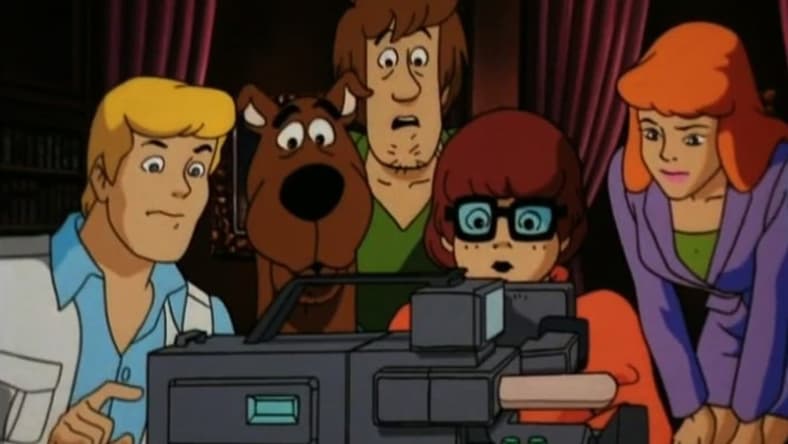
Millennials were spoiled when it came to kid-friendly horror. Between Goosebumps, Are You Afraid of the Dark?, and the existential terror that was the animated series Courage the Cowardly Dog, the late ’90s and early 2000s were packed with spooky programming designed to scare children just enough to keep them coming back for more. But no piece of children’s horror feels quite as pivotal as 1998’s Scooby-Doo on Zombie Island. The direct-to-video animated film marked a major shift for the beloved franchise, which had found itself in a sort of identity crisis in the mid-90s. The film served as a reset, taking the lovable Great Dane and his teenage companions from solving spooky (albeit goofy) mysteries in their teal and orange van and plunging them into a Fulci-adjacent story featuring–for the very first time–real monsters. For many millennials, including those who were too scared to finish a single episode of Goosebumps, Scooby-Doo on Zombie Island was their gateway into the horror genre, and it remains one of the best Scooby-Doo movies ever made.
Part of what made Scooby-Doo on Zombie Island such an effective gateway horror movie was that, unlike the aforementioned children’s media, Scooby-Doo as a franchise wasn’t necessarily perceived as horror. For decades (the first episode of Scooby-Doo Where Are You! premiered in 1969), Scooby-Doo was considered a staple of Saturday-morning television, cultivating a fanbase of both children and adults who enjoyed the show’s mix of comedy and adventure. And though the series featured Gothic castles, ghosts, and other paranormal elements, Scooby-Doo was never meant to be frightening. As American Center for Children and Media executive director David Kleeman said in a 2002 interview, “[Scooby-Doo] is just not a show that is going to overstimulate kids’ emotions and tensions. [It’s] fun without getting them worried or giving them nightmares.”
Until 1998.
After the success of the Emmy-nominated spinoff A Pup Named Scooby Doo, which ended in 1991, the franchise found itself in a slump of sorts, especially after the disappointment that was the 1994 made-for-TV movie, Scooby-Doo! in Arabian Nights. According to Lance Falk, who worked as model coordinator on Zombie Island, “Warner Brothers wanted to enter the direct-to-video, feature-length market, which was just kind of starting up.”
The direct-to-video market offered many studios the opportunity to make a massive profit with very little financial risk, but the team behind Zombie Island understood that simply stretching a standard Scooby-Doo mystery to feature length wouldn’t be enough. Director Jim Stenstrum was the first to suggest that they should “get rid of the taking off the mask thing” because it was “old” and “tired.” Davis Doi, who would go on to write the story Zombie Island was based on, agreed: “…You can yank people’s chains for about half an hour, but you can’t do it for an hour and a half and have it be a fake. It feels like the end where somebody wakes up, and it’s a dream. It just feels like a cheat.”
The team began brainstorming, eventually settling on a story involving zombies and Civil War soldiers. What they’d end up creating was a “more grown-up” story featuring some of the most horrific images in any animated series of the time.
For those who haven’t seen Scooby-Doo on Zombie Island in a while, the film follows Mystery Inc. years after the gang has gone their separate ways. Daphne (Mary Kay Bergman) is hosting her own show, Coast to Coast with Daphne Blake, produced by Fred (Frank Welker). After Daphne reveals on a talk show that she’s determined to find a “real” ghost (and that she misses the gang), Fred calls Velma (B.J. Ward), Shaggy (Billy West), and Scooby (Scott Innes) to reunite for her birthday and take a road trip across America, looking for evidence of ghosts.
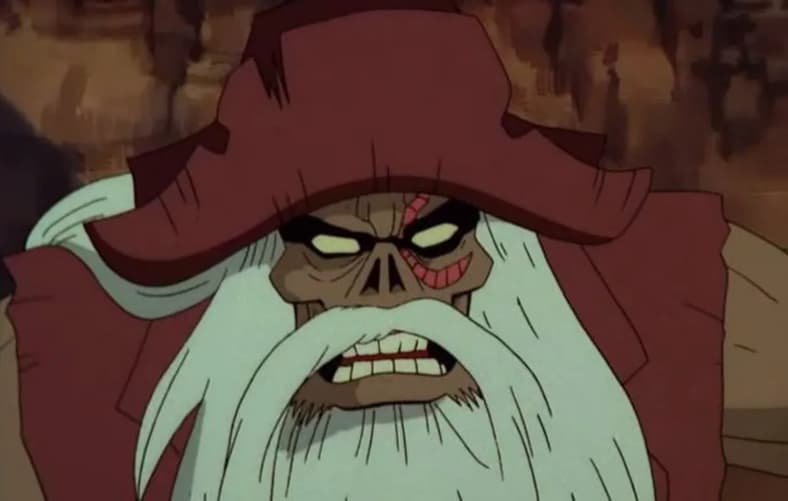
Unfortunately, they get more of the same, old, same, old, that is, until they meet Lena (Tara Strong), a mysterious young woman who claims that the island she works on is haunted by the ghost of a pirate, Captain Morgan Moonscar. The gang follows her to Moonscar Island, skeptical. Everything can be debunked. But that all changes in one of the film’s scariest scenes (and the one that made every Scooby-Doo fan realize that the franchise was entering a new, and much darker, era), when Shaggy and Scooby watch as Captain Moonscar’s corpse reanimates in front of their eyes.
Zombie Island only gets more complex from there. The villains aren’t the zombies, but Lena and Simone (Adrienne Barbeau), two beautiful immortal women who are the last survivors of a group of cat-worshiping colonists who were chased into the bayou by Captain Moonscar and devoured by alligators (let me reiterate: this is a children’s movie). The gods turn them into werecats in order to kill the pirates. Now, every harvest moon, they, along with ferryman Jacques (Jim Cummings), must lure victims to the island to preserve their immortality.
Whether Lena and Simone are truly villains is a debate for another article (after all, they avenged their murdered friends and killed the Confederate soldiers hiding on the island). But the decision to position them, and not the frightening-looking undead, as the film’s primary antagonists was a surprisingly sophisticated one, especially for children’s media. As a child, it was the first time that I realized that the villain could be anyone, especially the person (or people) you least expect. It was also the first time that I realized that the gang was in real danger, and any of the characters could suffer. It was an exciting and terrifying thought.

The success of Zombie Island would directly prompt the creation of Scooby-Doo and the Witch’s Ghost, which was released on VHS on October 5, 1999, with the pilot episode for Courage the Cowardly Dog shown at the end. This would be followed by the release of Scooby-Doo and the Cyber Chase in 2001, arguably the most polarizing of the three direct-to-video movies.
I’ve always been interested in horror–partially because of my love of fairy tales, partially because I naturally gravitate to anything exciting–but Scooby-Doo on Zombie Island was one of the first times I remember being legitimately scared of something I was watching and loving it. What set it apart from, say, Are You Afraid of the Dark? or Goosebumps was that even though it was scary, it also incorporated a fair amount of slapstick humor and jokes that felt grown-up and sophisticated, even though it was a cartoon. When I revisited Zombie Island over the weekend, I realized that I wouldn’t be surprised if most Scooby-Doo fans grew up to be Evil Dead fans.
Scooby-Doo on Zombie Island offered children a safe way to experience danger and the thrill of being frightened, and while it might not hold up entirely in 2026 (the inclusion of the Confederate soldiers and the implication that they are the “good guys” is…an interesting choice, to say the least), it’s still a perfect gateway horror movie for young viewers. The themes are dark, the monsters are confrontational and cause real destruction, and the setting is lush and immersive. Scooby-Doo on Zombie Island will always be remembered as every millennial’s introduction to horror. And maybe every millennial’s introduction to alternative music as well.
Categorized:Editorials