
How ‘Tales from the Crypt’s’ Stealth Backstory Episode Planted the Seeds for Modern Franchise Storytelling

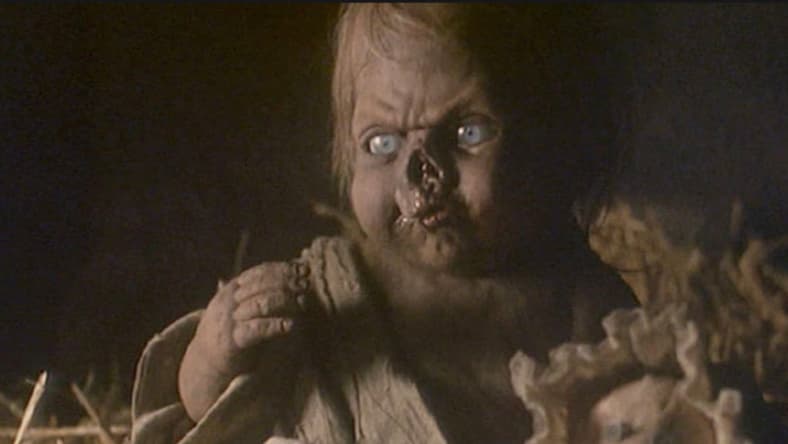
Tales from the Crypt’s “Lower Berth” turns into a surprising look at the Cryptkeeper’s origins, setting up a prescient formula for franchise storytelling.
Tales from the Crypt is a revered pillar of the horror industry, representing a real turning point for anthology storytelling that, in many ways, still hasn’t been topped. The no-holds-barred HBO series unabashedly pushed boundaries with its lurid stories that were helmed by and starring Hollywood’s top talent. Tales from the Crypt was also no stranger to more experimental concept episodes and daring franchise expansions, including a Saturday morning game show, feature films, and back-door pilots for genre spin-offs. Tales from the Crypt is also infamous for its fearless twist endings. However, few can compare to the truly gonzo conclusion of season two’s “Lower Berth.” The episode’s surprise is unlike any other Tales from the Crypt development and a visionary gamble that’s gone on to become many franchises’ new normal.
“Lower Berth,” which is based on Tales from the Crypt #33, tells a sweet love story between two abused sideshow attractions — a two-faced man and a 4000-year-old mummy. There’s a lot of hatred and anger in this episode, but these two “freaks” find a sense of community and understanding in each other’s company. “Lower Berth,” which is written by Fred Dekker and directed by Kevin Yagher, is basically Freaks meets The Elephant Man, with some classic Tales from the Crypt morality play machinations at work.
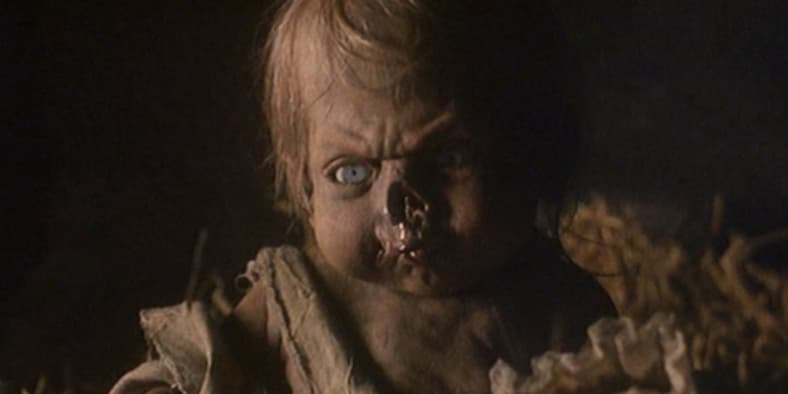
The episode’s two victims receive a happy ending of sorts when they escape captivity and get a chance at freedom. The episode’s conclusion is still steeped in melancholy. However, there’s still a surprisingly optimistic turn of events, which is quite rare for Tales from the Crypt. Enoch and Myrna’s happily ever after leads to the birth of their child, who might look a little familiar to audiences. It’s revealed that Enoch and Myrna’s bewildering baby is actually the Crypt Keeper. The entirety of “Lower Berth” functions as the Crypt Keeper’s backstory and a look into his parents’ unconventional meet-cute.
It’s such a bizarre concept for a Tales from the Crypt episode that gets strangely sweet and personal. The whole idea of explaining the Crypt Keeper’s origins feels oddly like a modern media affectation, rather than something that was being done in the ‘90s. Tales from the Crypt was ahead of the curve and a disturbing disruptor in anthology horror storytelling. However, this stealth backstory episode is one of Tales from the Crypt’s bigger swings and proof of just how forward-looking it could be in terms of unexpected world-building and canon.
“Lower Berth” is Yagher’s directorial debut, who is better known as the special effects savant who is – appropriately enough – responsible for the Crypt Keeper puppet, but also Freddy Krueger’s makeup as of A Nightmare on Elm Street 2, the designer of the Chucky doll from Child’s Play, and a visionary voice for the Hellraiser. Funnily enough, Yagher used the same Good Guy doll eyes from Child’s Play for the Baby Crypt Keeper, at which point they were also added to the adult Crypt Keeper puppet. It’s one of the rare instances of the Crypt Keeper puppet not just evolving, but through an actual story development. It’s also just a lot of fun to know that there’s literally a little bit of Chucky in the Crypt Keeper.

The nature of “Lower Berth’s” twist is definitely part of the episode’s fun. This makes it quite interesting to note that the episode’s description on the Tales From the Crypt DVD set completely spoils the episode’s big reveal, as if it should be common knowledge: “Lullaby and good fright with this revealing story of the Crypt Keeper’s birth. It’s a tale from the crib!” It turns this twist into a selling point to draw people into the episode.
For what it’s worth, the Crypt Keeper teases the episode’s twist in his opening narration, but is considerably more subtle — something that’s not the Crypt Keeper’s strong suit. He describes this episode as being about “the humble beginnings of my favorite horror hero.” This could go in a number of different directions, but the fact that he’s talking about himself is both funny and perfectly in character for the narcissistic cadaver.
The Crypt Keeper’s outro is decidedly more explicit so that the audience properly understands that they’ve just witnessed his origin story and birth. He confirms that he was the baby in question during the episode’s closing moments, and he even laments that Enoch and Myrna didn’t live long enough for him to become a star and the host of his own twisted TV show. There is no shortage of silly and surprising Tales from the Crypt closing outros, but “Lower Berth’s” is easily one of the oddest and – strangely enough — the most sentimental.
A backstory episode for Tales from the Crypt’s host is surprising subject matter for the series to tackle, but even more so when it’s a random entry in the middle of a season instead of the premiere or finale. For a point of reference, Freddy’s Nightmares, an anthology series hosted by Freddy Krueger, did exactly this for its first episode. Freddy Krueger was explicitly pertinent to a handful of episodes, but the premiere, “No More Mr. Nice Guy,” functions as Krueger’s origin story and recounts a crucial turning point in his life. Tales from the Crypt doesn’t opt to use such a story as an introduction to its universe and instead randomly delivers this treat as an unexpected bonus, which is part of what makes it such a fun surprise.
There’s a subtle art when it comes to anthology series hosts, their purpose, and how to use them as the ultimate cipher for the show’s universe and point of view. The Crypt Keeper is a beautiful embodiment of EC Comics’ gross-out sensibilities, right down to how his cackling maw kicks off each episode while slime oozes down the screen. It’s such a ludicrous, unnecessary idea to provide a character who is as ridiculous as the Crypt Keeper with actual lore and origins, albeit one that’s appealing all the same. He’s not a character who is meant to be taken seriously, yet this story’s existence asks the audience to consider an entire life for this caricature.

This comes across as a self-aware satire of twists and prequels, the likes of which have only become more relevant with the film industry’s increased reliance on IP expansion. “Lower Berth” isn’t quite “Young Crypt Keeper,” but it’s still not hard to picture an executive sincerely pitching a Tales from the Crypt reboot that’s anchored to the idea of, “What if we looked at the people who made the Crypt Keeper who he is today? What were his parents like?” Tales from the Crypt filters this trope through its own heightened pulpy sensibilities to offer an original take long before such an idea became a tired cliche.
Curiously, it’s the younger-skewing animated spin-off, Tales from the Cryptkeeper, that builds upon its predecessor’s example. It takes greater strides to flesh out the Crypt Keeper’s character and turn him into more than just a master of scare-monies. Season three’s episode, “All Booked Up,” features the Crypt Keeper as an active character who helps service the story and progress the plot.
The spin-off’s very first episode, “While the Cat’s Away,” even involves two brothers robbing a mansion, which turns out to actually be the Crypt Keeper’s infamous home. The episode concludes with the brothers escaping, only to run into the Crypt Keeper, who is on the way home from a vacation. It’s an effective way to kick off the series that reflexively uses the Crypt Keeper as the episode’s big twist. It’s an episode that’s structured in a comparable fashion to “Lower Berth” and potentially even learns from its ideas.
Alternatively, Tales from the Cryptkeeper could have kicked off with an animated adaptation of “Lower Berth” to further establish the Cryptkeeper’s expanded role. Tales from the Cryptkeeper’s second and third seasons feature playful in-fighting between the Old Witch and Vaultkeeper, who are all vying for storytelling supremacy. These additional characters were staples of EC Comics, but they were absent during Tales from the Crypt. This expanded lore makes the Crypt Keeper feel like more of a real person and not just a structural device, even if this material exists outside of the central stories.
It’s very tricky territory to incorporate an anthology series’ host into the narrative. For one, many anthology series don’t even opt for a host or narrator in the first place. At other times, the host is an intentionally blank slate that’s not meant to be anything other than an impartial guide. Part of the reason that Tales from the Crypt seemed to resonate with audiences more than Tales from the Darkside, Monsters, or The Outer Limits is that it’s not just the only anthology series to have a host, but a host who is a puppeteered corpse with a penchant for puns.
The Crypt Keeper doesn’t demand a backstory or additional context, but he’s certainly the most interesting anthology host to take down this route if such a world-building experiment is happening. He’s a character who popped with audiences and became a horror mascot who was in hot demand. The audience wanted more Crypt Keeper, which is why he was front and center in several spin-offs and even headlining his own musical albums.
A counterpoint that comes to mind regarding an anthology horror host who actually becomes a part of the story is in Jordan Peele’s 2019 Twilight Zone revival. The first season finale, “Blurryman,” is a meta episode about the nature of The Twilight Zone’s storytelling. “Blurryman” ultimately crescendos to a chilling conclusion in which the Slenderman-esque boogeyman is actually a cosmic version of Rod Serling. A more obscure example is The Hunger, a sexually-charged erotic horror anthology from the late ’90s, based on the film of the same name. Terence Stamp hosts the first season as a non-descript character. However, David Bowie takes over the hosting duties in the second season, which also kicks off with an episode, “Sanctuary,” that explains his introduction to the franchise.
The plight of Bowie’s character, Julian Priest, is the focus of the season’s premiere, only for his dark fate to leave him in a state of purgatory where he fulfills his hosting duties for the rest of the season. It’s an ambitious idea that pulls from Tales from the Crypt’s example, albeit still in the more conventional capacity of working as a season premiere, rather than a random episode. Had The Hunger continued, it’s easy to picture each season featuring a new host who is played by a high-profile guest star whose backstory makes up the season premiere. It’s territory that’s still considered to be ambitious for an anthology series, even when it’s explored in a more cagey manner, like Black Mirror’s “White Christmas” episode. This makes it all the more impressive that Tales from the Crypt was willing to take such risks over 25 years ago.
“Lower Berth” is the only Tales from the Crypt episode that truly puts the Crypt Keeper under its microscope. However, the series is still full of brief teases that provide a broad look at the Crypt Keeper’s trajectory as a character. There are references to Tales from the Crypt starting as a magazine, which indicates that his hosting duties for this show are just the latest iteration of this passion project of bringing ghoulish stories to the masses. The wraparound segments on Tales from the Crypt’s theatrical efforts also indicate that the Crypt Keeper has achieved a greater level of acclaim and that he’s been able to expand his brand even further.
It always feels like these “updates” are meant to be interpreted as jokes, rather than pieces of backstory that should be held under scrutiny. That being said, it creates many opportunities to do random origin story episodes that detail the Crypt Keeper transitioning his business from a line of comics into a TV show or what his humble start in Hollywood looked like. These are hardly essential stories, but the same could be said for “Lower Berth’s” big twist. There’s a way to make ideas like this work, while still staying true to the original Tales from the Crypt framework. Many audiences naturally bristle at the idea of forced prequels and shoehorning a connected universe into places where it doesn’t belong, but Tales from the Crypt has at least set a precedent for examining the Crypt Keeper as a character so that any further exhuming won’t feel taboo.
Additionally, more Crypt Keeper-centric episodes just weren’t practical at the time of Tales from the Crypt’s production. It took six puppeteers to work the Crypt Keeper, and the wraparound segments were the extent of what could be handled for this character. A full episode with the Crypt Keeper as a central character wasn’t plausible in the ’90s, although this presumably wouldn’t be the case anymore. A proper Tales from the Crypt reboot, with the right people involved, could potentially return to this concept and finally make it possible. However, the understated approach that’s taken in “Lower Berth” is why it’s such an effective episode that doesn’t ever feel forced and artificial. A new backstory episode would need to follow the same framework.
Thanks to Shudder’s recent streaming acquisition of Tales from the Crypt, audiences will finally be able to indulge in the over-the-top anthology series, some of whom will be watching it for the first time. “Lower Berth” isn’t Tales from the Crypt’s flashiest, scariest, or best-written episode, but there’s a strong case to be made that it’s one of the series’ most important installments. “Lower Berth” is a low-key highlight that’s way ahead of its time and a must-watch episode that’s truly doing something different.
It’s now easy to mock franchises that force backstory and contrived world-building. However, Tales from the Crypt gets ahead of the narrative and shows that it can be done in a way that doesn’t just work, but also takes advantage of the genre’s broad B-horror trappings. It’s a strategy that translates over to many other genres- and medium-breaking episodes. It’s why Tales from the Crypt is still a horror anthology titan over 25 years later.

Categorized:Editorials TV