
‘28 Years Later: The Bone Temple’ Delivered a Scene that Horror Fans Will Be Talking About for Ages


I have long been a champion of filmmaker Nia DaCosta. Her powerful take on Candyman blew my mind like a beehive exploding into a buzz of excitement. And I don’t care what the rage-infected trolls who review-bombed The Marvels say– that was a fun film that did exactly what it set out to do. The movie’s lack of success wasn’t DaCosta’s fault. Not even close. So, I was one of the many who lit up at the news that she would be directing 28 Years Later: The Bone Temple, part two in a trilogy developed by 28 Days Later creators Danny Boyle and Alex Garland. Released two weekends ago—just seven months after the highly successful 28 Years Later—I went in expecting to leave worshipping the film at the altar. Nia DaCosta did not disappoint.
Featuring shades of George A. Romero’s Day of the Dead, DaCosta melds gruesome violence and despair with a surprising ray of hope that shines through the film’s darkest corners. It’s as bold and satisfying a sequel as audiences could possibly hope for. If that wasn’t enough, it also happens to contain one of the most metal scenes I’ve witnessed in a horror film for quite some time. Abandon all hope, ye who wish to avoid spoilers, because I’m about to spoil the hell out of Bone Temple’s ending.

When we last met 28 Years Later’s Spike (Alfie Williams), the boy had left his island village and fallen into the hands of the psychotic Sir Jimmy Crystal (Jack O’Connell). Within the opening seconds of Bone Temple, we see just how poorly that’s going for him. Following a fight to the death, our young hero is inducted into Jimmy’s gang of Fingers (aka, the Jimmies). See, Jimmy views himself as the son of Satan, his red right hand. The Fingers—a deadly gang of youths—serve as the instruments of the mad cult leader. From place to place they travel, offering some wicked version of “charity” (usually resulting in extreme pain and death). Spike is no killer, and it’s only a matter of time before Jimmy realizes he has no use for him.
Toward the end of 28 Years Later: The Bone Temple, Jimmy and his merry band of Satanists happen across Dr. Kelson (Ralph Fiennes) and his titular tribute to the dead. Pillars of bone. A man with his flesh painted red. The awful stench of death consuming the air. Why, Kelson must be Satan! At least, that’s what any brainwashed, Devil-worshipping teen completely cut off from the world and in their own private hell would believe. The discovery couldn’t come at a better time for Spike, who has become the target of Jimmy’s ire after letting a pregnant woman go. The group decides they’ll ask Satan what to do with the boy. After all, he’s Jimmy’s papa, right? Surely, he’ll be fine with them intruding on his domain.
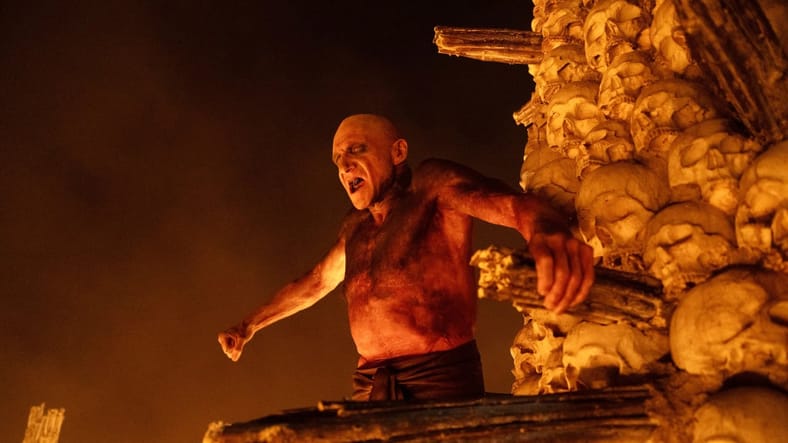
By this point, the audience and a couple of the Fingers (including Spike) are well aware that Jimmy is as bloated with bullshit as the infected that crawl around on the ground eating worms. Even Jimmy enjoys the smell of his own nonsense, believing himself that Kelson might actually be his Devil daddy. Once he realizes that isn’t the case though, he offers Kelson a deal; put on a convincing show, and he won’t reach down and pull the good doctor’s intestines out through his mouth. And then arrives a badass cinematic experience that’ll have us singing its praises all the way through 2026 and beyond.
Donning a black robe and eyes painted like a corpse, Kelson emerges from the darkness to the tune of Iron Maiden’s “The Number of the Beast” pumping through speakers set up around camp. The Jimmies have never heard a record before. It’s their first-ever rock concert. Bruce Dickinson’s operatic vocals. The wailing of instruments like screams from beyond. All of it is a devilish sorcery banging on their eardrums. As for Kelson? A quick peek at his trailer hints at a man with a doctor’s background but a deep passion for the arts. Perhaps once a theater kid forced to get a “real job”, now given his chance to perform. And does he ever.
DaCosta knew the scene would be risky. In an interview with Dread’s own Josh Korngut, the filmmaker admitted, “I was anxious about it when I read it”. And then she saw the early cut. “I was like, okay guys—you pulled it off. We’re good. We did it.”
In the scene, Ralph Fiennes darts around the set like a bat out of Hell. Simple yet clever pyrotechnics engulf the set in flames. Wind in their hair, the Jimmies headbang, spirits full of something they’ve never felt before. The power of art. The rebellion of rock n roll. The goddamn humanity of creative expression.
Nia DaCosta deserves her truckload of flowers for the visual mania she imbues the scene with. The filmmaker hypnotizes the audience like we’re right there with the Jimmies, entranced by the movements of Fiennes. I’d like to say the actor deserves award consideration, but honestly? Screw the Academy. Fiennes’ performance should very well cement itself in the annals of horror history, right alongside other iconic dance scenes like the From Dusk Till Dawn Salma Hayek banger. That’s worth more than any trophy. Yet the depth of the scene stretches beyond masterful execution from all parties involved.
For all the grim atmosphere and violence coursing through the veins of the film, the strength of 28 Years Later: The Bone Temple comes from its brief yet magical moments of humanity. The other scene we’ll be talking about all year sees Kelson dancing with the naked Alpha, Samson (Chi Lewis-Parry), proving that there is a way through to the infected. That might be silly to some, but the vulnerability of it strikes me as beautiful. It says that even in the most hopeless of times, you can still find hope. Whether it’s in the shredding of a guitar or two friends dancing in the nude, it’s there.
The franchise posits that the UK has been taken over by incurable madness. And it doesn’t take much to realize that the 28 Years Later trilogy mirrors our own current situation. We need that hope more than ever.
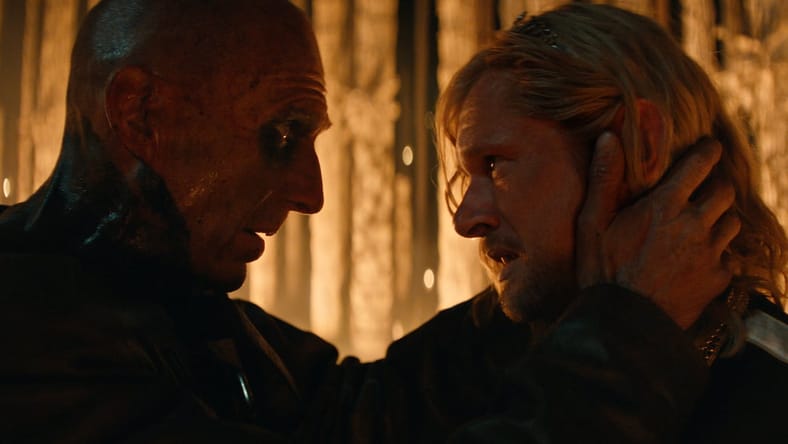
Kelson’s energetic tribute to Iron Maiden…it connects all of them, even if only briefly. Kelson, the Jimmies, Spike…in that moment, their hate for one another takes a backseat. They’re just a group of people moshing to some damn good music. Ultimately, the performance doesn’t save them from violence…though it almost does. Jimmy comes this close to leaving without bloodshed. But that doesn’t take away from the fact that the musical artistry of Iron Maiden delivers the profound notion to the kids that there is more to this life than death and pain. There is art, there is the humanity within it, and it’s more powerful than any ramblings from sadistic maniacs like Jimmy. Kelson may meet his tragic end, but his performance does just enough to get Spike the help he needs to take down the bastard.
Kelson’s influence on Samson through music and kindness shouldn’t be overlooked, either. In one way or another, those things help to free the behemoth from his rage. That’s why it’s so important to look at the infected as merely that, rather than zombies. You can’t cure being dead. But 28 Years Later: The Bone Temple introduces the notion that we can come back from rage. Ridding the world of the madness that has washed over it isn’t impossible, even if it feels that way sometimes.
All it takes is a little humanity. A little rebellion through art. A little belief that things can get better. And a good old-fashioned headbanging to the musical genius of Iron Maiden.
666 may be the number of the beast, but it’s also the amount of times I could watch Fiennes rock out on a loop without getting bored. With this scene, Nia DaCosta gave audiences more than a badass moment. She delivered a scene that embodies the rebellious nature of horror. That says you can censor, ban, attack the arts all you want, people are going to find a way to create and party in the face of the bullshit. Madness and despair be damned.
It’s still early, but 28 Years Later: The Bone Temple may very well prove to be the genre moment of the year.
What Others Are Saying
Categorized:Editorials